Thursday, December 29, 2011

Final Look at Delhi


I missed Jama Masjid the first time I was in Delhi. It was supposed to be quite easy to find from the Old Delhi Railway Station, but I had managed to walk right on by. I wanted to set that right. So I set off down the road to see what I could see. I thought I could see a minaret in the distance, so I headed in that direction. But Delhi is not an easy city to navigate in. It is possible to see things in the distance from things like bridges, but as soon as you get to ground level you become engulfed by buildings that close off the view. In addition, for a city of this size there are just not that many intersecting streets of size. They are few and far between. To get to a spot where you think you might have seen something, you have to cut into small and winding streets in neighbourhoods. And for me that quickly gets me turned around so that I don't exactly know what direction I was originally headed.

Rather than try to keep myself headed in the right direction in the rabbit warren of the neighbourhoods, I decided to keep following the main road I was on. I was aided by the fact that the road couldn't get past where I wanted to be because it headed more or less into a “V” where two sets of train tracks met. I kept on and eventually ran into the road called Chandni Chowk, which is a main bazaar area in Old Delhi. That helped. I set off down that road and found myself following a parade of some sort. There were a lot of students in the parade and they were doing various sorts of things. Some were doing some martial arts with sticks. Others were doing acrobatics of various sorts and with different accessories. It was rather interesting. I dawdled along with them as they would stop at various intervals and do things.


At length I discovered where they were headed. Out in front of the Old Delhi Railway Station there was a platform with people who appeared to be community leaders. Each group in the parade would trundle up and perform for them and then move off. It all appeared to be in honour of an Islamic festival to take place in the next few days.


But there were a lot of people there as well, and people in crowds just aren't very courteous. After a while I got tired of being jostled and bumped and pushed. It was time to go. I headed off down the street and found I had been in the same area the first time I had tried to find the mosque. This time I headed down a different street. I realized the mistake I had made the last time. I had followed the outer wall of the Red Fort. This went in a different direction than the one that headed towards the Jama Masjid. By the time I reached the end of the wall, I was past the mosque and couldn't find it. This time with my earlier turn, I came right up on it. Perfect!

Alas! This was as close as I got to it. As I headed up towards the mosque and prepared to enter by taking off my shoes, one official tsk-tsked me and told me I couldn't go in. It was Muslims only time as it was a prayer time. He was none too pleasant about it, but I simply started to put my shoes back on and wait. And then...


Another guy came up and put it like this: “You go outside! You can't go in until 1:30 when the Muslims are finished.” This put my back up. I was so annoyed at his tone of voice and the rude way he did it. So I said, “please.” He refused. So I told him he was rude and that I wouldn't be back. I did it loudly as well, and I even mocked him telling me to go. Possibly not the most polite thing I could have done myself, but I was quite annoyed. I was tempted to point out to him that they were now going to not get the money from me that they would have if I had been prepared to enter the mosque and pay their “photography” fee, even though the mosque was technically free to enter. But I didn't. I just left.

This left me with a decision on what to do with myself and what I might do with the money I had saved. I still had to remember that I was going to be cutting it close as to whether I would run out of money before getting to the airport the next day or not. But I still had a bit of room to play with.

I walked down the road and happened on yet another archaeological site that was not mentioned in anything I had read so far about Delhi. This was one of the original 7 citadels that had been built long ago by the old Muslim rulers. This was the citadel that is now called Kotla Firoz Shah. I had to look at it carefully, because it looked a bit small at first. I didn't want to spend a bunch of my remaining funds on something that wasn't going to be worth the time. But it was actually quite large when I looked it over from the outside. So I bought a ticket and went inside.

Once inside I started looking around. The citadel was built by a ruler named Firuz Shah Tughlaq. It was built sometime between 1351 and 1388 and had been built along the banks of the Yamuna River. The river has long since changed its course or level and now run some distance away from the old citadel. But there is an expressway running along the side of the citadel, presumably where the river used to be, so it's almost the same. Well maybe not.


For being 700 years old and having had all sorts of different rulers running around conquering the country and the city in particular, it's in remarkably good shape. It also helps that they are making efforts to restore the citadel, perhaps in preparation for inclusion on the World Heritage List. At the entrance sat the old palace, or what's left of it.


Then I tried to walk around behind it where there was a bunch of other ruins. Two of the custodian/guards of the site were walking around the grounds. They approached me and seemed to be suggesting that I couldn't go that way. They wanted me to follow them around to other, and it seemed to me they were suggesting more interesting, areas. And they also seemed to want to show me around. I smelled a request for money on the heels of being shown around, so I merely took their advice (for the moment) about not going through the arch to the unknown beyond, and headed back around the ruined palace. There I dawdled, taking some photos and poking around, while they tried to get me to go after them. They eventually gave up and moved off on their rounds.
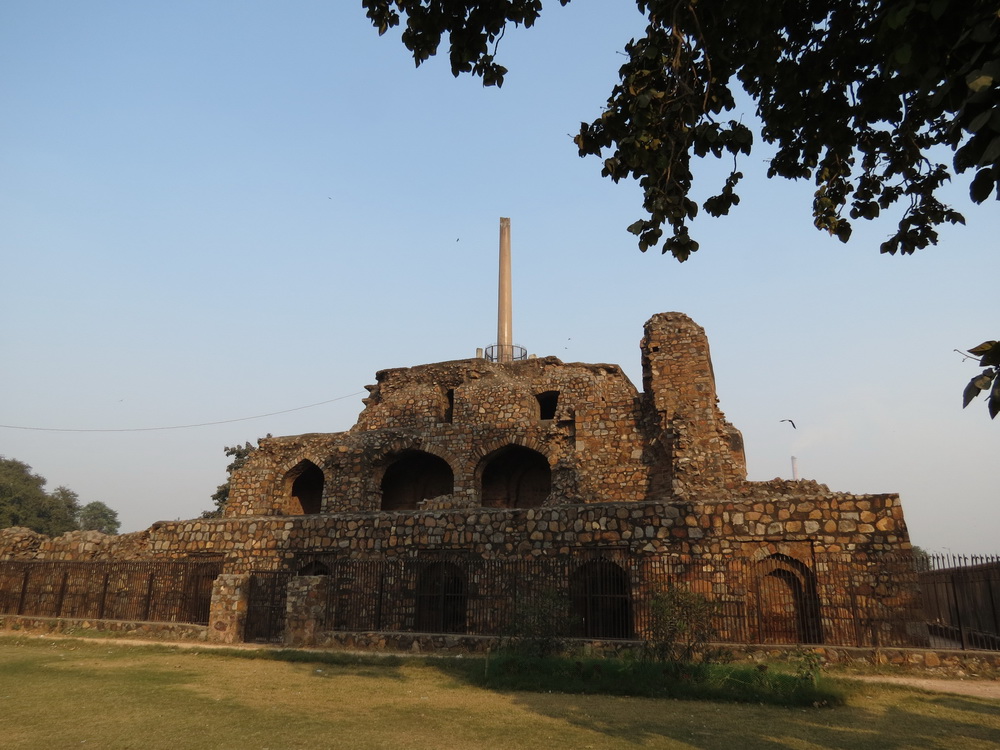
And I found that there were people in the area they didn't want me to go. I went in there and had a look around. It was a park area with people having picnics and such.


Next I headed out and around where the custodians were trying to herd me. I found a pyramidal structure with a pillar on top. It was a pillar of Ashoka (or maybe Asoka). I had been seeing this name around India, and I'm still not sure what Asoka is, but I did find out at this citadel that there are only two of these pillars. And one of them was at this citadel. It had been moved carefully from its original location and placed on this structure. It was first placed on the first level. Then, once the second level was built it was raised, and then again after the third and final level was completed.


Although I'm not completely sure it was allowed to climb up to the top, there were a number of people who had done so. However, all the entrances were barred up, with only a hole in one of the sets of bars giving access. So I think it was illicit entry. I still went up. Hey, what's good for some should be good for all, I say. At the top the view was really very nice.


Next to the pyramidal structure was the mosque. The walls had fallen down at some point, but it was still a functioning space and I noticed a number of people doing some kind of prayers before the wall facing to Mecca.


After that little corner had been investigated I headed into the lawn area where there was a large well. This is where I bumped into the two guards/caretakers again. The well had been fenced off with gates, that were closed, at the entrances. But the guards beckoned me forward and opened it up and then invited me in. My heart sank a bit because I was sure this was going to cost me. And I was really getting short on money if I was going to make it to the next day without having to go to a bank again. But they were also so insistent that I couldn't quite figure out a good way to refuse. So I went in. One of them explained to me the reason why it was fenced off. The well is quite deep, 50 meters or something like that. There are no fences keeping people from the edge of the well, and I was told that 3 children had fallen in at some point and drowned in the well. I could understand why it was off-limits. And yet it was also really interesting inside. I liked looking around at the structure of this enormous well.
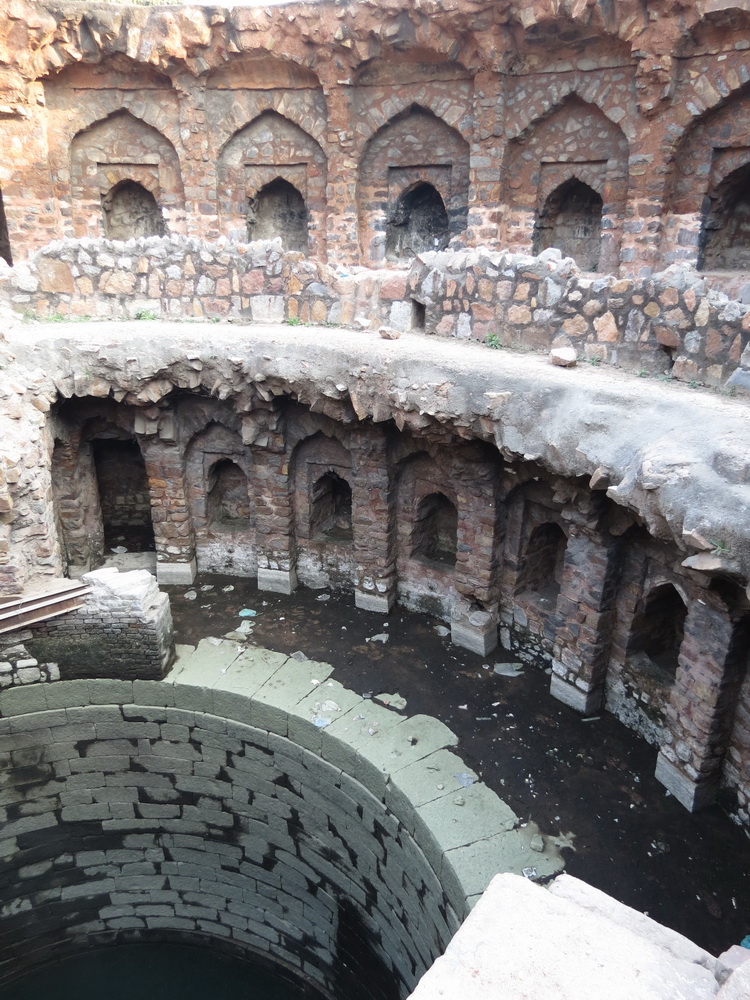

After they showed it to me, we left. I started walking towards the entrance, fully intending to not make a big deal of anything. And I was also going to pretend that I had no idea of what might be expected of me, in terms of a monetary thank for being allowed into the well. They never said anything either, and I don't know if it was because they were embarrassed to have to make it clear, whether it was the other couple who wandered into the well after us, who were Indian, and who didn't offer any monetary thank you, or whether they were just being friendly and I had once again been overly suspicious. In any case, I left the citadel without having to pay anything else for the experience. And it made up for the rude treatment at the Jama Masjid mosque. It put a nice little cap on my last day in Delhi and left a good impression of India to leave the country with.

So I went and had my last big meal in India, or Indian food and went back to my hotel to prepare for my flight to Egypt the next day.

Sunday, December 25, 2011

Back in Delhi


I should have just gone ahead and returned to Delhi on a bus during the day. I really didn't do too much during the day after arriving. I did however go to see the latest Mission Impossible movie. I quite liked it, but I really, really didn't like the 20 minute intermission right after the chick got kicked out the window of the world's tallest building. Then I slept for 12 hours. I don't know why I did that. I wasn't that tired. But bright eyed and bushy tailed at the ripe old hour of 11 in the morning, I got up and decided what to do for the second last day in India.

There are lots and lots of places of interest in Delhi. It's almost a shame that I don't have more time, and more money, to spend here. My chosen site for what remained of the day was a place called the Qutab Minar (or Qutub Minar, or Qutb Minar, depending on the sign one reads, or the person one talks to). It was a place that was built by the Muslim rulers of roughly a thousand years ago.

It is a stop on the Delhi metro system, so I figured it should be quite near the station. The train came out above ground just before my destination. Looking out the windows, I saw a domed building of some sort in the distance. I didn't see something looking like the Qutab Minar, however which was a tall minaret tower. (I don't know why I didn't see it at the time; it was pretty much right next to the domed building, and much taller. But the benefit of knowing where everything was located was something I didn't have as I returned to station later.) The domed building looked old and I thought it could be another point of interest if I could figure out where it was exactly and what it might be called. Luckily at the exit to the station there were two information panels that talked about the Qutab Minar complex as well as another complex that was nearby, called the Mehrauli Archaeological Park. I would have bet any money that was the place with the domed building. It was also, according to the panels, quite close to the Qutab Minar complex.

Outside the station, I was approached by a bunch of tuk tuk drivers wanting to take me to the Qutab Minar area. I guessed this was a high traffic area for getting to the complex. I guess it's not so surprising given the name of the station. I went with the guy who said the magic words: “shared taxi” and “20 rupees.” Of course, he also said it was 3 kilometers away and it definitely wasn't. But not having seen the tower from the station, I didn't know exactly where I was going, so I went with the guy. It wasn't going to cost very much.

I got there and realized, that as a World Heritage Site, this was going to be a 250 rupee ticket. And they had an audio guide available. With that being a hundred more, I was a bit worried that I might be over-extending my last cash. I only had about 2000 rupees left for two and half days. I was going to have to play it a bit carefully so that I wouldn't need to go to the bank machine. But I have been liking the audio guides, so I sprang for it this time as well. It turned out to be not a good choice. I believe they have just rolled the feature at this particular site. As I walked up to the window, they were still taking things out of plastic packaging. And as that might suggest, they still have kinks to work out of the system. As I was going through the site, the audio stations were poorly identified and not really well laid out, so it was a bit confusing. As a result, I was somewhat frustrated by using it and didn't get as much as I might have out of the guide.

Nevertheless, the Qutab Minar complex is another fascinating piece of history in Delhi. The most impressive part of the complex is the minar itself. It is a very tall tower with the mark of three early emperors. The bottom half of the tower was built by Qutbud-Din Aibak. Then he died. The second, third, and fourth stages of the tower were constructed under emperor Iltutmish. This lasted until roughly the next thunderstorm, when lightning struck the tower and destroyed the top story. It wa replaced by a third emperor, Firuz Tughluq. He replaced what had been red sandstone with white marble, giving the tower a very interesting look.

This was not the end of the construction story for the Minar, however. During the English colonial period, an Englishman by the name of Smith came along and thought it didn't look quite complete. So he added a bit to the top of the structure. Later an English viceroy decided that the addition didn't look right and had it removed. The addition wasn't destroyed though and today sits off in a corner of the complex. It is somewhat cheekily (if rightfully) called Smith's Folly.


The Minar was built beside a mosque that was built by the rulers. However the mosque was built very early in the Muslim rule of India. As a result the craftsmen they had access to were mainly Hindu and were unfamiliar with Muslim building styles. Thus, the mosque has many Hindu building features. Muslim architecture does not have a lot of decoration, so this mosque is somewhat unique for its adornments and ornamental carvings on the columns. There is another theory about the ornate carvings in some parts of the mosque. The mosque was built on top of an older, Hindu temple. The temple would have had pillars with ornate carvings on them and it is thought that they used the pillars in building the mosque and thus there are these ornate carvings.


The west wall of the Mosque, facing Mecca, was the prayer wall of the mosque. Huge is stature, it was an imposing structure, even in ruins. There were a number of arches through the wall, allowing passage to the west, but it must have been an awesome part of the mosque in its time.


Successive early Muslim rulers wanted to increase the power and grandeur of the mosque and complex. The Qutab Minar was built as a monument to victory. The mosque was also increase in size. Or so the audio guide informed me. I couldn't really see what it was talking about, but there are apparently signs of the mosque having been expanded in size two times to make the mosque quite massive. But I really didn't know where the walls were of this massive mosque. I took the audio guide's word for it.

Off to the north of the mosque one ruler, Ala-un-Din Khalji, decided to make an even greater monument than the Qutab Minar. He wanted a tower twice the size of the Qutab Minar. He had his workers set about building, but they got only this far before he died. The audio guide had people playing the parts of the various characters. The guy playing Khalji stated that his advisors were jealous and betrayed him. This suggested to me that perhaps his death was not entirely natural or accidental, that maybe he had been taken out. But the narrator only said he had died before he could finish the new tower. The information plaques said the same.

In any case, the new tower would certainly have been a sight. It still is, but for different reasons. The flutings on the sides are easy to see, but whatever ornate work would have graced the outside of the building is left to the imagination.

In another corner of the complex is the tomb of Iltutmish, one of those who built the Qutab Minar. Unlike most Muslim tombs, this one had no dome on it. There are lots of theories (although apparently no records from the time), one of them being that it was left open to appease God. Archaeological evidence, however, suggests there was a dome, and it collapsed. Actually there is evidence that there were at least two domes, both of which collapsed. And the ghost of Iltutmish (on the audio guide) had the gall to blame the Indian workers building it, as they didn't know the technology of building domes. I say it's a poor leader who blames his subjects. (As in, it's a poor carpenter who blames his tools; get it? Ha ha!) Inside, however, are some ornate carvings along the western wall.


The ruins were in very good condition. This may have been due to it having been covered up by sand and dirt. After enjoying a prominent position in the empire for a long time, the site was abandoned and gradually faded from the world. During the period British rule, it was rediscovered and dug up and restored. Now it is one of the premier archaeological sites in Delhi. Or it would be if more people knew about it. I had never heard of it before I got here. But then I haven't really researched much about the places I have visited. But everyone has heard of the Red Fort, no?

I left the complex and headed off to find the nearby Mehrauli complex. But I was unsure what direction to go to find it. I looked around for about a half hour trying to find it. I failed. I ended up heading back in the direction of the station.

Along the way, I saw a pavement chandelier shop sitting among the trees.

Then I found a memorial monument to a pacifistic Jain monk, Tirthankar. I had to remove my shoes to go up and have a look...


...but the mound provided an excellent view over to the Qutab Minar for a final look before returning to the area of my hotel.

Saturday, December 24, 2011

Ram Bagh Garden


Amritsar is a different animal as far as Indian cities are concerned. I hadn't realized how different until today. I decided to visit the Ram Bagh Garden. It was one of the spots listed as a point of interest by the guest house on their card. It seemed like it might be a good place to just relax for a while as the day passed and it got to be time to go and catch my bus to Delhi.

I set out and crossed the tracks in search of the park. I first thought I had found the park when I reached a gate with an enclosed area inside. But there was no grass. There were no people. There was a building and a tree. I went in and it seemed to be a special Sikh place actually. I was trespassing a bit, I think, but they were welcoming anyway. It turned out that the spot was a martyring place. At some point, and I'm not sure when and I don't know who was martyred or how many there were. The man in the area didn't speak any English, but he showed me the place.


But the sign attached to the tree made clear that Sikhs were hung there and it seemed that the British were the ones doing the hangings. I think it might have been in 1817, which seemed to be the year that was on the sign, but I'm not sure.


Then I headed out again to find the park. I was fooled at first by the state of the building in the garden. It was in the process of being renovated and brought up to a level where people could go in and look around. It may, at some point, be a tourist attraction in its own right, possibly with an entrance fee attached. But for now it's a somewhat decrepit, crumbling old building. I was somewhat disappointed that this was the spot that was considered of interest.


I found a bench nearby and sat down to just enjoy the day. After a while I got up and followed another path around the old house and found... a park.

A real park. With people doing things I have seen in parks the world over. There were kids in a roller-blading area.


There were people doing an exercise class.


There were others who were just sitting and chatting.


There was even what looked like a taekwondo class in progress. People of all ages were using the park. And I realized that this was the first time in nearly three months in India that I have seen a park actually being used. It was a surprise to realize it. And it was refreshing. Amritsar is truly a different kind of city in this country.

Mata Mandir and Smaller Sights in Amritsar


The main sites for tourists in Amritsar are the Golden Temple, the border closing ceremony, and the so-called Silver Temple. With my ample time in the city, I decided to make sure I would see the Silver Temple, or Durgiana Mandir as it's called. But I had read about another place called Mata Temple as well. A guy in my guest house told me he had visited it as well, and he gave it a raving thumbs up. I set out to find it as well.

I had looked it up in Google Maps and on Google Earth, but Mata Temple wasn't actually listed anywhere, so it was difficult to find. I didn't want to have to rely on a rickshaw driver to get me there if I could find it myself and within a reasonable distance. I eventually found a spot with a photo posted on Google Earth, and knew roughly where I would have to go to find it.

I started walking and avoided the rickshaw guys for the most part. One guy, though, seemed to think that my walking right past him with barely a muttered, “Hi,” in response to his greeting was actually an invitation to turn his rickshaw around and come after me and try to get me to ride in his rickshaw. No. I don't want to ride. I'm walking and I don't know why you are following me. It took a while, but he gave up.

Then I was not entirely sure where to go next, so I stopped at a corner to ask a man where I had to go. Another rickshaw driver rode up and asked where I was going. He had a fare already, so I let him tell me what direction I had to go. Of course, I also knew that he was probably going to be dropping his fare off shortly and I would have to face him again. And I did. He followed me for a long while wanting to take me to the temple. I told him I was really wanting to walk. He told me it was so far. He just didn't get it. In the end he kind of gave up, but I thought I might see him yet again. So when I discovered what a different animal Amritsar really is, I took the opportunity to duck out and take a bit of a rest.

Unlike most of the spots that I have visited in India, Amritsar has recreational parks. Sitting in the middle of a couple of neighbourhoods, I saw parks with playgrounds and benches and nicely landscaped lawns. It was really nice, and something I haven't seen much of at all in India so far. It was a refreshing surprise.


After a short rest, I headed back out to find the temple. There was no sign of the rickshaw driver. Score! After asking a few more people, I found the well-marked lane to find the temple (by well-marked, I actually mean there was no indication at all that I was headed in the right direction), and headed down it. Along the way, I had people call out hello's and then ask if I was looking for the temple. When I said yes, they indicated the way with a big smile. Helpful, friendly locals. It's so nice to be back in that kind of India.


I found the temple and it was really interesting. The temple required a visit through a maze of corridors that led up stairs and through corridors, past idols of all kinds of different gods, even through tunnels that were shaped to give the impression of being in caves, some with water on the floor. It was really cool. Except for the huge number of people asking for a donation. Again, that could have been left for one guy at the door. But all in all, it was a visit well worth the effort involved.


Then it was on to the Silver Temple, which meant getting back across the train tracks. It was reasonably easy to manage, but still required asking directions a couple of times. This was always forthcoming, with no exasperation on the part of the helpers. They just helped. Ah, India. Is there any way I can fly to Egypt from here without having to return to Delhi?

I arrived at the Durgiana Temple and it was quite impressive as well. It also sits in the middle of a pool of water. I'm not sure if that is an attempt to make it as impressive as the Golden Temple or if they really need it. I haven't seen another Hindu temple so situated, so I'm suspicious.


Whatever the case, the Silver Temple isn't all that silver. It too seems to gilded in gold. I'm not sure what the silver refers to, but the back part of the temple is all white marble, so maybe it refers to the colour of the temple there. It is still an attractive temple.


I arrived as some sort of ceremony was going on inside. This was at noon. While I was watching, a man approached me and started talking to me. He showed me a page where he had written: Lifeisnowhere. He asked me to read it and he would explain what it was in a few moments. I have seen it before, but I still initially saw: Life is nowhere. After looking at it again, I remembered that it actually says: Life is now here.


He came back and told me he was a teacher and wanted to talk to me. I was a bit wary, wondering if this was going to end up costing me anything. But he just talked to me about being to experience the whole world even though he has never been anywhere. I thought that was lovely, but I was still glad I was able to travel and experience the world first hand. A British couple came in and he invited them over. He taught us a few words in Hindi, that I would have liked to have known a lot earlier, with only a few days left in the country, but better late than never. Unfortunately I didn't write them down, and now they are lost to me.

Then he took his leave of us and it had really been just a man being friendly. Super!

After that I finished looking around the temple grounds and headed off to find the Golden Temple again. Nearby, I had seen a stand selling sleeper bus tickets to Delhi. I could have tried to take the train, but the train times are somewhat inconvenient, and with the extra length of the trip here from Haridwar, I didn't want to be stuck on a train for a full day or so waiting for fog to clear. I don't know what might happen with the bus, but I'll deal with that should it occur. It's all why I am going back with three days to spare. If something goes horribly wrong, then I have time to get in place for my flight.

I had really enjoyed Amritsar and I looked forward to just chillin' in a park the following day before my night bus back to icky Delhi.