Showing posts with label India. Show all posts

Thursday, December 29, 2011

Final Look at Delhi


I missed Jama Masjid the first time I was in Delhi. It was supposed to be quite easy to find from the Old Delhi Railway Station, but I had managed to walk right on by. I wanted to set that right. So I set off down the road to see what I could see. I thought I could see a minaret in the distance, so I headed in that direction. But Delhi is not an easy city to navigate in. It is possible to see things in the distance from things like bridges, but as soon as you get to ground level you become engulfed by buildings that close off the view. In addition, for a city of this size there are just not that many intersecting streets of size. They are few and far between. To get to a spot where you think you might have seen something, you have to cut into small and winding streets in neighbourhoods. And for me that quickly gets me turned around so that I don't exactly know what direction I was originally headed.

Rather than try to keep myself headed in the right direction in the rabbit warren of the neighbourhoods, I decided to keep following the main road I was on. I was aided by the fact that the road couldn't get past where I wanted to be because it headed more or less into a “V” where two sets of train tracks met. I kept on and eventually ran into the road called Chandni Chowk, which is a main bazaar area in Old Delhi. That helped. I set off down that road and found myself following a parade of some sort. There were a lot of students in the parade and they were doing various sorts of things. Some were doing some martial arts with sticks. Others were doing acrobatics of various sorts and with different accessories. It was rather interesting. I dawdled along with them as they would stop at various intervals and do things.


At length I discovered where they were headed. Out in front of the Old Delhi Railway Station there was a platform with people who appeared to be community leaders. Each group in the parade would trundle up and perform for them and then move off. It all appeared to be in honour of an Islamic festival to take place in the next few days.


But there were a lot of people there as well, and people in crowds just aren't very courteous. After a while I got tired of being jostled and bumped and pushed. It was time to go. I headed off down the street and found I had been in the same area the first time I had tried to find the mosque. This time I headed down a different street. I realized the mistake I had made the last time. I had followed the outer wall of the Red Fort. This went in a different direction than the one that headed towards the Jama Masjid. By the time I reached the end of the wall, I was past the mosque and couldn't find it. This time with my earlier turn, I came right up on it. Perfect!

Alas! This was as close as I got to it. As I headed up towards the mosque and prepared to enter by taking off my shoes, one official tsk-tsked me and told me I couldn't go in. It was Muslims only time as it was a prayer time. He was none too pleasant about it, but I simply started to put my shoes back on and wait. And then...


Another guy came up and put it like this: “You go outside! You can't go in until 1:30 when the Muslims are finished.” This put my back up. I was so annoyed at his tone of voice and the rude way he did it. So I said, “please.” He refused. So I told him he was rude and that I wouldn't be back. I did it loudly as well, and I even mocked him telling me to go. Possibly not the most polite thing I could have done myself, but I was quite annoyed. I was tempted to point out to him that they were now going to not get the money from me that they would have if I had been prepared to enter the mosque and pay their “photography” fee, even though the mosque was technically free to enter. But I didn't. I just left.

This left me with a decision on what to do with myself and what I might do with the money I had saved. I still had to remember that I was going to be cutting it close as to whether I would run out of money before getting to the airport the next day or not. But I still had a bit of room to play with.

I walked down the road and happened on yet another archaeological site that was not mentioned in anything I had read so far about Delhi. This was one of the original 7 citadels that had been built long ago by the old Muslim rulers. This was the citadel that is now called Kotla Firoz Shah. I had to look at it carefully, because it looked a bit small at first. I didn't want to spend a bunch of my remaining funds on something that wasn't going to be worth the time. But it was actually quite large when I looked it over from the outside. So I bought a ticket and went inside.

Once inside I started looking around. The citadel was built by a ruler named Firuz Shah Tughlaq. It was built sometime between 1351 and 1388 and had been built along the banks of the Yamuna River. The river has long since changed its course or level and now run some distance away from the old citadel. But there is an expressway running along the side of the citadel, presumably where the river used to be, so it's almost the same. Well maybe not.


For being 700 years old and having had all sorts of different rulers running around conquering the country and the city in particular, it's in remarkably good shape. It also helps that they are making efforts to restore the citadel, perhaps in preparation for inclusion on the World Heritage List. At the entrance sat the old palace, or what's left of it.


Then I tried to walk around behind it where there was a bunch of other ruins. Two of the custodian/guards of the site were walking around the grounds. They approached me and seemed to be suggesting that I couldn't go that way. They wanted me to follow them around to other, and it seemed to me they were suggesting more interesting, areas. And they also seemed to want to show me around. I smelled a request for money on the heels of being shown around, so I merely took their advice (for the moment) about not going through the arch to the unknown beyond, and headed back around the ruined palace. There I dawdled, taking some photos and poking around, while they tried to get me to go after them. They eventually gave up and moved off on their rounds.
And I found that there were people in the area they didn't want me to go. I went in there and had a look around. It was a park area with people having picnics and such.


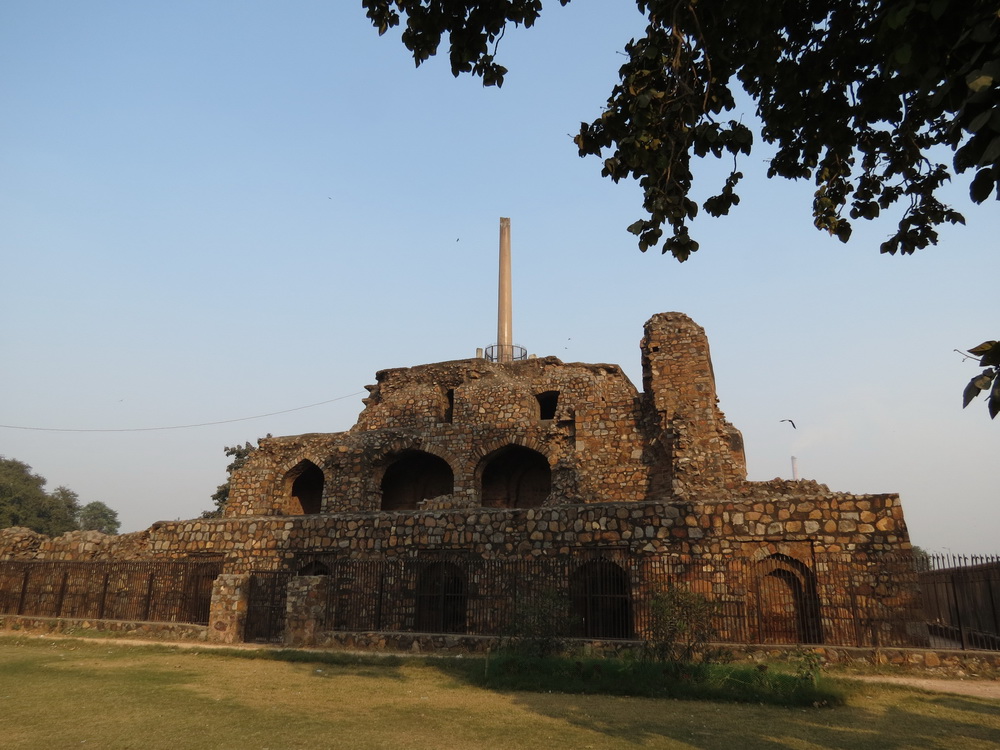
Next I headed out and around where the custodians were trying to herd me. I found a pyramidal structure with a pillar on top. It was a pillar of Ashoka (or maybe Asoka). I had been seeing this name around India, and I'm still not sure what Asoka is, but I did find out at this citadel that there are only two of these pillars. And one of them was at this citadel. It had been moved carefully from its original location and placed on this structure. It was first placed on the first level. Then, once the second level was built it was raised, and then again after the third and final level was completed.


Although I'm not completely sure it was allowed to climb up to the top, there were a number of people who had done so. However, all the entrances were barred up, with only a hole in one of the sets of bars giving access. So I think it was illicit entry. I still went up. Hey, what's good for some should be good for all, I say. At the top the view was really very nice.


Next to the pyramidal structure was the mosque. The walls had fallen down at some point, but it was still a functioning space and I noticed a number of people doing some kind of prayers before the wall facing to Mecca.


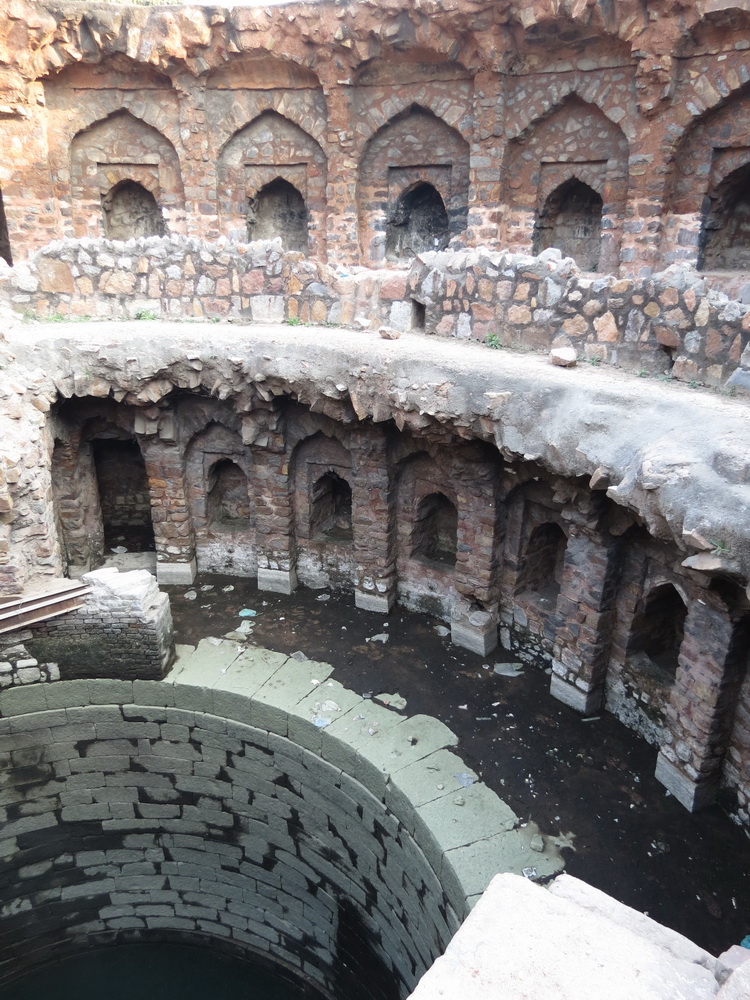
After that little corner had been investigated I headed into the lawn area where there was a large well. This is where I bumped into the two guards/caretakers again. The well had been fenced off with gates, that were closed, at the entrances. But the guards beckoned me forward and opened it up and then invited me in. My heart sank a bit because I was sure this was going to cost me. And I was really getting short on money if I was going to make it to the next day without having to go to a bank again. But they were also so insistent that I couldn't quite figure out a good way to refuse. So I went in. One of them explained to me the reason why it was fenced off. The well is quite deep, 50 meters or something like that. There are no fences keeping people from the edge of the well, and I was told that 3 children had fallen in at some point and drowned in the well. I could understand why it was off-limits. And yet it was also really interesting inside. I liked looking around at the structure of this enormous well.

After they showed it to me, we left. I started walking towards the entrance, fully intending to not make a big deal of anything. And I was also going to pretend that I had no idea of what might be expected of me, in terms of a monetary thank for being allowed into the well. They never said anything either, and I don't know if it was because they were embarrassed to have to make it clear, whether it was the other couple who wandered into the well after us, who were Indian, and who didn't offer any monetary thank you, or whether they were just being friendly and I had once again been overly suspicious. In any case, I left the citadel without having to pay anything else for the experience. And it made up for the rude treatment at the Jama Masjid mosque. It put a nice little cap on my last day in Delhi and left a good impression of India to leave the country with.

So I went and had my last big meal in India, or Indian food and went back to my hotel to prepare for my flight to Egypt the next day.

Saturday, December 24, 2011

Ram Bagh Garden


Amritsar is a different animal as far as Indian cities are concerned. I hadn't realized how different until today. I decided to visit the Ram Bagh Garden. It was one of the spots listed as a point of interest by the guest house on their card. It seemed like it might be a good place to just relax for a while as the day passed and it got to be time to go and catch my bus to Delhi.

I set out and crossed the tracks in search of the park. I first thought I had found the park when I reached a gate with an enclosed area inside. But there was no grass. There were no people. There was a building and a tree. I went in and it seemed to be a special Sikh place actually. I was trespassing a bit, I think, but they were welcoming anyway. It turned out that the spot was a martyring place. At some point, and I'm not sure when and I don't know who was martyred or how many there were. The man in the area didn't speak any English, but he showed me the place.


But the sign attached to the tree made clear that Sikhs were hung there and it seemed that the British were the ones doing the hangings. I think it might have been in 1817, which seemed to be the year that was on the sign, but I'm not sure.


Then I headed out again to find the park. I was fooled at first by the state of the building in the garden. It was in the process of being renovated and brought up to a level where people could go in and look around. It may, at some point, be a tourist attraction in its own right, possibly with an entrance fee attached. But for now it's a somewhat decrepit, crumbling old building. I was somewhat disappointed that this was the spot that was considered of interest.


I found a bench nearby and sat down to just enjoy the day. After a while I got up and followed another path around the old house and found... a park.

A real park. With people doing things I have seen in parks the world over. There were kids in a roller-blading area.


There were people doing an exercise class.


There were others who were just sitting and chatting.


There was even what looked like a taekwondo class in progress. People of all ages were using the park. And I realized that this was the first time in nearly three months in India that I have seen a park actually being used. It was a surprise to realize it. And it was refreshing. Amritsar is truly a different kind of city in this country.

Mata Mandir and Smaller Sights in Amritsar


The main sites for tourists in Amritsar are the Golden Temple, the border closing ceremony, and the so-called Silver Temple. With my ample time in the city, I decided to make sure I would see the Silver Temple, or Durgiana Mandir as it's called. But I had read about another place called Mata Temple as well. A guy in my guest house told me he had visited it as well, and he gave it a raving thumbs up. I set out to find it as well.

I had looked it up in Google Maps and on Google Earth, but Mata Temple wasn't actually listed anywhere, so it was difficult to find. I didn't want to have to rely on a rickshaw driver to get me there if I could find it myself and within a reasonable distance. I eventually found a spot with a photo posted on Google Earth, and knew roughly where I would have to go to find it.

I started walking and avoided the rickshaw guys for the most part. One guy, though, seemed to think that my walking right past him with barely a muttered, “Hi,” in response to his greeting was actually an invitation to turn his rickshaw around and come after me and try to get me to ride in his rickshaw. No. I don't want to ride. I'm walking and I don't know why you are following me. It took a while, but he gave up.

Then I was not entirely sure where to go next, so I stopped at a corner to ask a man where I had to go. Another rickshaw driver rode up and asked where I was going. He had a fare already, so I let him tell me what direction I had to go. Of course, I also knew that he was probably going to be dropping his fare off shortly and I would have to face him again. And I did. He followed me for a long while wanting to take me to the temple. I told him I was really wanting to walk. He told me it was so far. He just didn't get it. In the end he kind of gave up, but I thought I might see him yet again. So when I discovered what a different animal Amritsar really is, I took the opportunity to duck out and take a bit of a rest.

Unlike most of the spots that I have visited in India, Amritsar has recreational parks. Sitting in the middle of a couple of neighbourhoods, I saw parks with playgrounds and benches and nicely landscaped lawns. It was really nice, and something I haven't seen much of at all in India so far. It was a refreshing surprise.


After a short rest, I headed back out to find the temple. There was no sign of the rickshaw driver. Score! After asking a few more people, I found the well-marked lane to find the temple (by well-marked, I actually mean there was no indication at all that I was headed in the right direction), and headed down it. Along the way, I had people call out hello's and then ask if I was looking for the temple. When I said yes, they indicated the way with a big smile. Helpful, friendly locals. It's so nice to be back in that kind of India.


I found the temple and it was really interesting. The temple required a visit through a maze of corridors that led up stairs and through corridors, past idols of all kinds of different gods, even through tunnels that were shaped to give the impression of being in caves, some with water on the floor. It was really cool. Except for the huge number of people asking for a donation. Again, that could have been left for one guy at the door. But all in all, it was a visit well worth the effort involved.


Then it was on to the Silver Temple, which meant getting back across the train tracks. It was reasonably easy to manage, but still required asking directions a couple of times. This was always forthcoming, with no exasperation on the part of the helpers. They just helped. Ah, India. Is there any way I can fly to Egypt from here without having to return to Delhi?

I arrived at the Durgiana Temple and it was quite impressive as well. It also sits in the middle of a pool of water. I'm not sure if that is an attempt to make it as impressive as the Golden Temple or if they really need it. I haven't seen another Hindu temple so situated, so I'm suspicious.


Whatever the case, the Silver Temple isn't all that silver. It too seems to gilded in gold. I'm not sure what the silver refers to, but the back part of the temple is all white marble, so maybe it refers to the colour of the temple there. It is still an attractive temple.


I arrived as some sort of ceremony was going on inside. This was at noon. While I was watching, a man approached me and started talking to me. He showed me a page where he had written: Lifeisnowhere. He asked me to read it and he would explain what it was in a few moments. I have seen it before, but I still initially saw: Life is nowhere. After looking at it again, I remembered that it actually says: Life is now here.


He came back and told me he was a teacher and wanted to talk to me. I was a bit wary, wondering if this was going to end up costing me anything. But he just talked to me about being to experience the whole world even though he has never been anywhere. I thought that was lovely, but I was still glad I was able to travel and experience the world first hand. A British couple came in and he invited them over. He taught us a few words in Hindi, that I would have liked to have known a lot earlier, with only a few days left in the country, but better late than never. Unfortunately I didn't write them down, and now they are lost to me.

Then he took his leave of us and it had really been just a man being friendly. Super!

After that I finished looking around the temple grounds and headed off to find the Golden Temple again. Nearby, I had seen a stand selling sleeper bus tickets to Delhi. I could have tried to take the train, but the train times are somewhat inconvenient, and with the extra length of the trip here from Haridwar, I didn't want to be stuck on a train for a full day or so waiting for fog to clear. I don't know what might happen with the bus, but I'll deal with that should it occur. It's all why I am going back with three days to spare. If something goes horribly wrong, then I have time to get in place for my flight.

I had really enjoyed Amritsar and I looked forward to just chillin' in a park the following day before my night bus back to icky Delhi.

Amritsar in the Daylight


After getting my first view of the Golden Temple in the evening hours, I wanted to go back and see more of it and to see it in the daylight. So I got up and headed over to the temple again. There was also another site nearby the temple called Jallianwala Bagh. This is the site of an infamous massacre by the British against peaceful and unarmed protesters.

In the early days of the move to independence, not just in India but in all of its colonies, Britain would give some autonomy only to claw it back in other ways. In India responsible government was granted the country, but then a couple of other laws, most notably the Rowlatt laws were introduced. This took some power away from the supposedly free-acting Indian government. People started to demonstrate against the laws. In one instance, here in Amritsar, the people were gathering to meet and find ways of opposing the British government's moves. They were abiding by Gandhi's principles of doing so without violence, and indeed in the same spirit and Gandhi, were committed to taking punishment without retaliation. On April 13th, 1919, a group of about twenty thousand people had gathered in a place called Jallianwala Bagh. “Bagh” means garden, but this was not really a garden. It was an empty piece of land that was a place of garbage and refuse. It was situated in a neighbourhood that surrounded it on almost all sides. There were a couple of very small crawl-type spaces between a couple of buildings and one narrow entrance to the “garden.”

The area around the bagh was raised over the years as buildings were put in place and the ground in the bagh itself was some 5 feet lower than the surrounding area. This is where the twenty thousand people were meeting. A detachment of the British army, under the command of Brigadier General Dyer, arrived at Jallianwala Bagh and entered through the alley. They took up positions on the high ground and aimed. Without identifying themselves or their intentions, and without giving any warning, Dyer ordered his men to begin firing on the assembled group. They had nowhere to go. If ever a situation could be called shooting fish in a barrel, this was it. Panic took over the group. People tried climbing over the walls to safety, but the walls were 10 to 15 feet in height. When they got to the top, many were shot before they could jump to the other side. People fell injured and dying, only to be trampled by others trying to escape. The army held the only viable exit. Nobody could get away.


 Others tried to seek safety by jumping into a well that was in the garden. Later, a couple hundred bodies would be found in the well, having drowned by not being able to survive for long, or perhaps by having others jump in on top of them.


Estimates varied as to how long the firing went on. Dyer estimated 15 to 20 minutes. Given the number of men and the number of rounds fired, it could have been only about 5 minutes. However long it was, 1650 rounds were fired. In all, about 380 people died, including one baby and 41 boys. Some 1500 people were injured. None were armed. None had any warning.

Dyer was roasted on the spit of public opinion, both in India and in England. The governor of Punjab, Michael O'Dwyer also found disfavour. One survivor of the massacre, Uddam Singh, followed O'Dwyer home to England and, many years later, shot and killed him in a public event. For his act of vengeance/justice he was hanged. His ashes were returned to India in 1973 to a hero's welcome.

After the massacre, the government purchased the garden from the owners and turned it into a real garden and memorial to the people who died there. They preserved many key pieces of the site and event, including bullet holes on some of the buildings, and the well (which has been named the Martyr's Well). There is an eternal flame, and a large memorial to the people who died on that tragic day.
Walking through the garden, I got a horrible feeling of how trapped and helpless the people who were there must have felt. There really seemed to be no way out.

Of course, this didn't stop kids from approaching because they wanted me to take their photo. It's so nice to be back in areas where this happens, and where they don't immediately stick their hands out for their modelling fee.


After this sobering visit, I headed back into the Golden Temple complex for a visit during the day. And seeing it in the light of day, although still mightily impressed, I was doubly glad I had first seen it in the night. The effect of that glowing gold roof, lit up in the night was mightily impressive.


Yet, the daytime view was almost as impressive. With all the people coming to worship at the temple, there was activity everywhere. There was a long line of people waiting to get into the temple. I didn't think I would be trying to visit the inside again. This was another good reason to come during the much less busy night time hours. I walked right into the temple to look around. No lines, no waiting.


I circumambulated the whole pool. I hadn't able to do that with Zena the previous night. It had been getting a bit late, and she didn't seem to realize that there was a whole lot of stuff to look at all the way around the pool. And, of course, trying to tell her anything like that was just speaking to a blank wall. She didn't things she didn't want to hear. So we just walked back to the entrance rather than finishing the whole round. Of course, it didn't really matter, as I had much more time than she did, so I would have the time to see everything.

So now I got to finish the whole round. I saw the miracle tree, where the deformed man had been healed.


There was a prayer hall just outside the complex.


Another spot held either a memorial or possibly the remains of an inspirational Sikh leader who fought for the kingdom. The story goes that, at age about 70, he grew enraged at the Mughal leader and took up arms against them, and he vowed not to stop until he had taken Amritsar. During the battles, his head was cut off. One of his advisers reminded him of his oath, whereupon he picked up his head in one hand and continued fighting. This inspired his troops and carried them to victory.


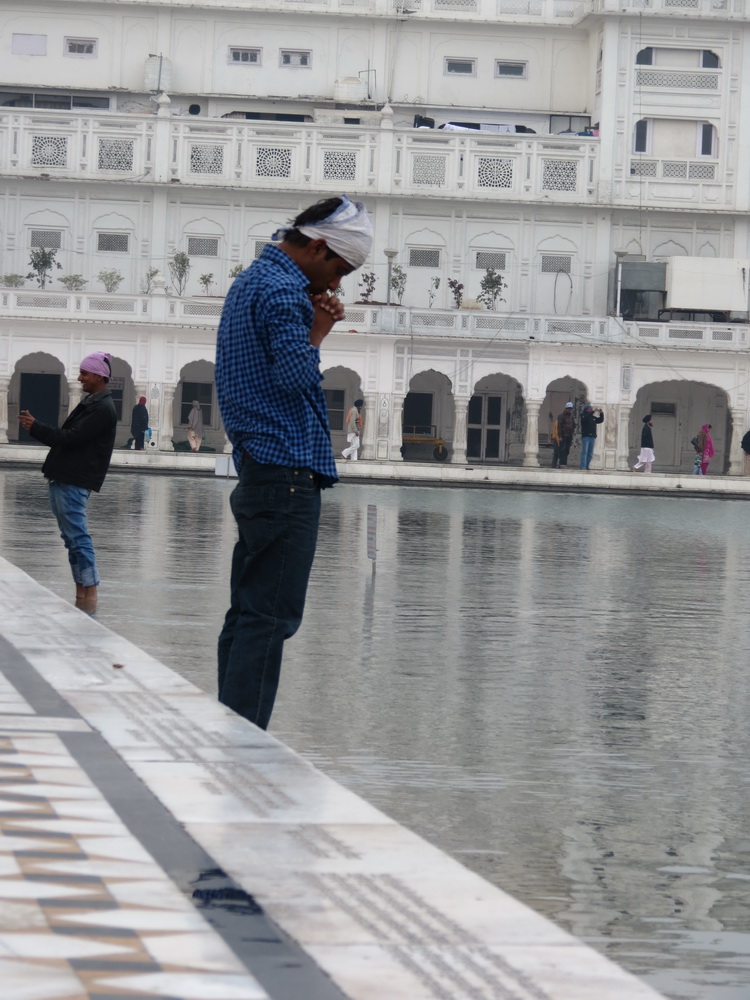
Then I sat for a while beside the pool and watched people taking their ablutions...


...saying their devotions...


...and just sitting in their own contemplations and thoughts.


Despite all the activity in the complex, it was peaceful. I had been told that all Sikhs are to come to the Golden Temple at some point in their lives and give a week in service to the temple and the people who come. They cook, or clean, or answer questions. They guard the entrances to ensure compliance with the rules by visitors. They take and hold shoes (and socks), and other belongings. It is, I suppose a lot like other religions where the life's goal is to visit one of the places of pilgrimage, like Mecca in Islam or Jerusalem for many of the world's religions. I'm not sure if others have that service component. But the Golden Temple is for people of all faiths. All are welcome here, and people of all religions come here to pray. One man told me (the night before) that it was a place for Hindus, Muslims, and Sikhs. It was all he could say in English. I think he really wanted to make sure that I understood all could come here without fear. All were welcome and none would be turned away. And then another man chimed in that the Golden Temple had entrances from all sides so that all could come and worship. I wish all religions could operate like that. The world might be a much nicer place.