After failing to get a clear look at the wild elephants during my jeep safari in Kaziranga National Park, I decided that I really had to get a camera that I could do things with again. And one that had a great zoom. So I asked where to find a camera bazaar of some sort. I was sent to a nearby area. I was also told about the events in the city for the big festival that was going on at the moment. It was to culminate on the following day with a celebration of Dev Deepawali, a festival of light. This sounded great and I now really wanted to get a camera. And the camera that I really wanted to probably get was the camera that was next in the series after my sx30 that I had lost to the river in the Sundarban Tiger Reserve area. It had been recently released and I had seen it in Guwahati, but thought I might find a better deal in a more central city. So I wandered around the area I was sent to see for quite a while. I found only a couple of shops and nobody seemed to have the sx40. So I eventually decided that I would have to put up with the little Nikon I had bought to deal with this festival and wait until I reached Mumbai to get a new camera. But there was a shop that was closed that never opened before I decided to hang up the idea.
I headed off towards the river, the holy Ganges, known to Indians as the Ganga. Varanasi is the among the most known locations for the river and the rituals that are associated with it.
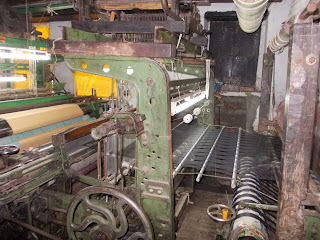
As I walked along, a man began to match my pace and began to talk to me. He told me he has a silk factory and that he would like to show it to me and how it works. And, oh yeah, he also sells silk products and I could have a look at some of those as well. He was quick to add that he wasn't asking me to buy anything. He just wanted me to have a look if I wished. Then it was up to me. He didn't want to be one of those pushy people. Pushy people who charge huge prices only alienated people and then those people never come back. He wasn't one of those. He also said that the shop people down by the river weren't even selling real silk, but it would be obvious that he was because I could see his factory. It was a very soft sell and I ended up following him to his shop. I saw his factory, but it wasn't working this day as it was a holiday for Muslims as well as the Hindus (I had come to Varanasi during an important festival, Dev Deepawali), so his factory was actually closed. I did get to see the looms and all of that. I have seen the whole process before so that was okay. I have developed a rule that I won't buy anything from anyone if I don't actually see it being made. I didn't actually think I would be buying anything from him, but even if I did, I had seen his operation and figured I could trust it all.
He showed me into his showroom, just a room in his house. He didn't need a shop with a shop front. He ran on reputation and on just approaching people in the street, I suppose. He pulled out a whole bunch of scarves and shawls and such. The array was amazing and the patterns ranged from very simple to stunningly complex. He and his family have been in the silk business for 150 years, he said, and they work the patterns themselves and how to key them into the machines. I was really impressed.
And I ended up being impressed to buy a couple of pieces that I suspect that I paid a lot too much for. But they were nice and I didn't begrudge Gheesu the money. He could probably have been talked down quite a bit, but I am just not good at that. And in the end I am satisfied with the things I bought.
Afterwards, he took me to the corner I would go off to find the Ganga and he headed off on his way.

I made my way down to where I thought I could get through to the river, but I wasn't sure exactly where I needed to go. I did keep seeing funeral processions going by. I knew that there was a spot on the river where cremations were done. So I decided to follow one of the processions. That might get me to the river.

And it worked. I had a first real view of the Holy Ganges.

And of the architecture of the waterfront.
And, since I had followed dead people down to the cremation area, I also saw the burning ghat. It is considered disrespectful for people to take photos of the cremations in progress, so I took only a photo of the stacks of wood that were outside the burning area. There is a viewing area that is up above the burning area for the lower caste and the middle caste. The cremation area for the high caste people is up above the viewing area. For anyone but the families, entering the actual burning area would be met with a lot of resistance.
And all of this is actually unknown because all of that information is explained by people who are hanging around in the viewing area. These people hang around and explain things then hit up watchers for money “for the poor in the hospices” surrounding the area, or for some other charitable purpose. Of course they never produce credentials or offer anything that is credible. But the situation puts pressure on the tourist watchers. They sound as though they might be real. But they aren't. And everywhere I went I was warned to pay them absolutely no mind, and certainly not to give them any money.
Of course, when you actually watch them work, they only work the ones that supposedly have money, the white people. They go to the foreigners and hit them up with money. Not the tourist Indians.
The “hospice worker” I saw working explained how things worked and then was harassing this group of French tourists for money. He kept haranguing them for about twenty minutes. At one point a couple of Indian tourists walked up to the rail, took out their fancy cameras and took photos of the cremations in progress. Nothing. One of the French dudes saw that and pulled out his camera. The “hospice worker” whipped his head around and started telling the guy how disrespectful he was being and awful the guy was. I jumped in at that point and told him that he should talk first to the Indian, who had the picture on his camera, before telling the French guy off. I was virtually ignored, but the guy did stop being quite so rude.
Shortly thereafter it became my turn. A “hospice worker” appeared at my elbow and asked if I knew what was going on. I told him I did. He proceeded to explain things to me anyway. I did learn a little bit from his presentation. For instance, I learned that most people are cremated. But there are six categories of deaths that don't get cremated. Children are considered pure and so just head straight to “heaven.” Pregnant women are carrying a pure being, so they also are not cremated. Next, the priests of the Hindu faith are pure. People who have been bitten by a cobra have died of the holy poison and thus avoid cremation. Lepers are supposed to smell bad when their bodies are burned, as are the bodies of animals, so both are not cremated. The bodies of any of these people (or animals) are weighted with stones and ropes, taken to the middle of the river, and sunk to the bottom. Unfortunately, the ropes don't always hold and sometimes one of the bodies floats to the surface of the river and floats away.
I also learned that it takes 2 to 3 hours for a cremation to take place. The body is brought to the Ganges and dipped in. Then it is placed on a pyre and burned in a fairly intense fire during most of the body is reduced to ashes. Some bones remain intact though. Once the cremation is complete, the ashes, and intact bones, are gathered and placed in the river.
It was also explained that women were not present at the cremations. The reason given was that women are too emotional and might jump into the fires after their husbands. I personally did not believe that kind of crap. There was a time (and it still happens in some areas apparently) when widows were tossed into a fire after their husbands, being useless for life any longer, according to the old interpretation of Hindu scripture. But I doubt that many wives would willingly follow their husbands to the fire. In any case, women are not allowed to be present in the cremation area.
Then the “hospice worker” told me of his work with the poor and disadvantaged and asked me for a donation. I said no. He cajoled and wheedled and tried a number of directions to get money from me. I told him I was sorry for all those people, but I wasn't giving him any money. Then he started telling me my karma was going to suffer. I just kind of laughed at him. I laughed at the next guy and didn't even let him begin telling me anything about what was going on.
It seems reasonable to suppose that there a respect issue of in terms of photographing a cremation. It's even probable that families would respond negatively to people being in their grieving space. But in the end it is probably much more up to them than anyone watching, and these little worms preying on the tourists in the area are pretty twisted.
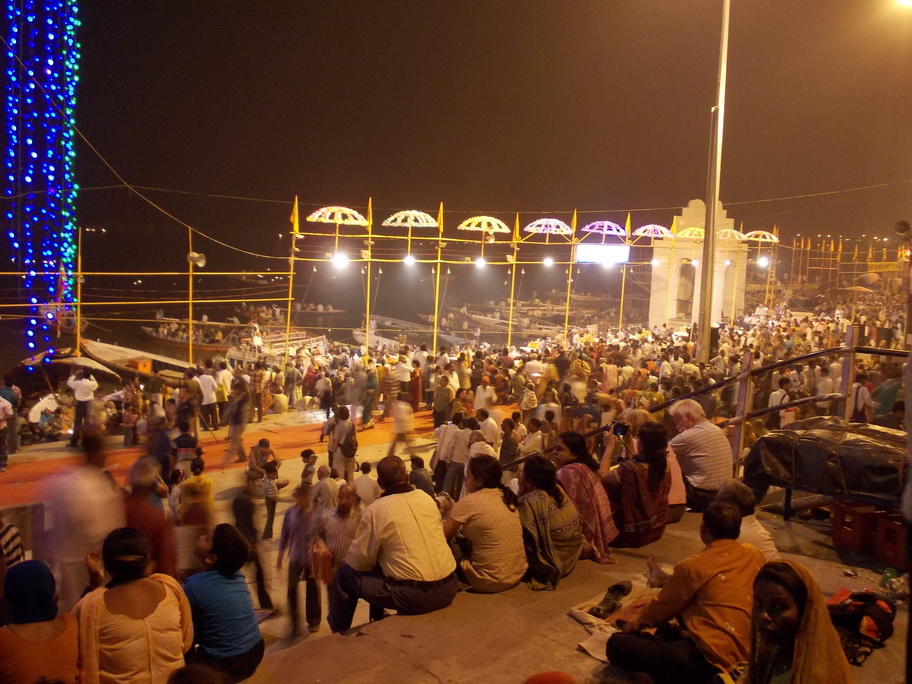
I watched the cremations going on for a little while, then finally headed off down the riverfront. I walked around for a while and the sun soon set. This day was nearing the end of a festival period. There was a celebration area at the main ghat (riverfront building area) and I sat and watched for a while. It was somewhat interesting, but because I was not able to really understand what was happening, I became a bit bored before too long and headed to find a place for a bite to eat, and then back to my hotel.

On the way back to the hotel, I passed the camera shop that had been closed earlier. It was open. And in the window I spotted the camera that I had been wanting to have a look at. I went in and had a look. And I wanted more information. So I was taken to another shop that was about to close, but was owned by a guy who also owned the shop I had entered. Then I hemmed and hawed and decided that I was going to be buying the camera, it was just a matter of when. I decided when would be then. So I got the money together and bought it. And I became very glad I did by the end of the next night.
 Sarnath is an archaeological site related to Buddha and is one of four such sites that are important in the life of Buddha. It lay in ruins and had been largely taken apart by later people seeking to reuse the materials of the monastery for other buildings. It was rediscovered by a man who came to the area in search of a way to rejuvenate Buddhism in India. That man was Anagarika Dharmapala. When we arrived at the Sarnath temple we first entered the working temple. There was a statue of Anagarika Dharmapala. He discovered Sarnath in bad condition and set about restoring it to its former glory. Somewhere along the way, some ruins of a previous temple/monastery were also discovered. Legend had it that Buddha made his first sermon at the spot and the monastery was built later.
 We arrived both a day late and also on something of an auspicious day for the temple. On the full moon of November of every year there are relics of Buddha, possessed by the temple at Sarnath, that are put out on display. The full moon of November happens to coincide with Dev Deepawali and I was otherwise engaged at the time. We went to Sarnath on the day after the full moon and the relics had been re-stored away. Oh well. On the other hand, some seemingly well-respected of Buddhism happened to be present at the temple, and so we got to watch people walking around with him making sure he had enough shade. I did kind of wonder who he was and how important he might have been.
 The temple itself was well-restored, but seemed very new and hardly seemed to be the old thing it really is.
 Gord got into a conversation with a monk-like seeming guy at the temple and lagged behind while he was talking. Olivia and I headed towards the archaeological site, but were blocked by a locked gate. We saw some people coming in by what looked like some kind of entrance at the back and thought we might be able to get in some way from the back of the temple. There seemed to be a ticket booth in that direction, so Olivia went to wait there and I went to see about Gord. While I was doing that, Olivia went ahead and bought entrance tickets. But when we arrived and met up again, it turned out that we had tickets to get into the zoo. A little zoo. A rather pathetic little zoo. There were a few birds, a couple of crocodiles and a little lake with a boat and boatman eagerly trying to drum up business. He didn't find any from us.
 Inside there was some very restored ruins. They were so restored that they mostly didn't look like they might have been real ruins. I suspect this might have been the reason that, even though it was such an important site in Buddhism, it was not a World Heritage site. Nevertheless, because the whole site had been basically razed, the whole plan of a monastery was clear. And it was quite a large area, although I have seen larger monasteries.


 The one structure that remained relatively intact over time was the Damekh Stupa, apparently built right on the place where Buddha gave the first sermon after his enlightenment. It was quite large, for a stupa. I was impressed in spite of myself.