Showing posts with label Hue. Show all posts

Sunday, November 6, 2011

A Morning to Explore More of Hue


I hadn't actually done much wandering around in Hue while I was in town. I had decided to do most of that exploring on tours. The city tour had been a bit of a wrong move, as I probably would have enjoyed just wandering around on my own a bit more. But I had my last morning in Hue to do some of that. So after getting cornered into writing a review on Tripadvisor of the hotel where I stayed, and getting a photo with the woman who had made my tour arrangements, Dung, I headed out for a bit of a look around.

I mostly just walked around the citadel. The outer wall is some 10 kilometers around, which was a bit more than I had time for, but the royal palace wall was only a few hundred meters around, so I walked partway around that.


On one side of the inner wall, I found a really elaborate entrance gate into the royal palace area.


The weird thing about that was that there was an entrance, but no bridge across the moat. It was kind of strange.

Then I hurried back to the hotel, found some lunch and got ready to catch my afternoon train to Hanoi.

Going to See the Vietnamese DMZ


Like Korea, Vietnam was at one time split into two separate entities. But where Korea is still two countries, Vietnam was reunited when the Vietnam War ended. However, during the time when they were split, there was a de-militarized zone that was a buffer between the north and the south.

Hue makes a convenient, if a bit out of the way, spot from which to experience the DMZ of Vietnam. So at the rather early hour of 6, I got up and went out to await pick-up for the tour. The first thing was to get some breakfast, which was part of the tour cost. After breakfast, we piled onto the bus and headed north out of town. For the next couple of hours, the countryside went by. I wish I had been paying better attention to it, for it was pastoral and a slice of real life. However, after a short sleep and an early rise I was more interested in napping than in paying attention to what was going on outside the bus.

We arrived at a small city called Dong Ha, that I can only remember because that is also the name of one of my former students. Our guide joined us at this point and we set off to see the DMZ sights. She gave us a bit of history while we were headed to the first stop. She told us how Ho Chi Minh had left Vietnam to find some way to liberate his people from the French. He returned with the communist doctrine and by 1945 had rallied his people to toss out the French. Independence was declared on September 2 1945, hot on the heels of the end of the second world war. But the French didn't just give up willingly. This spawned the first Indo-China war. During the war, the de-militarized zone was established at the Ben Hai River at the 17th parallel. Five kilometers on either side of the river were set up as a no man's land. Lots of land mines and other ordinance were placed in the area. As the war proceeded, the Vietnamese chose sides, the north or the south and migrated to the side chosen. The people around the DMZ though didn't really choose sides roamed more or less freely back and forth (from what I could gather). Eventually, the French lost and left the Vietnam, Cambodia, and Laos. This left Ho Chi Minh and his communist philosophy in the north and the democratic government in the south. Elections were set up and took place in the early 50's. The winner was to be able to unite the country and be president. Ho Chi Minh won. Handily. He took some 80 percent of the vote. Unfortunately the south's president was not willing to concede defeat and refused to allow the country to be reunited and Ho Chi Minh to be the reunited country's president. Then the US, operating on their domino effect philosophy, intervened to aid the south. Thus began the second Indo-China war. The DMZ had been set up as a temporary division, but lingered on as the two Vietnam's fought the war for seventeen years. In the end the US pulled out of the war, and the south lost, and the country was reunited as a single country under a communist doctrine, and the DMZ was dissolved. Unfortunately because of all the wars and the weaponization of the DMZ, there were all kinds of ordinance and land mines in the area, to go with craters and other degradations that war brings. It took many years for the area to be made safe and to become useful once again. But now it is hard to imagine the area as one of devastation and emptiness. It is now populated and planted and bears very few traces of the wars that ravaged the area not so long ago.

This chat brought us to our first stop, a memorial to those who had fought so valiantly against the forces of evil that sought to destroy the people and bring ruin to the country. They would be the evil Americans. We stayed at the monument for about 15 minutes to get a feel for the country and how it might have been 40 years ago.


Then we piled into the bus again and headed down into the river valley and shortly thereafter crossed the dividing line, the Ben Hai River. We passed slowly so that we could see the big flag (which was on the other side of the bus from me), and the bridge that connected north to south (which was on my side of the bus).


On the north's side were a set of loudspeakers that were used to send propagandistic messages across to the south's denizens.


And then we headed east along the river to the Vinh Moc tunnels. They were situated on the north side of the river, which I found a bit odd. They were built by people who believed in the virtue of the north, and I presume they were built to savage the south. But because the forces of the south were on the other side of the river, I didn't really understand how the tunnels here could have been overly effective. I know I must have missed something. Anyhow, we arrived and walked through stands of bamboo to another museum extolling the virtues of the north and the sacrifice of those who had used the tunnels in the great and noble struggle. (Yes, I suppose I am getting a bit sarcastic in my descriptions of all this. I just find anyone who presents such lopsided, and one-sided, portraits of “the enemy” deserves a bit of sarcasm.)

We passed bomb craters that were transformed into air vents...


...entrances that must have been better concealed than this...


...and views out to the really nearby ocean.


This was all on our way to the museum where we saw photos of daily life in the tunnels, as well as maps of where tunnels had been constructed and used during the war. It was just a small museum, but there were some little bits that were of interest.


Then it was down into the tunnels. These were far bigger than the tunnels at Cu Chi near Saigon. I could stand almost upright through most of the way, where in Cu Chi, I had to practically crawl. These tunnels were also much more extensive. There were living quarters that were obvious, as well as a maternity/hospital area, meeting rooms, and storage spots. And there were exits that were up at ground level as well as in the cliffs by the sea. These tunnels were also deeper, with the third level going as deep as 23 meters. And again, I didn't really understand how people spent a long time living like that. I guess one has to do what one has to do.


From the Vinh Moc tunnels, we headed back to Dong Ha to drop someone off and to get lunch. And then it was up into the hills to visit some of the war spots relating to the American troops. First we stopped at a bridge that was at the start of one of the Ho Chi Minh Trails. During the Vietnam War, there were numerous supply trails used by the north Vietnamese to send supplies and troops to the south. Originally they were just called supply roads, but over time and probably in an effort to give them a bit more romance, they came to be collectively called the Ho Chi Minh Trail. Altogether there were 50000 kilometers of roads used to make up this supply line. And all led to the south. Originally the bridge in this spot was a steel bridge that was much smaller. A few years ago, it fell down and was replaced by this suspension bridge.

There is a sign that identifies it as a Ho Chi Minh road, with a little plaque to commemorate its historical significance.


From the Ho Chi Minh Trailhead, we headed further up into the hills toward Laos (which at this point was only about 50 kilometers away), to an airfield that was used by the American forces during the war. This airfield was high in the hills and therefore had a great advantage. It was thus desired by both sides. In 1968 it was the focus of what came to be known as the Tet Offensive. During the Tet holiday, a very important holiday in Vietnam that coincides with the lunar new year, the Vietnamese launched an attack to take the Ta Con airfield from the Americans. For several days fierce fighting ravaged through the area before the Americans were forced to abandon the base and retreat to the south. This battle was also highly publicized as foreign journalists were there and were able to transmit images of the battle over live or almost live television signals. This was therefore the beginning of instant news coverage that we are so used to today. At the time of the Vietnam War, the Ta Con airfield was 3 square kilometers and a nearby training base was another several square kilometers in area. Now the ethnic peoples of the area have turned the land into coffee plantations and fruit farms and all that remains of the airfield and base is a few hundred square meters of area. In that space there is a small museum (which is again heavily slanted to against the American forces who fled in panic and disarray against the mightily superior and victorious forces of the north), as well a number war vehicles that were abandoned in the surrounding area. And one forlorn guy whose job seemed to be to go out in the fields and find bits and pieces of war history, dog tags, spent shell casings, medals of various sorts, and try to sell them to visitors coming to the museum. This day was pretty hard for him as few people seemed even inclined to have a look at his collection of things. I almost felt sorry for him.

Our final stop for the day was on the way back to Dong Ha. There was a small hill that rose high among the surrounding countryside. It was well protected as it was difficult to ascend. In fact the American forces didn't climb it, they used helicopters to get to the top. On the top of the little mountain they established a radio tower and lookout post that was one of the last places vacated by the American forces when they retreated after the Tet Offensive.

And then we returned to Hue, with another 2 hour drive into the late afternoon. It was a long day, but it was quite interesting.

Saturday, November 5, 2011

Hue, The City Tour


I wasn't sure how I wanted to go about seeing the sights of Hue. There were some things about the city that I wanted to see. There was the citadel and a couple of other things. I also knew this was sort of the best base from which to go and see the DMZ of Vietnam. When I arrived at the Hue train station, I accepted a ride from a representative of one of the hotels in town and got a reasonable for a reasonable price. They also had a helpful, if a bit persistent, front desk that pushed the city tours on visitors. Now there is nothing wrong with that. I suppose I would, too. But I listened and then decided to go with the city tour they suggested and then the DMZ tour as well. The DMZ tour involved a lot of travel as the spots to be visited were a hundred kilometers away. And the cost was 15 dollars. I had no qualms about that one. But the city tour included things that, had I really paused to consider it carefully, I didn't really care about seeing, among them three tombs of three former emperors. I had really only heard about the Hue Citadel, and that was, truth to tell, the only thing I really cared to see. There was a pagoda on the tour. Yawn! I've been seeing lots of pagodas and Buddhist temples. There was an old house for the mandarins of the emperor. I've seen plenty of old houses, although the history surrounding them was a bit interesting. And there was an incense and other craft village to be visited. I've seen lots of craft places and all of that. I really didn't care if I went there or not. So on the tour, there was only one of the spots that I really gave a rat's ass about seeing. Not a really great choice, all in all. But I would see what Hue was all about and it was only 9 dollars, so...

We started off at the Hue Citadel. This was a rather large stone-walled city from the time of the most recent emperors of Vietnam. There were 13 of them. The last one ceded his power and control of the country to Ho Chi Minh in 1945 after the French were sent packing. During the following 30 years, between the first Indo-China war (the one with the French trying to hang on to their colonies), the second Indo-China war (the one where the Americans were trying to keep another domino in Communist domino chain from falling), and the elements, much of the glory of the citadel had been turned to ash and dust. The walls remained. Some structures remained as well. But most of the buildings were bombed or otherwise destroyed. Since the country was re-unified under one flag in 1975, there have been restoration and rebuilding efforts taking place and a lot has been put back, but there is still lots to be done.

The outer wall has survived.

The wall surrounding the royal quarters also still stands. It is quite impressive.

This was where we had to pay the first of five (!?!) extra entrance fees. No wonder it was such a cheap tour. The fee was almost 3 dollars. Inside we saw the royal coronation building.


In the coronation building, we were unable to photograph the rather opulent throne, in order to protect it, but the original plan of the royal area was fair game. So this is what is looked like at one time..


...and this is what it looks like these days. In time things will be returned to their original plan, but for now, one has to use one's imagination. In the emperor's enclave, there was a house for the emperor, one for his mother, one for his concubines, and children. There was a place for the education of the children and all sorts of others. But there was no place specifically for the emperor's wife. I guess it was tough to be a royal wife in that time.


We looked around inside the area for about half an hour. And much in all as it was a place of royalty at one time, it really was just a big empty space where a bunch of possibly impressive old-style buildings used to be. I am getting a bit jaded with this part of the world, I think. It will be good to move into central Asia, I think.


There were some big bronze urns near the entrance. There were a whole bunch of them actually, all through the area. They were to represent the longevity of the empire and used to have big chunks of gold in them, with the royal seal stamped on them. The gold is gone now. :)
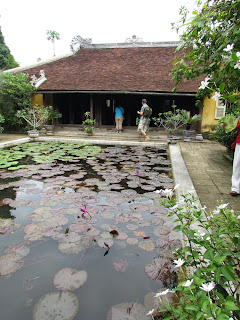


After finishing with the citadel, we moved on to the house of one the mandarin's, called the Garden House. This was a cheap entry at only 50 cents. Aside from just being an old-style house, with some rather strong Chinese appearing influences, the house did have this wall guarding it to the front and then a pond as well.


The spot where Hue is located was specifically chosen for its Feng Shui characteristics. (I told you there were some decidedly Chinese influences.) In particular, Hue is located in a valley bounded by a mountain to each of the directions south, west and north. To the east is the sea, so the city is well-guarded. In addition, to the south of the citadel is the Perfume River. Beyond the river is another small mountain. These are said to guard the citadel from attack by demons of the sky and of the ground. This arrangement is symbolically replicated by building a wall and a pond in each of the houses of the mandarins (who, despite the name that sounds like they are Chinese, were the civil servants who worked for the emperors.


Then we headed to the Buddhist pagoda. Our guide, somewhat derisively, told us that in Cambodia and other places, everything Buddhist is called a temple, but here in Vietnam a temple is a place of worship while a pagoda is both a place for people to come to worship and a place that is an active Buddhist monastery. I'm not sure of the reason for the scorn that came through the guide's voice as he told us about this, but it was most definitely there. We hung out there for about half an hour. It was a serene place.


They also had a relic from a Buddhist monk who was at this monastery. He was very upset at the government of the south. They were Catholic and were repressing all other religions, including Buddhism. He got so upset that he drove his car down to Ho Chi Minh City and then doused himself with gasoline and self-immolated. It is a famous picture from the time. They preserve his car on the premises.


We headed for lunch and then it was on to the tombs. I opted not to visit the first two tombs. I have been finding tombs to be rather uninteresting. Instead, I and another guy who didn't want to visit tombs headed off into the surrounding village. There is a river passing by the tomb and a village by the river. We stopped and chatted with a couple of old women who were sitting by the river. They were hilarious. And they spoke not a word of English. Since we spoke no Vietnamese, it made for an unintelligible conversation that probably did not follow at all, although we did seem to agree that the woman wanted us to mail her the photos we took of her. It was a delightful time we spent instead of visiting the tomb.


We passed on the second tomb as well. I don't know what it looked like on the inside, but I think we got a much better view of it by walking down the road a couple hundred meters.


And there was this person walking through the rice fields that also made a nice photo.


Before the last tomb we stopped at a village where they make incense sticks and conical hats. We didn't really stop off in a village. We stopped at one of the shops in the village so that we could have an opportunity to buy something, cleverly disguised as an opportunity to see how these things are made.


But they made interesting patterns with the incense sticks.


Finally we headed to the third and final tomb. Our guide had told us that if we wanted to visit one of the tombs this was the one to visit. It was in its original condition and it was beautiful. Well, I wouldn't go that far, but it was quite nice.


And I did find the actual burial spot to be quite understated, far simpler than I would have expected.


A dragonboat took us back to town on the Perfume River, to complete a nice, but in the end unwanted, tour day. I saw a lot of Hue, but I hadn't really been interested in much of it, unfortunately.