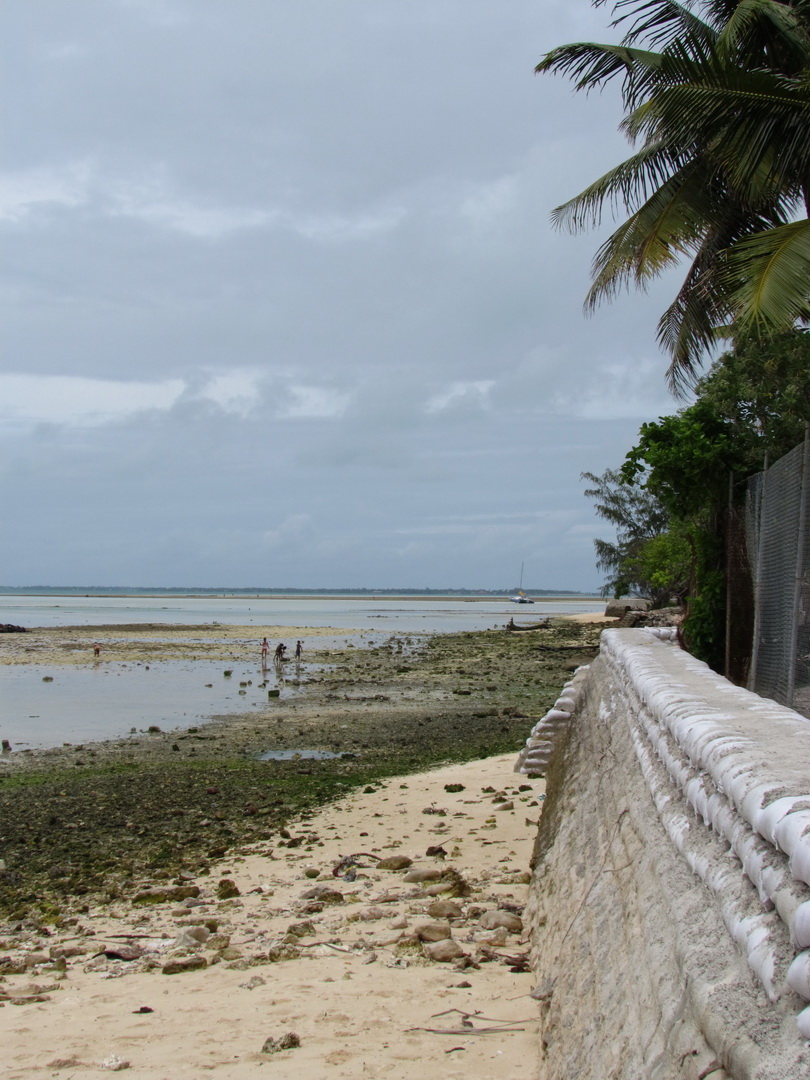
Saturday, May 7, 2011

Tarawa and The World War II Tour


My first day in Kiribati was rather uneventful. I needed money, so I headed to an ATM. Kiribati has in the neighbourhood of 100 000 people. Around twenty thousand are on Tarawa, and most of those are on the south side. They have no central bank. They haven't got their own money. So they use Australian money and one of the Australian banks has a branch here. Only one, I am told. Plus a couple of ATM's here and there. One was reasonably close to the Otintaai Hotel (pronounced “o-shin-tie), so I headed there. I had been told that the local tourist office was in Betio, and I could get there on a minibus, but as I was walking along, I passed a tour office. So after I got some money from the bank, I made the mistake of going into the tour office. It was a mistake because it was a tour office much like a tour office in North America. They had their own tours and they were rather expensive, and then they added a booking/effort fee on top of that. I don't know whether I would have fared better if I had gone to the tourism office, but after I was done at the Kiribati Holidays office, I had spent the better part of the 500 dollars I had taken out at the ATM. Sigh!! But they did make it so that I didn't have to spend much time working out on my own how to do the things I wanted to do. So even at the premium price, I decided that it was worth it. And what did they set up for me? Well, I'm glad you asked. I heard about a bunch of World War II history here in Kiribati, and that there are lots of relics and remnants left lying about. I wanted to go around and see them. So I set up a tour to do that. It turned out that it was a private tour, which explained the rather high price of it. I also read about the outer island experience. Tarawa is the main island of Kiribati, at least in this western group, the former Gilbert Islands (which in the Kiribati language comes out to Kiribati). It's the seat of government and there are lots of government worker types and all of that here. Lots of immigrants and foreign workers are on this island. To get a taste of how the real Kiribatians live, it is suggested that a person goes to one or more of the outer islands for a few days. So I set up a 2 day stay out on Abaiang. (I couldn't safely make it longer. The flights out and back are only every two days and to stay for 4 days would have me returning on the Sunday, the day before my flight out. With the country being just a bunch of small islands, it would only take a weather disruption which, although unlikely at this time of year wouldn't be impossible, I would not be making my flight. Plus, I want some more time to explore Tarawa on my own.) And I booked a stay in an open-style, Kiribati-type accommodation on the north part of Tarawa. But it is ridiculously expensive. That one makes me shudder. But I will see how it turns out. Once in a lifetime and all that kind of claptrap that we use to justify our ridiculous expenses.

And then I went back to the ATM for more money. :( I'm such an easy target. I spent the afternoon catching up with email and meeting some people here. They are quite friendly.

The next morning, I met my guide for my tour. Her name was Toka (although I don't know exactly how it's spelled, but it sounded something like that). Joe, who had helped set me up with my stuff to do while here, was along as well. And off we went. There are a lot of questions that I had, and still have to be honest, about what happened. The impression that I got from Toka was that the Japanese were here after they began their Pacific campaign. They pretty much enslaved the Kiribatians and made them do the usual stuff that conquerors who are waging war do, build fortifications, stay away from restricted areas, eat only a little bit and get real thin, and generally do the bidding of the conquerors. It seemed, from what I could gather, that the Japanese were well aware that at some point they were going to be fighting someone for control of the island and the country. They put a bunch of gun emplacements on the beach on the South Tarawa. The beach faces south into the ocean and were well placed to defend against an invasion attempt. This beach is referred to as Black Beach, because the locals were forbidden from going to it, on pain of execution (and probably immediate execution by guards on the beach). These guns have been left in place, rotting and rusting away. There have been attempts to keep them preserved, particularly from the tides, by putting bunkers around them to keep the waves at bay.


There is one gun that was especially troublesome for the invading American and Allied forces. Try as they might, they couldn't take it out of action by just firing on it. So one pilot took it upon himself and took one for the team. He made a suicide run at the gun and smashed it out of action, at the cost of his plane and his life. I'm somewhat dubious, though. Maybe I am overestimating the bulk of fighter planes and all that they carried, but I think if a plane hit a gun that size, it might have done more damage than knocking off the end of the gun. But I wasn't there and so I don't really know.

After Black Beach, we went to a training center for merchant sailors from Kiribati. One of the main exports from Kiribati is people, not as slaves, of course, but as workers. There aren't many goods that Kiribati produces period, let alone for export. But they have people who can go and earn money and send it back to Kiribati. One of the industries that they can work in is shipping. There is a German operated training facility in South Tarawa that trains sailors for work on cargo ships. In this facility is a remnant of the Japanese occupation. A generator in a bunker in Betio was intact after the Japanese left and was brought, in pieces, to the Marine Training Centre and reassembled. It needed a couple of parts to work, but they weren't available, so a German engineer in the facility made the parts and put the generator together, and today it powers the training centre. So at least one good thing resulted from the Japanese occupation.


Next it was on to Bairiki, the village/town just before Betio. Here is a cemetery that contains, among the regular dead of Kiribati, a memorial to those that died in the “tragic event” of the 15th of October, 1942. I am unclear on what exactly that event is, and Toka didn't have an answer for it either. (This is that main reason for dissatisfaction with the tour. I had specifically asked if the guide I would have would know the relevant history and events surroundings the sites we would visit, and I was told yes, she would. But then she didn't seem too clear on the events in question, such as at this location. She knew the history, but not some of the apparently key events. And I figures that if I was paying the kind of money I was paying, I was entitled to know things like what had happened on the 15th of October in 1942. I will have to Google it, I suppose. In any case, she made up for it with a very dry sense of humour. We were driving past the Prime Ministers residence at one point and I tried to take a picture. But I was too slow. I got a photo of a post instead. She looked at it and said it was a very nice post. I roared at that, I was so amused. Then she graciously backed up and allowed me to get a better photo.)


Next it was on to the Betio War Memorial Park. This was at the very southwest corner of South Tarawa. A gun emplacement is there and has a clear view up the Black Beach direction and around the end of the island onto Green Beach, as it is called. It should have handily defended the area against invasion. Maybe the gunner was taking a nap or having a sandwich or something because Green Beach is so named because this is where the Marines landed when the attack was launched, where they made their beachhead, where they gained a foothold on Tarawa that allowed for the re-taking of Tarawa from the Japanese. But the gun should have been able to cut them down without breaking much of a sweat. Instead, it's now a hulking wreck and we are still free. And again, as in the Solomon Islands, actually standing there looking at the whole layout of the area, it really is easy to see how difficult it must have been and to get a sense (albeit slight) of what the Allied forces faced when they made their assault on the Japanese position here. Reading an account of it on the internet doesn't give that same picture.


Then it was on to the densely populated area of the end of Betio town, where people live in little huts and bungalows all huddled together in a slum-like area. Apparently this is one of the most densely populated spots in the world. But there are twenty thousand people on Tarawa and maybe 8 or ten thousand in this little area of Betio. I would think that Bangladesh and parts of India, among other places would have some kind of density record hands down over what I saw in Betio. And they are much dirtier and have much worse public health conditions. I've never been to those places, but... I guess the experts know better than me.

Passing through this part of Betio, we arrived at another colourfully named beach, Red Beach I. The name of Red Beach came clear as Toka told me that on November 20, 1943, when the Allied forces (and primarily American forces here, from the lists of what type of casualties were suffered in the battle) attacked, they had believed that the ocean would be at low tide. In fact, they were not and the attacking Marines and Navy forces landed and were forced to wade through waist water. The Japanese had anticipated the landing and were hiding in the trees, waiting. And they mowed them down. With the restricted mobility from wading through water, the soldiers were sitting ducks, pun intended. In that initial battle for Tarawa, 1113 Marines and 30 Navy personnel were killed. Another 2290 Marines and 59 Navy personnel were wounded. The beach ran red with blood.


So did Red Beach II.

 
And Red Beach III.


A nearby memorial plaque and time capsule commemorates the battle and the lives lost to it. It stands in the parking lot of the local sports center. The sports center was begun by the Chinese during the previous government, which showed them some favour. But the new administration favoured the Taiwanese and the Chinese apparently left the country in something of a huff. So the Taiwanese finished it.


And near to the US memorial is another memorial with a small gun emplacement. This one is for the Japanese lives lost during the battle. It's behind a fence and isn't accessible. Personally, I found it a bit wrong-headed to have a memorial for the Japanese here in one of the countries they brutalized, and one of the countries that had a decisive battle, that they lost. I'm not saying they shouldn't mourn the loss of their fathers and grandfathers and all. But maybe they should have chosen a different location for a memorial, in a different country? I guess there are a small number of mourners that gather every year to perform some memorial ceremony, and it just seems that would be asking for trouble. But Toka told me that there is never a problem.


Near Red Beach III is the High Court. Not of the stature you might find in other countries, and you might need directions to find it, but it's here nonetheless.


The final official part of the tour was this bunker, headquarters of the Japanese command in the area. The Americans took it out in the end, and apparently the entire commanding group on the island, whereupon the Japanese forces fell into disarray and were quickly defeated. The fence around the area, an attempt to keep the bunker from becoming ruined is apparently only for show. As I was looking at it, a teenager appeared from inside, climbed through a hole in the fence and wandered off into town. The thought's there at least.


After the bunker, it was time for lunch. We headed to a Chinese restaurant nearby and ordered. As I was looking around, I noticed that Koreans are here, too. Of course, it seemed odd to me that someone had convinced the Chinese proprietor of a restaurant that is in a country that uses Kiribati and English as the local languages to put menu items up in Korean.


Then it was back off towards my accommodation for the night. Earlier we had passed a number of interesting things that I hadn't had the chance to see well. Toka stopped to let me have a look on the way back. So I got to see the pre-school that Canada built for Kiribati.


Of course, Japan built the parliament house.

And a causeway linking Betio to the rest of Tarawa. But education is the future, right? And Japan was probably trying to atone for the past anyway.


And then there was the rather startling sign that suggests that Kiribati is screwed in light of global warming and the melting polar ice caps. I have never been in a country with such a low maximum height above sea level. It is possible that some of the other islands are somewhat higher than this, but it won't be by much.

And then it was to a different, and slightly cheaper guest house, but not by much. It was however, much nicer in other ways and I was able to enjoy a very spectacular sunset.

Off to Kiribati

I have been referring to the country as Kiribati as long as I have been thinking about coming here. But whenever I have mentioned where I am headed to people in the Solomon Islands or anywhere that knows the country, they have been calling it Kiribass. I thought as first that this was just some name they knew, but I guess I have been wrong the whole time. In the Kiribati language, anytime there is a “ti” in a word, it is pronounced as “s.” There are apparently only 13 sounds total in the Kiribati language. Now if they were going to adopt the Roman alphabet for spelling anything, I don't know why they didn't adopt “s” for the “s” sound, but I guess it's their prerogative.

After arriving in Honiara, I went and collected my stuff and the Bulaia guest house and waited there for a while before heading to the airport. It was going to be another all nighter, as the flight was at about 2 am. I'm going to have stop that. I'm glad that the next flight, to Fiji, is at 8 am. I saw Clifton again. I was glad about that as I hadn't seen him to say goodbye before heading to Auki. And as we talked, he told me that he also knew Chris Porter. It really is a weirdly small world in some ways. Clifton had helped Porter's business with the government.

Anyway, I headed to the airport and caught my flight. We landed first in Nauru. I have no idea what's in Nauru, but it just one small island and most of the passengers got off there. There were only about 15 people who took off for Kiribati. I did see in the airport at Nauru, though, that Nauru is the location of one of the major data gathering stations for the US agency studying global warming. Maybe that's it.

And then it was off to Kiribati. I don't know exactly how to describe landing in Kiribati. It's like another world in a lot of ways. Kiribati is a nation composed of 16 or 18 islands. All but one of the islands (I think) are atolls. That means that they are ring-like and have lagoons in the center. Most are open, but there is one island that is almost a closed circle, so it has an almost enclosed lagoon. There are three groups of islands. There is the “main group” I guess, encompassing the island of Tarawa (which is the seat of government), and 8 or so other islands nearby. At the other side of the nation, off to the east, there is another smaller groups of islands, including Christmas Island. These islands are actually to the east of the international date line, so for many years, this country had the distinction of having two different dates, depending on where you were situated. After they gained independence, however, the government decided that that was silly, so they decreed that the whole country was going to be on the same side of the date line, so they moved it. This essentially made Kiribati the country that is the most easterly-situated country in the world. In the center of the country is a third group of islands, currently referred to as the Phoenix Islands. These islands are the reason I decided to come to Kiribati.

There is a website called www.ted.com. It's an organization that holds symposiums a couple of times a year. They tape the talks given by people, on all sorts of topics, on the website. One of those talks was by a man who helped set up the Phoenix Islands as a marine park, one of the largest marine parks in the world. I was struck by the story because the Phoenix Islands have one of the best fish stocks in the world as well. But instead of exploiting the fish stocks and basically bringing devastation to the area because of fishing, Kiribati decided to go the more difficult route and establish the area as a protected area. And I figured that a country that would do something like that deserved a look. So I thought that if it wasn't too difficult, or expensive, I would come take a look. I am not going to get to the park. It is too isolated and costly to get to, and there isn't much to see anyway (a few rocks and birds), but the country should be enough.

As we arrived in Kiribati, we descended through the morning clouds, which had a truly cool bunch of colours from the sunrise, we approached this spit of sand with a bunch of coconut palms on it. That is how it looked from a distance. As we got closer, it didn't change much. It really is just a narrow bit of sand, held together by palms and mangroves and the currents (and now some pavement and seawalls). We passed over the landing strip, not even really an airport, and curved around to come in and land. I learned later that the reason for that is to alert people and animals that a plane is landing shortly. There is no fence around the airport, so anyone can wander around. I guess they need a warning at times that planes are coming.

The terminal is a cinder block building. I don't think there is even a building for check-in. You arrive and go in where it says passengers only. (I will find out for sure tomorrow when I fly to one of the outer islands to experience something of the real culture of the country.) The arrival hall, immigration, baggage claim and customs areas are all in the same place. You just kind of turn around to do each thing. And then you are out in the parking lot. But there is no information booth outside, or taxi stand (there aren't actually any taxis here). There is a police office, and one of the officers was very helpful in pointing me to the right spot to catch one of the mini-buses going along the road in either direction to the various towns on Tarawa, both north and south.

I did catch one, with the help of a local, who was quite amused when I didn't really know where I was going. But he made sure I got to where I was going, even though I didn't have any local currency on me either (there are no currency exchange booths, or ATMs, at the airport either), only when we got to the hotel and I tried to ask how much of the Solomon currency to pay, he just waved me off. I had a free ride. I guess what I read about Kiribati being a very friendly place was true. While we were driving along, there were spots where the island isn't much more than 50 meters wide. And on one side there is crashing ocean, while on the other side are the calm waters of the protected lagoon. It really is amazing, and alien in ways that can't be explained.

Down with Chris Porter!!!

I guess there are a lot of dolphins in the Solomon Islands. Now without judging too much (how could they??!!?), the Solomon Islanders treat them pretty much like fish. They catch them and eat them. Well, one enterprising Canadian, Chris Porter came to the Solomon Islands and made a deal with the government. He was going to catch some of them, pen them up so they could be kept track of, and then sold to zoos and shows of various sorts around the world. This, he did. Only, he didn't do a few other necessary things. One, he didn't keep it secret enough from the animal rights groups. So somewhere in the last couple of years of his activities, he ran afoul of the various groups who tried to block him. He also didn't get the permission from the traditional land owners in the area where he was keeping the dolphins penned. It just happened to be the area that Lonsdale's tribe, or group, or whatever they would be called, owned. He told his Chris Porter guy to cease and desist until he paid them appropriately. Lonsdale eventually went to the Solomon Islands court system and got a judgment against Mr. Porter. Chris Porter promptly skipped town and headed back to Canada. The third thing that he didn't do, though, was feed the dolphins properly. Many of the dolphins got sick and since he fled the Solomon Islands last year, the last dolphins died from various reasons. But while he was in business, Mr. Porter earned 135000 dollars per dolphin that he sold, and he sold 83. That's over 10 million dollars. Lonsdale heard that Porter is now a politician in Canada. If he has managed to get himself elected, someone should alert the media so as to bring some probably unwanted attention his direction.

Tulagi and Gela

Tulagi is the town that is on the island of Gela. Gela is a small island and it was easily toured by foot in about 3 hours. When I got up Margaret, Lonsdale's wife had breakfast ready for me. It was scones and spam. For a place that wasn't supposed to cater, they were doing a lot of catering for the guest.

After I had breakfast, Lonsdale called on a neighbour to come and accompany me on my trip around the island. I told him it wasn't necessary, but Lonsdale more or less insisted, saying that there were undesirable elements on the island who would try to mug visitors. I am still not sure that's really the case, given what I have experienced of the Solomon Islands, but he knows better than I. So I accepted the company (hoping it wasn't going to cost too much) and off we went. My guide/knight's name was Wilfred. He's the son of a preacher who is on the island, but he what he calls a “backslider.” Somewhat proudly, I might add. He's the guy who comes in to service late (if at all, and he grinned as he said it), sits in the back, doesn't know the hymns, maybe yawns a bit during the sermon, and slinks off early after services to meet friends. He smokes, drinks, and parties with his friends. But he is definitely good people. I liked Wilfred a lot. And even though he kind of struck a serious-ish pose here, that's not really him. He pretty much had a smile on his face the whole way. He pointed out lots of interesting things about the island, from the old cannery that had been abandoned by the company that ran it (they moved elsewhere for greener pastures), to the various transports and such that were remnants of the war and the battle at Tulagi in particular.

We started at the town area and headed around to the wharf. First we went through the gap that had been carved out by prisoners at the prison there. The day before, when I arrived and Lonsdale was bringing me to his guesthouse, Lonsdale told me that there had been one prisoner who had been working on digging the gap. A lady, who might have been married to the local magistrate, was crossing above, but she slipped and fell. The prisoner leaped up and caught her, saving her life. For his trouble, he was deemed to have served his time and he was set free.


As we headed towards the wharf, we passed the police station. It seemed to be a bit of overkill given that there are only about 400 people on the island. But then Wilfred explained that this was the main police station for all of Central Province. Even though it was a really small island, because it had been the seat of the government for all of the Solomon Islands for a while in the 1930's and 40's, it remained the seat of government for Central Province, and thus has a large police station. That is empty.


We headed past a number of guest houses and homes near the wharf and then moved on into the almost unpopulated part of the island. This is where the history was located. There were troop transports that had been sunk or abandoned. There was an iron “cave” for hiding and supplies that the US put in place. There were many remnants of the Tulagi battle, just sitting here and there around the back part of the island. It was really interesting. And it is all just more or less sitting there, uncared for, and it seems to be relatively unknown. It would probably make for a great tourism point to start promoting the island as a historical destination. That might wreck the ambience of the island, but it would start to build revenue for the Solomon Islands.


We passed an old factory of some sort. Now, there is a guy who goes out and finds old ships. He tows them in, fixes them up, and then sells them off again.


There is a little swamp where crocodiles come in. (But I'm not sure if that is real or not, because Wilfred was awfully nonchalant about walking past. I would be completely on guard, well, I was actually, if I knew crocodiles could be in there, particularly with the size of the ones I saw in Australia.)

As we came back into town, there was an elementary school. And the classrooms seemed to be the typical sort of elementary classrooms you would find anywhere.


Except for the open doors on a Sunday, allowing any curious fool with a camera to come poking his nose in to take a few photos, that is.


Back at the guesthouse, Lonsdale and his family had gone to church. For his company and information, I felt I needed to give Wilfred something. But Wilfred hadn't mentioned the matter at all. I eventually broached the subject by saying that I couldn't offer him much, but... He waved that off and said it had been his pleasure and they just wanted visitors to remember a good time on the island and not to have had any kind of trouble. He said that if I gave him anything, he would appreciate it and consider it a treasured gift. And, true to his word, he was very happy to accept the 50 Solomon dollars that I gave him.

Later, Lonsdale's wife had lunch ready and I ate some really good fish. And when I broached the subject of paying for meals with Lonsdale, he too said that it wasn't necessary, that they considered it treating a guest well. I pressed it a bit and he said that I could give him whatever I felt was proper, but I ought to give it to the cook, his wife. In the end, I didn't get to do that because while I had a short nap, Margaret had gone off to her church's women's meeting. Lonsdale accepted the money good-naturedly on her behalf.

Finally it was off to meet the ferry back to Honiara and then to catch my flight to Kiribati. But I must say, that that day I spent in Tulagi was the highlight of many wonderful experiences I had in the Solomon Islands. Anyone going to the country should definitely check out the Florida Palm Lodge in Tulagi.

And then, Tulagi

Well, I woke up at Serah's and it was still cloudy. I got up and Serah had gotten some doughnuts for me for breakfast. I had thought that if she had put together a reasonable breakfast, I would not say anything about having paid the full price for the meals portion of staying with her. But doughnuts? And not very good ones? I said that I thought it was kind of steep to have paid so much for meals for the food she had served. She said that I had had all the meals promised, but I mentioned the quality of the meals and she hung her head a bit and asked if I wanted some money back. I said yes and she asked how much. I told her how much and she didn't even really put up a fight. She just agreed. She said that she would get it for me in town as she had paid out the money I had paid her to other people already. That was agreeable to me.

Then we got ready and went out to meet Ronnie, who had said he would be around to pick me up at 8 o'clock. We waited. And waited. And waited. By 8:30, Ronnie still had not shown up and we were wondering if he had the days mixed up. Serah was calling around trying to find him and to get her daughter to pick some things up for her. It was a bit of a scramble. Finally Ronnie showed up at 8:45. He had had to take a cousin somewhere for some funeral preparation of some sort. But he hadn't bothered to call and let us know. He has some work to do if he is going to become trusted and someone that people would recommend. But he arrived in the end. As we drove back to town, he was stopping by almost anyone headed in the right direction and asking them if they were headed to town. If they were, he was getting them in the back of his truck and bringing them along. For a fee, of course. Now I had hired the truck to take me to and from Serah's place. He already had that fee, and he was getting more “taxi” fees on top of that. It's just one more way that a foreigner and a traveller gets ripped off, I guess. But Serah understood the way it was going. She didn't give him any money for the ride and tried to give it to me later, despite my having kicked up a fuss about the meals fee while staying with her. And she also helped me find a place to stay on a little island halfway back to Honiara, called Tulagi, as well. I didn't take the transport fee. I almost gave her all the money, but held back on principle.

Then it was just sitting in town waiting for the ferry cat to come in. The ride was fairly uneventful, although as I watched the sky, I was worried. The days have been getting slowly more overcast and rainy. Yesterday was a bit stormy with thunder and lightning in the mix. If a storm comes in and the seas get too rough, the ferry will not run and I will be stuck here on Tulagi, possibly able to watch my plane take off without me. On the other hand, even with the rain and all, the ocean has not gotten at all rough. So there is probably no problem. That leaves only the problem of how many people will be getting on the boat tomorrow. It being Sunday, I am really hoping that it isn't too busy. I may have to muscle my way on in front of someone else. I hope I don't have to do that. That would suck.

However, whatever happens on that score, this little island is a gem. It is very small, I can probably walk around it on the little road in an hour or two. And it has loads of history. Tulagi, on the island of Gela, was at one time the seat of government for the Solomon Islands. In addition, one of the major battles in the campaign to liberate Guadalcanal was fought here. There are apparently a number of wrecked planes and such on the island from the war. It's odd actually that there isn't much tourism here. With so much history here, I would have thought that there would be plenty of people coming here to have a look around. There is also a nice little town here and (would you believe it?) lots of nice people as well. Serah had called a friend of hers, or maybe a relative, who runs a guest house here, and arranged to have me stay. He was actually on the boat with us, but phone service cut out before that was established. I met him as we were both coming off the boat after arriving at the island. His name is Lonsdale (Now that's a name.) and he walked me to his guest house, the Florida Palms Lodge. It's on a little sand beach that looks out towards Honiara through a couple of nice little islands. The overwhelming feeling I had when we got here was the same as when I used to visit my grandparents when they owned a cottage on a lake in Ontario. It was neighbourly and peaceful and homey.


I will explore tomorrow, but Lonsdale took me out for a short walk to see a little bit of the town. Then, as we were returning for dinner, we passed a little beach with a bunch of canoes. It was the fish market. And Lonsdale went shopping for tomorrow's meals. The men with the canoes go out fishing during the day and then return with their catch to sell it on the beach. Those who want to buy fish, go over and haggle the price out with the fishermen and then carry their purchases home. It's really kind of neat.


We came home and Lonsdale's wife cooked dinner, which they shared with me. I may have to try to pay them some for the meal. It was delicious.

I really like Tulagi. I wish I could be spending a couple of days here. It is definitely the spot of my visit to the Solomon Islands.