Saturday, May 7, 2011

Serah's Lagoon Hideaway

The day got off to a bit of a rocky start. I had been doubting Ronnie's motives and efficacy. I suppose it started with the fact that when we met yesterday, we went to get a bite of lunch and he allowed me to pay without so much as a protest, or a thank you. Then he had been late both times he said he would meet me. I realize that island time is a different concept, but I am the guest here and I consider my time to be important. Anyway, I got up to meet Ronnie at 6 as agreed. By 6:30, Ronnie still had not appeared and I just went back to bed. If he couldn't meet me at the appointed time that early in the morning, I had better things to do. I figured he would send someone to fetch me if and when he showed up.

I guess he arrived about 6:45, but didn't send anyone for me. He said he would come back. He returned at 7:30 or 7:45, and did send someone to get me at that time. But I was a touch cranky. And I wanted a definite answer on how much staying at Serah's was going to cost. And when I asked him, he said, “200, I think.” “You think, or you know?” “I know.” All right then. I decided not to fight it any more and just go. We got out here and he hadn't actually gotten in touch with Serah. He had talked to her daughter in town, but hadn't heard from Serah herself. So I got in a canoe where Ronnie dropped me off and headed out to the hideaway. And when we arrived, Serah was called out and said, “Oh, hi. I didn't know you were coming.” Sigh!! She had actually been turning people away for the past couple of days because she is going to Fiji for about a month and will just close her place while she is away. But because I am only here for one night, she decided that I could stay. That's a good thing, as Ronnie had already left. And then, the price was quite a bit higher than Ronnie told me. (Once meals are figured in, it's three times higher.) Ronnie has work to do. If he is going to have people recommending him in any way, he's going to have to be more reliable.

In any case, I was here, I had no viable way back, and it is a rather nice environment, so I just sat back and relaxed. It's a peaceful lagoon. Because I was a surprise guest, Serah had to run around a bit to get stuff for me to eat, so it wasn't what she would normally offer her guests. But she put it together quickly and set up a room for me and welcomed me like a truly gracious hostess. And she talked. And talked. And talked. I learned much of her life story and the story of what's up with the Solomon Islands. It was all rather informative, and it was nice to talk to her. I think I would have preferred more of the peaceful setting though.


She will be leaving next week to go to a craft fair of sorts in Fiji. She makes shell money. She gets hold of shells here in the islands and, with the help of family and other people in the community, cuts, grinds and puts holes into pieces of shell. Then she strings them onto some sort of line and makes what amounts to money, in the small villages of the Solomon Islands. These shell strings can be used to buy things in exactly the same way as money. They are not valid in the cities though. I asked to see them and she showed me her wares. It's quite fascinating. She has been working very hard lately to make a bunch of shell necklaces and strings to take to Fiji. And I bought some from her as well.

After that, I took a little canoe trip around the lagoon to get a good look at it from the water. Unfortunately, I didn't take my umbrella and while I was on the water, a squall came over the mountain nearby and it began to rain on me. And my new camera. I had to stop, hunch over the bag holding my camera and try to keep it as dry as possible. I did succeed, but I shall have to listen to the little voice in my head that says to bring the umbrella next time.


People in the bay have been, I gather from Serah, somewhat marginalized and don't have the same land rights. So between the mangrove forests and their own ingenuity, they have created their own land. They have gone out into the lagoon and cut up a bunch of coral into blocks. They have taken the coral blocks and made walls on the outer edges of the mangrove forests. Then they filled in the areas behind the walls with dirt and other stuff and created a bit of land.


Serah herself has spent 21 years, she told me, creating her property, on which she now has her guesthouse. I think it's quite an accomplishment.

And now, I am sitting here as the sky clears, with almost no lights on the lagoon, watching the stars twinkle, and some kind of sea life that is acting like fireflies, winking with bits of bioluminescent light in the waters around my little bungalow. (This is what it looks like in the daytime.)

It's a great place just to unwind.

Off to Auki on Malaita

Bright and early, I got up and headed to the main wharf in Honiara to catch the boat/ferry to Malaita. It's a seacat, and so it's quite stable and fast. The journey was to take between 3 and 3 and a half hours. Because it was Thursday, it was going to stop at a place called Tulagi. Tulagi is another of the places mentioned at the US War Memorial as having been the site of a significant battle. I will stop there on my way back to Guadalcanal and stay overnight on Saturday. The trip itself was quite easy, although for most of the way there wasn't much to see until we reached Tulagi/Florida Island at the halfway point of the trip. There the vegetation was very green.

There were some nice looking houses...


...and some shabbier looking houses.


And there was this lone tree sitting out in the water, way off shore. I think it's a mangrove, but with no buddies as of yet.


People use these canoes to move about. They are cut from one log and hollowed out as one piece.


The edge of the island seemed to have a bunch of shallow areas nearby.


And there was this remnant of something that has sunk, but was very close to the surface.


Upon arriving at Auki, it was raining fairly heavily and it seemed that many people were waiting for the rain to stop before disembarking. That was alright with me, even though I did have an umbrella. When I got off the boat, a guy named Ronnie appeared to be waiting for me. At the hostel in Honiara, the manager told me that I should contact him when I got there (he is her cousin or brother-in-law, or something like that), but apparently she contacted him to let me know I was coming. In any case, I didn't have a chance to get the lay of the land before I had someone seeking to fill up my time, for a fee of course.

Initially, Ronnie told me about an opportunity to get out to a village to experience the real culture of the Solomon Islands, with villagers who still live much as they used to live a couple hundred years ago. The price wasn't bad either for the opportunity to do that, about 50 dollars a day, when you convert the money. But then he told me how it would cost to get there, the equivalent of about 200 dollars. Hmmm... So, it was going to cost about twice as much to get to the place as it was to spend a couple days having the experience. And then there was going to be a fair amount of time involved in getting to and from the village as well. It became out of my budget. Actually doing things here in the Solomon Islands is fairly reasonable pricewise, but transportation is a bit ridiculous. If they really want to start improving the tourism situation here, they need to address that somehow.

Well, after I kaiboshed the village, Ronnie came up with plan B. There is a lagoon here in Malaita called Langa Langa Lagoon. It is also a cultural spot where one can see shell money and manmade coral islands and get out of the city atmosphere. He suggested that I could go and stay there for a night and that would give me a feel for the culture here as well. Although he couldn't give an exact price on it (which seemed kind of weird to me, since it seemed to be his business), it sounded interesting and I decided to take that opportunity.

Meanwhile, I had checked into the Auki Motel. They are really friendly there (and where in the Solomon Islands are they not friendly?). But remember now, they are not that kind of motel. (Read rule 6.)


I talked to them a long time. They were telling me about traditional medicine in the islands and how local healers can heal almost anything, including cancer, tuberculosis, diabetes, and even holes in hearts. They told me one healer even wanted to get a patient with HIV. I'm not sure how much was really true, but I do believe that traditional healers need to get more attention. And if the diabetes thing is true, I ought to send my brother here.

I took a little walk around town. Auki is quite small and it is easy to have a good walk around and see the place in about half an hour. It's quite a typical seeming place for the Solomon Islands.


Of course, maybe it's not. I ought to be careful, since it's always the outsiders who are the scapegoats.

Then I met another of the guests at the motel. He is a volunteer here in the islands helping people with some form of media development and presentation infrastructure. He had come to Auki to participate in some sort of big meeting with many other volunteers in his program. I talked to him for a long while about volunteering and how he got involved. I might have to consider some sort of program like that. It really sounded interesting.

I met him at the dinner table. I think there were other people at the motel, but he and I were the only ones who were foreigners and able to afford the fare at the motel. But it was definitely tasty. Eric, the motel's cook, is really good at his job. I highly recommend the motel for a stay if anyone comes here.

Then it was off to beddy-bye as I was to be picked up by Ronnie around 6-6:30 in the morning to go out to Langa Langa Lagoon.

Honiara, Mataniko Cascade Trek

History doesn't sing at a distance. Not to me at least. But more on that later.

In the wake of finding out that a tour of World War II historical sites wasn't going to be in the cards for me, I arranged to go for a trek to a waterfall nearby. It was suggested that I might want to go early to beat the heat. I had no objection to that. I was here yesterday when it was fairly blistering by 10 in the morning, and just got warmer from there. So I set my alarm for 6:45 and got out of here about 7. I went to a store and got some water and then set out for the nearby town of Tuvaru. From there I was to find a little village called Laelae. As I walked into the what I thought might be Tuvaru (there were no signs), I saw a bunch of people standing at what seemed to be one of the van/bus stops. I walked up to them and one of the people standing there greeted me and asked if he could help me. I said yes. I told him I was looking for Laelae. And you know what he said? He said he was the chief of that village. I don't know how often it happens that way. It seems to happen to me a fair amount. I will be looking for someone who is from somewhere and I will just run into that person by accident. Or I will run into one of the most important people from a place that I am trying to find. Here I happened to meet the head cheese of the place I was trying to find.

Anyway, he told me to follow him. He took me to the village and called over what I assume was a nephew (he said uncle, but I think he may have been confused about the meanings of uncle and nephew). He introduced the nephew as Ken. What a great name. He told me what the prices of things were (100 for the guide and 100 for the entrance fee; hmmm, I didn't know about any entrance fee, and there didn't seem to be any gate or anything, but that's okay, it's their show), and sent me off with Ken.

We crossed the river and headed up the hill through the village. As I learned later, the river is called the Mataniko River. And we were headed up to the headwaters to return to where we started. It was quite a climb, even though it really wasn't. But with the humidity and the early heat, it was quite exhausting. Even Ken seemed to feel it. He told me that he's 19 and finished high school. He didn't go on to university; there are no universities in the Solomon Islands and anyone going on has to go someplace else like Fiji or Australia. Towards the top of the hill, we met a couple of kids going the opposite direction. Ken told me that they were living in the bush. He showed me where their village used to be. However during the “tension time” they fled further into the hills and established a new village. They were told they could come back, that the tensions had eased, but they didn't want to come back. (There was a period of rioting a few years back and things had been quite heated. It has settled to peace now and everyone is much happier now.)
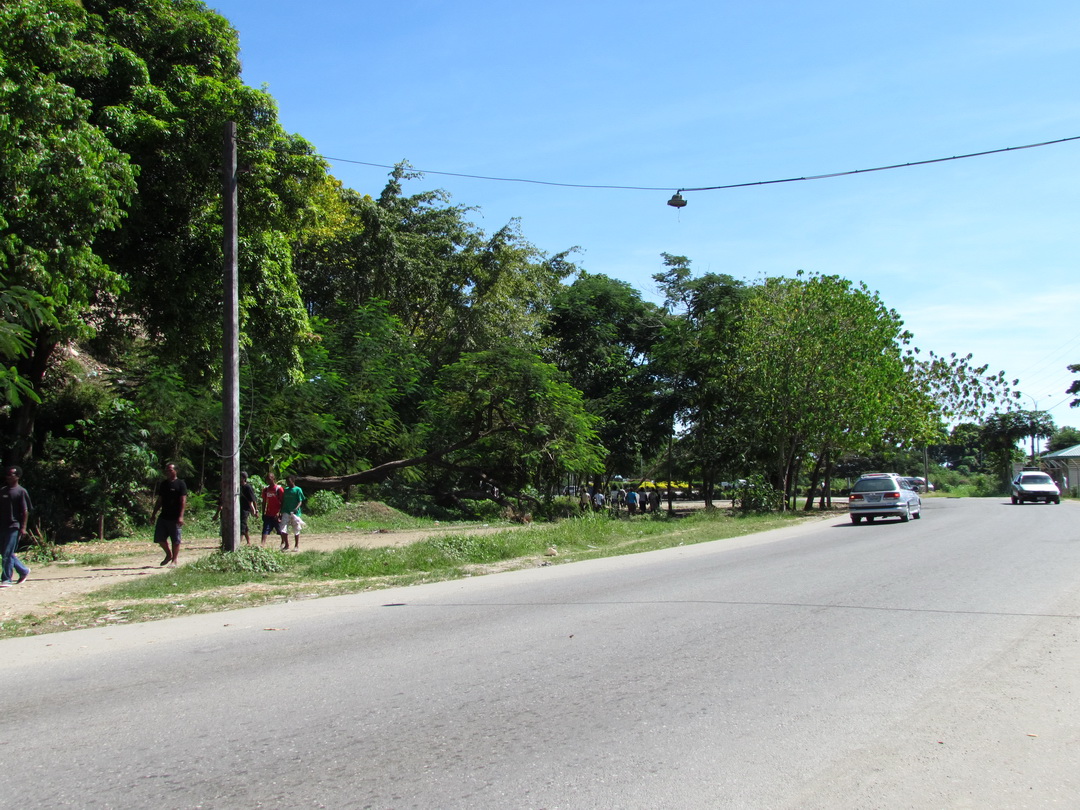

We continued up the to the top of the hill and there were some splendid views of the surrounding area.


We rested at the top of an embankment before heading down to the cascade/falls.


And then it was down to a rather amazing waterfall. What you see here is just the bottom of it all, only it's not even really the bottom of the structure of it. To the left is a deep cavern that goes through the rock.


We climbed to the top of the waterfall and the water comes down and splits in two. The near water here comes down behind the point of view and becomes the cascade viewed at first. The far water cascades down the other side and falls into the other end of the cavern and meets up with the water from the other side at the very bottom.


At the very top of it all is a cave from where the water has its source and begins this rather amazing sight. From here, I wish I had been able to take more photos, but as it happened we had to do some swimming. I'm very glad I think of things like going swimming and protecting my camera. I had been told that there was a bit of swimming, but that it was more like wading and there might even be inner tubes. I'm glad I didn't really take that seriously and brought along two large ziplock bags. I was able to put all my stuff into one, seal it and then put the first bag into a second bag and seal that as well. It seemed airtight, thus watertight, but Ken still offered to carry it for me, lest I let it all go in the water. But because it was all trussed up, it was too much trouble to be digging the camera out to take photos every time we went around a bend. So I can only tell a little about the whole thing. It was amazing. The river from the cascade had dug a channel through the volcanic rock. We swam a ways through quite deep water with vertical, but possibly climbable, walls on either side for a couple of hundred meters. Ken was swimming with one had raised in the air holding my camera and other stuff out of the water. The river would turn corners and slow, become shallow and the deepen again. It wasn't that far before we were back to wading levels, but we spent the next hour and a half wading, walking along one shore, then crossing to the other, then wading some more. And the jungle was all around. It was really splendid. If anyone ever comes here I highly recommend this trek. And a waterproof camera (if I hadn't had to replace my camera, I might have opted to get a waterproof camera in Brisbane. Oh well. I have my memories.

As we arrived back in the area of Ken's village, I was able to take my camera back out and take a few more photos of what appeared to be normal daily life.


At the bottom of the river, back at the village, I gave Ken some extra money for protecting my camera so well (not a drop got to it or any of my other stuff), and headed down the road back to the hostel to dry off and rest. I met some more people who are staying here, including a man who is a land use planner. He was telling me about the problems they are having here with development. The lands are owned by the indigenous people here (as it should be). But the rules for anyone to buy some land and develop it are almost prohibitively difficult. This is not just for outside interests, but also for the people of the Solomon Islands. They are currently searching for ways to change the rules to make it a bit easier to encourage development.

After resting for a while and cheering the youth football (soccer) team as they won to move into a tournament final on Friday, I headed out to have a look at the US War Memorial.

But first, I hiked up the hill to have a look at the National Parliament of the Solomon Islands. It's kind of unimpressive, actually.


And this is pretty much all the security there is for the building, although there is a guard at the entrance. (The Solomon Islands, by the way, has a parliamentary system, like Canada, with the Queen as its nominal Head of State.)


I had seen the US War Memorial on the hill as I walked out to take the waterfall trek earlier. It took a bit of searching to find the way, but I did find it by mid-afternoon.


A long time ago, I did a paper on the Plains of Abraham. I researched Wolfe and Montcalme. I read about the battle, about the positions of each, about the mistakes and the strategy, the tactics, where the armies stood, how they moved. And it really doesn't mean much to me. Perhaps if I had read it while standing at the spot, it might have meant more. Or I might have understood it better. Who knows? But when I am actually standing in a place where history has happened, I can see all the spots that are involved and I can imagine it much better.

At the US War Memorial (which, by the way had a fantastic view out over the strait; how do the Americans get such nice real estate all the time?), I read all the plaques about a battle that I have heard about, the campaign to capture Guadalcanal from the Japanese. That is the main island of the Solomon Islands, the seat of government. I never studied the campaign, and I didn't know much about it, in all honesty. I just knew it was one of the most important episodes of the war in the Pacific. But I would read the plaques here at the memorial and then I could walk to the wall and look out and see the spot that was described in the commentary. I even realized while I was up there that I had walked through one of the areas that was the scene of one of the decisive battles in the Guadalcanal campaign. That was the Mataniko (or Matanikau as it's spelled on the plaque) river valley.

It is quite stirring really to look out and think about the fierce fighting that raged not really that long ago. And then to see that nothing really remains to show the scope of it all. (I suppose if I was an avid scuba diver I could somehow arrange to go out and look at the wrecks on the bottom of the sound.) Today, there is just the peaceful city or Honiara sitting on the edge of the water.

Honiara, Open for Business

Today took me a long time to accomplish only a little. I guess I need to work at slowing down a bit and recognizing that I have a long way to go and sometimes it's just going to take a bit of time. Easter got in the way and I just kind of feel like I've been spinning my wheels for a couple of days. And I guess, in a way, I have.

I went to the visitor's bureau and got some information. Then I tried to get some form of guide or tour or something to get out and see some of the war history of the area. It took a while to find the office, but it was closed, so I had to find another one, which turned out to be right next door. In the end, it seems that it will be a no go on any sort of organized tour. I opted to book a guide to take a short hike to a waterfall in the area tomorrow. It's not too expensive.

I got some internet time for my computer and booked a ticket to Fiji from Tarawa, fulfilling Kiribati's requirement to have an onward ticket, and then the nice woman in the local airline booking office kindly printed it out for me.

And I booked some time out of Honiara. There is a boat operator here who runs a trip daily from here to Malaita, a nearby island. When I went in in the morning, he outlined a bunch of options for me, and said if I came back at 2, his assistant Doris would have a quote for me. The whole plan sounded to me as though it was going to be rather expensive. And it was. When I returned to the office to see Doris she told me the three day trip was going to cost 4500 Solomon dollars, which I think comes out at roughly 600 dollars. Aagghh! That's too much, I told her. So she and I set to work trying to find something that would work. She was very nice and helpful and in the end, I convinced her to take a photo with me.

So I guess it wasn't such a bad day. I just didn't get much in the way of traveling and seeing anything interesting done. I did meet some nice people though.

And then I looked in the little guidebook that the woman at the visitor's bureau gave me. At the back there is a little table of useful phrases to use when speaking with locals who don't speak much English. Of course, the languages here are English and a pidgin language that is based on English. And when I was looking through it, I found it rather amusing. See if you can figure any of these out:

English                                  Pidgin

See you again.                      Lukim yu moa.
When                                   Wanem taem
Little                                     lelebet
Quick                                   kwiktaem
Where are you going             wea nao yu go
Where are you from              yu bilong wea
I'm from Australia                 Mi blong Australia
It's prohibited                       Hem taboo
I'm a vegetarian                    Mi no kaikai meat

Honiara

My trip from Darwin to Honiara in the Solomon Islands was marred by niggling little difficulties. I had lost my camera on Saturday of the Easter long weekend. That meant that it was going to be difficult to correct that, as Australia proved to be strong on being closed during public holidays. (I did find a Duty-Free shop open where I bought a new camera.) I still had to get a ticket out of the Solomon Islands as they won't allow anyone in for a visit until proof can be shown that they have an onward ticket to depart the nation. I corrected that, but I did it in a park in Brisbane that happened to have free wifi access, and I didn't have access to a printer, so I couldn't get physical proof of my intention to leave the Solomon Islands. This became an issue when I got to the airport. The woman at the check-in desk seemed rather put off that I didn't have a piece of paper to show, as I was told that the first thing that would happen when I reached the Solomon Islands was that I would be asked to show my onward ticket and they didn't have computers to find it from a record number. So I had to convince them to print it off for me. And all of this was under the influence of lack of sleep. I had been up at about 8 in Darwin, my flight from Darwin was at 2 in the morning, and my flight to the Solomon Islands was at 9 the night of my arrival in Brisbane. With that short time in Brisbane, I decided there was no point in trying to stay anywhere, which meant not having anywhere to catch a bit of sleep. But I got a camera, I caught a little bit of rest in a far corner of the Brisbane airport where there were some rather deserted, but quite comfortable cushioned benches, and the check-in staff printed off a copy of my onward ticket. The only thing left was that I had once again not done a thing about staying somewhere in a country where I was going to arrive in the middle of the night. In that past that has spelled trouble. I hoped it was going to go well this night.

I immediately noticed something interesting as boarding for the flight commenced. The staff knew most of the boarding passengers, and seemed to know them quite well. There was banter and questions about how families were and when they were moving from place to place. There seems to be a fairly regular community to this little circuit from Brisbane to the Solomon Islands to Nauru and then to Kiribati. I remember that kind of feeling when I would visit my father in Penticton when I was young and we would fly. There were only 39 passengers on the plane, so there was plenty of room and for the first time in a while I had a meal on the plane. I have been flying budget airlines for a while now and they don't just offer meals to passengers as part of the ticket price. This airline did, though. So that probably means it wasn't really a budget airline and my ticket was higher than normal. Which it was.

My arrival in Honiara was just as easy. There were only two of us who got off at Honiara. The rest were going on to one of the other two stops, Nauru or Kiribati. That made immigration very quick. And not once was I asked for my onward ticket. I think it's just put on the responsibility of the airlines to make sure so that they don't have to upgrade the airport systems out here. But they told me in Brisbane that if a passenger couldn't produce an onward ticket, the airline would get a big fine. Fair enough, but it annoyed me a tad that they didn't even seem to care enough to ask when I got here after I had everyone up in arms in Brisbane about my not having a physical copy of my ticket. It did bode well for how easy it might be to get to a place to stay. And it was easy. I had to take a taxi, but there was no haggling. The Solomon Islands is rather more expensive than a lot of places I have been (barring Australia, of course), but the taxi driver didn't seem to be gouging me. He didn't even seem to try. He told me a little about the city (town, is how he put it, since it isn't in a league with big cities I would be familiar with), and took me around to three or four different places to stay. The first was closed; the second was more expensive than I wanted to pay. The third one was a backpacker's place and, despite a bit of confusion of answers I got from the manager, translated through my cab driver (which, to be honest, felt like the hostel manager was trying to see if he could gouge me a bit), it ended up being a reasonable price with a reasonable room, so I opted to stay in Honiara's Chinatown area.


And then, at long last, after about 40 hours or so, I got some much needed sleep.

The next morning, I got up and met a couple of my hostel mates, Clifton and Nelson. They are pretty much living here as it's the cheapest spot to live among the various choices of accommodation. They are really nice and gave me lots of information about Honiara and what I might find here and where I could go. Clifton told me he would take me to the visitor bureau on the Tuesday. It was closed on Monday because of Easter Monday. I can't seem to avoid the whole disruption to being able to do much of anything because of this holiday. Oh well.

I went for a walk and had a look at everything in the light of day. It's a nice little town. It looks like a lot of little towns everywhere. There are narrow paved streets. There are dirt roads along side streets.


There is a main street where most of the action is. There is a one-way bridge over the river separating Chinatown from downtown.  (And I noticed that even though there were still cars that hadn't gone over the bridge yet, there were times when the flow of traffic just stopped from one direction in order to allow traffic in the other direction to go.  What courtesy!!!)


There is even a couple of casinos, although the one in town seems to be a bit run down. (It reminded me of Stampede Casino in the early days.) And it was fairly quiet in town due to its being a public holiday. I walked around for while and ended up finding the location of the visitor's bureau on my own, but as Clifton had told me I was going to have to wait until Tuesday for it to be of use to me.


 I found some nice parks along the water. There were a couple of plaques explaining how Honiara and Guadalcanal figured in the World War II campaigns in the area. The area of water in front of Honiara is called Iron Bottom Sound. The reason for that is that a large number of ships went down in these waters.


Later on, I found Honiara's Botanical Gardens, which were a nice cool place to walk during the high heat of the day.


And everywhere, I met friendly people. Again, I had been warned over and over about it being dangerous here. Not so much physically dangerous, but danger from pickpockets and other forms of theft. Wikitravel warned me. Clifton warned me. My taxi driver warned me. Everyone was warning me, and what did I find? Clifton and Nelson giving me all sorts of information about Honiara and the Solomon Islands, and just shooting the shit with me for a while. There was Franco the security guard who came out to talk to me for a while as I was checking out the boat office where I could get a ticket to another island nearby. There was the father of the kids in the playground by the water, who smiled over and said hi. There was the woman I overtook as I was walking out of the botanical gardens who told me about the children's park by the water and wanted to take me there. There was the guy in the river at the botanical gardens, in the midst of some kind of washing, who looked up and waved and welcomed me to the islands. There were all the myriads of people who smiled and said hi on the street, or who asked me where I was from, or who just generally acted in a welcoming way. Are there pickpockets here? Probably. Are there ways I can be separated from my valuables? Sure. I can only do my best and keep my valuables as safe as I can, but it's no more than I would do anywhere else, and I don't think it's anymore dangerous here than anywhere else. It's certainly among the friendliest places I have been.

Wednesday, May 4, 2011

Brisbane

I bought a new camera today. I have no shots to share though because I bought it in a duty free shop downtown. The rules for the purchase, though, were that I could not use it before leaving Australia. It was placed in a sealed bag and had all kinds of documentation attached to it to prove that I hadn't tampered with the seal until I was behind the immigration process at the airport. This was on pain of a 5000 dollar fine or up to a year in prison. So my day in the downtown Brisbane area, which was mostly closed anyway as it was the Easter weekend and most businesses just can't afford to pay employees to work it (with a 17 or 18 dollar minimum wage and the extras that would be paid on top of that for working a holiday, I can understand), and my time in the Brisbane Botanical Garden have gone unrecorded, at least in photos. Actually, I was really tired as it was another flight in the middle of the night, so I didn't see much anyway.

And then it was off to Honiara in the Solomon Islands.

The Loss of a Camera

This entry mourns the loss of a comrade who has passed too soon. With me for two years, I am saddened to report that my dear... camera... has vanished. I was having a restful day in Darwin, sitting and reading. I had put my camera down on the bench beside me. After a while I got up and headed off towards the Darwin Botanical Garden, but had left the camera sitting on the bench. By the time I realized it and returned, my camera bag had wandered off on its own. Hahaha! Some brigand had seen it on the bench and had taken it. And despite it being Easter weekend, the person did not have an overwhelming sense of civic duty and hand it in somewhere. So a new camera became inevitable.