Showing posts with label Philippines. Show all posts

Monday, March 28, 2011

Mount Pinatubo

In June 1991, Mount Pinatubo erupted.  Mount Pinatubo is a volcano about two hours north of Manila.  I went to Clark in order to catch my flight to Malaysia, and while I was there I had the opportunity to visit Mount Pinatubo on a tour.  I visited the local Angeles/Clark branch of the Department of Tourism.  What can you tell me about taking a tour of Mount Pinatubo?  Well, I was told, they weren't currently recommending tours to the mountain.  Oh.  Why not?  Well last year, a number of tourists died in a mishap.  Oh.  It turned out to that there was a landslide of some sort that buried some tourists from Belgium.  The accident occurred during the rainy season and, if it was still my wish to go, they could set me up with a tour.  Hmmm...  They weren't recommending tours to the mountain, but they could set me up with a tour if I still wanted to go.  I love second-world countries.  Anything goes.

Well, yes, I would still like to go.  So I got set up to go out on Sunday, starting at the ripe hour of 6 am.  And off we went.  An hour later, we passed something I had read about in one of the maps I had been given.  During WWII, the Japanese had taken a large number of Filipino and American soldiers prisoner and marched to a place near where we were.  It is now referred to as the Death March.  47000 people died in the march and there is a shrine to memorialize it.  But we passed right by.  If I hadn't known about it, I wouldn't had any idea that it was anything special.  Hmmm...

A little while later, we stopped at this spa place that also served as tour guide repository and sign-in location, where we duly filled out waivers removing all blame from these people should anything untoward happen during the tour.  Hmmm...

We picked up our guide and headed off to the mountain.  Now to be fair, despite all my other misgivings about the tour as it turned out, the mountain is quite spectacular.  Here is one of the first views of the mountain as we moved up towards it in the 4x4.


We drove past small mountains of ash.


And we walked past them as well.  The little dots you can see in this photo... They are people.


We climbed from there into the are below the crater, where life has returned quite strongly in the past 20 years.


And crested the crater's edge to a breathtaking view.


There are one or two indications that the area is still active.  Lower down the slopes, a river runs warm (although the crater lake is not particularly warm).  And around the little mountain on the left there is a small vent that is discharging steam.

It truly is an amazing sight to behold.  And that is the source of the reticence I have about my visit.  I didn't learn much.  Our guide showed us up the mountain to the crater.  He made sure we didn't stray, or get hurt.  He kept his eye on us so that nothing untoward happened during our visit.  But he offered nothing in the way of explanations.  I asked a number of questions about the area and what had happened, but received short replies, often one word, a yes or a no.  It was a fairly pricey tour, all things considered, and I would have thought we would get some history, some explanations about what happened in 1991, who was affected and how.  But there was nothing except short answers to questions that I could think to ask.  It was the same with the driver.  We passed one of the other more significant pieces of history attached to the area in the Capas Shrine to the Death March, but had it not been for me having seen something about it on the map I had, we wouldn't have even stopped.  And the driver didn't say much about it when we did (after I asked if we could stop).  For the price of the tour, it seemed to me that we could spend a few moments at the shrine and learn something about the events that it remembers.  As it was, we only had time to take a couple of photos of the shrine...

...And I did manage to get a photo of one of the markers along the road showing the route of the Death March.

I'm glad I went.  I enjoyed seeing Mount Pinatubo and the hike to get up to the crater.  But unless the value provided during the tour changes, I don't think I would do it again, and I don't think I would recommend it to anyone I know.  Which is unfortunate because the area seems to be quite interesting.

Hapao's Rice Terraces

I had read about the rice terraces around the Banaue area.  They are inscribed on the UNESCO World Heritage list (not that that really means anything anymore, but I still like to visit areas that are so inscribed).  When I arrived in Banaue at the Jeepney terminal at the top of the hill, there were the usual sorts of people hawking themselves and their tours to the new arrivals.  As a foreigner, I especially stand out and at times I am practically at the bottom of a dog-pile.  One friendly young man named Noli (something I will probably always remember because in Korean, Noli means play), helped me out of the jeepney and, without too much of a hard sell offered to take me down to a particular hotel.  If I didn't like it, I could choose any of the others in the area and there were lots to choose from.  He also told me that he was a guide and could show me around the area.  Well, I often find that I don't have the kind of time it would take to do it myself, so I need guides and people to do these things, and I figured I would take him up on it, as he was nice enough.  This persisted even though he put me in a motor-trike and went around the corner and down the hill.  All of four hundred meters (maybe) to the hotel in question.  And when I looked at where we had been, there was a staircase down to the same spot that took off at least half the distance.  Oh well, I don't think I will ever stop being taken in by those with transportation on offer.  I got checked in and set up my tour for the next day with the young man.  I didn't feel up to the longer options through the (apparently) more spectacular areas, so I opted for the trip through the Hapao rice terraces.  They were quite picturesque and I had a good time walking through the terraces with my guide.


When I reached this point in the journey (from Banaue proper to this point it was about an hour and a half of bouncy, jouncy roads that were being "improved," but my guide suggested that government corruption was keeping the funds that would make the improvements possible from being fully in evidence), we were about to enter the area called Hapao, where the rice terraces were located.  Now my guide, who you can see looking pensive (I'm not sure if he was just being polite and waiting for me without trying to look like he was waiting for me, a la Star Wars ("I don't know, just fly casual, Chewie."), or if he was striking some kind of pose, but it made a cool photo.) here, made his fee of 750 pesos for the day, and the trike driver made 900 pesos for the day.  But when we arrived at the checkpoint below where this photo of the rice terraces was taken, I paid to the entire community of Hapao the grand sum of 10 pesos.

I asked Noli just to confirm the situation, and yes, the only thing the community got was 10 pesos.  Initially, this had me feeling uneasy.  My guides were individuals (although they were working for families, for instance Noli has 12 brothers and sisters, but still many fewer than a whole community), and they were making these huge sums compared to the community of Hapao that was making about 25 cents for allowing me to come in and tramp all over the source of their livelihoods.  Initially, I was feeling like I shouldn't recommend this experience because of that.  However, when I returned to Manila the next day and went to the Department of Tourism offices for advice and I asked about this issue, I got a different point of view.  I was told that the native communities were not encouraged to ask for more.  They were in fact encouraged to be happy that people were coming to see the rice terraces and not to worry about the money.  They were making enough to live and that would be fine.  The reason for discouraging a higher "entrance fee"?  When other communities had learned about money, and tourist money in particular, they let their terraces and livelihoods deteriorate in favour of making that tourist dollar.  By not getting more than the 10 pesos for the visit, the natives in the area maintained their terraces because that was still how they had enough food to keep living.  (Now, I later decided that Department of Tourism advice and information is a tad suspect, but I'm hoping this part was true enough.)


Anyway, we tramped through the rice terraces and saw some interesting things.  My guide was a freelance guide (as in not registered), and though he probably wasn't the best guide around, he did tell me many things about the terraces.  For instance, last year was a very dry year.  Hapao suffered less than other areas around Banaue, but they still had to resort to newere methods to bring rain, such as cloud seeding.  Unfortunately these sorts of methods have their own difficulties, with chemicals and such being involved.  As a result there has been increasing damage to the terraces, with landslides and such taking their toll.

This one occurred last year.  Unfortunately, because it is so tall and because of its location, it cannot be repaired.  Others, when they are small or less steep, can be repaired and this is undertaken by the owner.  As time has gone on, there has been more and more damage to the terraces, and the marks of that damage can be seen all around.

As for ownership of the terraces, they are family owned.  A rich family may own 10 or fifteen terraces.  When the parents become too old, they will apportion them out to the children.  The first child might get three or four choice terraces.  The second might two or three.  The third one or two.  However, by the fifth or sixth child, there are usually no more terraces to be handed down.  They can only be given education.  This was the case with Noli.  He was the 12th child in his family and was in the process of being educated, when his father died.  His father, incidentally, was a forest conservation officer and knew a great many people in the valley, and was well-liked.  He had a large turnout for his funeral.  But when he died, Noli was unable to continue to go to school and had to drop out and help with farming on the family terraces, even though he was not going to own any of them.  I can imagine this sort of situation in North America.  We hear these stories often enough, and they so often end up badly, with the individuals ending up on the street, drug addicts or prostitutes.  But Noli took a different route.  He knew no English, but he had a friend who was a tour guide.  His friend taught him English, in particular the English he would be needing to be a guide.  Noli listened (he was a trike driver) and learned how to speak about the area, and then began to give tours himself.  He worked towards becoming something more than the circumstances he found himself in and worked beyond the limits imposed by he forced lack of education.  I was glad to have him as my guide.  It was a good day.

Thursday, March 24, 2011

Banaue

There isn't much to say about Banaue.  I found it a much less attractive place than Sagada.  Where Sagada looks prosperous, Banaue looks rundown and poor.  Where the houses in Sagada are cared for with apparent pride, many buildings are shabby, broken husks in Banaue.  Where people in Sagada did many things out of simple kindness for visitors, in Banaue, the smallest of things had a price.  People were still very friendly, but all services came with their price.  On the other hand, there are rice terraces above the town and they are quite impressive from the viewpoint of the town.
One interesting feature of the town is the school.  The road through town leading out to the rice terraces of Batad, goes through the middle of the school.
 And I think that is all I will say about Banaue.

Sagada's Rice Terraces

The afternoon after visiting the caves of Sagada, I decided to take another tour of the rice terraces of the area.  Pierre and I arranged it with Alfred, our cave guide.  Initially I had thought we could just go and wander about on our own, but Alfred told us that the people of the terrace area wouldn't allow people through without a guide.  So Alfred came with us.  We took a transport out to the terrace village.  And then it was down to the terraces themselves.  Before we got there though we saw the main transportation mode for rice, and presumably the grain stalks and seedlings and most of the materials used in maintaining the rice terraces.  In this area as well, there are no machines, so all work is done by brute force.  In fact, one of the communities we passed through had no road access at all.  While there, Alfred had to yell at a child who was playing with fire.  A fire accident in that community would be a disaster.

To get to the community where we would pass only with a guide, we walked among the terraces.  It's rather stunning.


The area also has some gold in the hills and there are some villagers that work the mines, by hand, and reap the meager benefits.
At the bottom of the terraces is a waterfall, Bomod-ok Falls.  When we first arrived at the falls, the only sound was the crashing of the falls.  In the rainy season, approaching the falls is impossible as there is too much water coming down.  As it wasn't the rainy season for our visit, swimming was possible.  Of course, the water is high mountain water.  It was cold.  I didn't swim, but Alfred and Pierre took a dip in the serenity...
And then the peace was shattered.  A high school group from Baguio had arrived in town during the afternoon and they arrived at the waterfall while we were there.  The chattering, laughing students were having a great time, but shortly sent us scurrying from the scene.  We headed back up to the road through the terraces, and it really was a very nice visit.

The Caves of Sagada

My first morning in Sagada, I decided to take a tour to the caves in town.  It is a loose structure to the tours in town.  A bunch of guides show up at the tourist office.  People who want to do one of the various area tours show up.  The guy in the tourism office groups people together and off they go.  Payment is left to the guide and the tour-takers.  I met a couple from Manila, Gerry and Karen, the night before and we arranged to meet for a tour.  I duly met them and off we went.  The tourist office man added Pierre, from France, so we were a group of four, the suggested size of a group for the caves.  We took a nice walk through town and passed the local rice terraces.  It's really quite an impressive sight.
There are no machines in the valley, so the whole of this area is tended by hand.

Then it was into the caves.  The first cave we visited was called Lumiang Burial Cave.  As I mentioned before, the older members of the native people of the area practiced a form of burial that places coffins on the sides of cliffs or at the mouths of caves.

It is possible to do a cave tour called the Cave Connection, where you can go from the Lumiang Cave to the Sumaging Cave on the other side of the hill, but under the hill.  My companions weren't up for that, so we just walked around instead.  That is when we had the view of the terraces above.  The second cave had stalactites at the entrance and numerous formations inside.

At the front of the this formation is a bunch of cascading pools.  Behind them is a formation that looks like the top of a crocodile's jaw.


When I had visited the little gift/snack shop at the top of the cave, I had seen a postcard calling the cave the Porn Cave.  I asked Alfred, our guide about this, so he took pains to show me the formations in questions.  They are, in order, the pregnant queen, the king, the princess, and the baby prince.

While we were in the caves, the guides all carried lanterns, creating a fairly eerie sight when viewed from below.


And we took a group photo in front of the King's Curtain.

Sagada, a nice place

I will be candid here.  Of my trip to the north of Luzon island in the Philippines, during which I visited Baguio, Sagada, and Banaue, by far I enjoyed Sagada the best.  It is a beautiful little town that sits in a valley atop a mountain at the end of a narrow, snaking road.  The people are friendly and helpful.  You can find good food in all sorts of places (as long as the the restaurant you are frequenting has the ingredients, a challenge at times), and nice scenery.  It looks prosperous, yet the living is cheap.  Where everywhere else in the Philippines I have been finding rooms at 900 to 1500 pesos (22 to 38 dollars) a night, with the first night here being a ridiculous 80 dollars (due to my own mistake of ignoring my own advice and trusting a cabbie), I was surprised to be told my nice room in Sagada's George Guesthouse was 300 pesos a night (about 8 dollars).  I think I actually did a double take.  If anyone has the opportunity to come to the Philippines, I highly recommend going to Sagada.


My first night in town, I took a walk to Echo Valley.  I tried to go by myself, but one of the ways the people of the valley bring money in is through the tourist trade and by providing guide services, even when the tourist might be looking for a quiet walk by himself.  I was able to initially make that point to the boy who tried to attach himself to me.  But then I took a wrong turn and ended up walking up to the local priest's house.  When I came back down, realizing my mistake, the boy reappeared and wasn't going to be sent away this time.  I think children sense weakness, and I think they are also ruthless in attacking it.  I resisted for a long time as the boy told me things about the local cemetery, a couple of graves, the view of the town, the echo properties of the valley.  But then I slipped and asked a question.  Damn!!  Then I knew I was going to have to pay him.  So I resigned myself to it and asked him how much he thought he was going to be worth.  As he was just a (remarkably well-informed and entertaining) fledgling guide, he wasn't worth what a regular guide would be worth (400 pesos).  He was only worth 100 pesos.  As that is about 2.50, I didn't mind.  I asked him more questions and let him tell me lots about the valley and hanging coffins to be found there.

The coffins are put up on the sides of cliffs or at the entrance of caves in order to give the spirits the chance to continue to roam and experience freedom.  Many of the local people are now Christian and bury their dead in the cemetery, but the old ones still follow the old traditions and bury their dead in coffins on the sides of hills.  My young guide told me that the most recent burial had been in December.

In the end, I learned a lot and did manage to experience the peace of the little valley of echoes, at least to a point.

Saturday, March 19, 2011

Coron

Coron, and Palawan really, are anomalies.  In Puerto Princesa I saw the kind of tourism industry that I recognize from all the tourism countries that I have visited.  You sign up for a tour with someone who is filling up a boat or a bus or a van.  Then a whole bunch of you get in that vehicle and head off for a fabulous adventure (sometimes it's not exactly the case), after which you are deposited at your accommodation with a bunch of great memories.  I have seen it dozens of times in dozens of places.  And then I got to El Nido.  There they had people setting up tours.  But if there weren't enough to fill the boat, well, that was okay.  We went anyway.  In the same boat as originally planned.  With the same amount of food as originally planned.  That was refreshing.

And then I arrived in Coron.  I had trouble even getting on a tour of the nearby sights initially.  The place I was staying suggested that a local tour company might be running a tour the next day, but maybe not.  Huh?  That doesn't sound like a tourist area.  If there were interested people, wouldn't they jump at the chance?  Apparently not.  I went to check in another place, the main place in the area, the dive shop.  The woman there told me she could arrange a boat.  I could tell him where to take me.  And it would be better to get some more people because we could share the boat cost and it would be cheaper for me.  Hmmm... How would I find the others to share?  I wondered.  Oh, no problem, I could just ask around, I was told.  I was new in the area, I didn't know anyone, and I didn't even really know what there was that I would want to see as I had decided on the spur of the moment to go there, and I was being given the means to make a do-it-yourself tour.  I didn't really go for it. 

So I walked out onto the street and a guy in a booth called me over and asked if I wanted to see the sights the next day.  Aha!!!  Here was the tourism I was used to.  I agreed and signed up.  It sounded good and was to include 8 stops.  Their brochure said that there was a minimum of 5 for the tour to proceed, but I figured there was no problem.  The guy said it was all set.

I duly showed up the next morning and then one other guy showed up.  And off we went.  The guy from the tour stand took us to the wharf, looked about, found a boat, called the pilot over and asked him to take us around.  He handed the boatman our lunch stuff and then left us to do our thing.  Hmmm...  It was seeming a lot like El Nido again.  Which was nice.  But it was loads different than I was used in the tourist experiences I have had up to now.

The boatman took us across to his home village (I presume), to pick up the boat captain.  I guess the captain sent his son (I presume it was the son) to troll for a fare for the day, and then to come back and get him when he was successful.  It's really an interesting system here!!

And how was it?  It was amazing.  Coron, the town is not much.  It's just a dirty little place, really, and centered around the main reason it seems to exist on the tourist circuit.  That is diving.  So the Sea Dive Resort on the waterfront is the main operator, it seems.  And then there are the usual sorts of places that go with the main tourist outfits, the travel offices and little snack shops and restaurants.  And then there are the people that go with it.

But once you get out on one of the sightseeing deals to Coron Island, across the strait, it's a different ballgame.  There are coral reefs and lagoons.  There are strange island lakes and brackish waters, thermoclines and tiny beaches.  It's quite a neat place to explore, and all so close it's easy to do in one day.  We set off to a snorkeling place over a coral reef.  I can't show the reef as I don't have an underwater camera (something I am thinking about remedying), but here is a shot of all the boats with people who were snorkeling in the area.
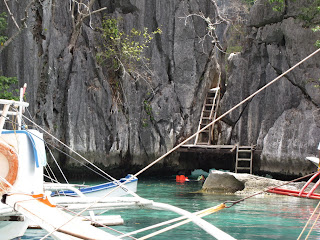

After snorkeling for a while, it was off to the twin lagoons.  There are two lagoons side by side, but separated by a small rock ridge.  We went into one lagoon with the boat, to the entrance for the other lagoon, where we swam and experienced the thermoclines.  People could either swim through, or climb over on the ladder.  On the other side, while swimming you could see the different layers of water.  The different layers of water make it really blurry to see.  Initially I thought it was my mask, but then I saw a relatively undisturbed patch and clearly saw the layers.  It was quite fascinating.  Equally fascinating was the changing water temperature.  The lagoon has seawater on the bottom, the is cool.  On top, coming from the island (that I think is geothermal, possibly even a volcano), is warm water, that gets hot at times.  That is fresh water.  The different types of water and temperatures makes for a strange swimming experience, as the layers stir together, and you go from hot/warm water to cold and back again.

After that it was off to one of two lakes that exist on the island.  It is hard to even tell they are there when you arrive at them.  This was the entrance to Barracuda Lake.  One account of the lake, that was related to me by my boatmate, is that the top layer of the lake is fresh water.  As you descend, you encounter a layer of hot, almost scalding water that is swirling.  Underneath that is seawater that has some entrance way down under the surface.  I don't know about any of that.  I only know that we had the lake to ourselves for the hour we were there, and it was quite beautiful.

Next it was off to lunch.  We were shown one area by the boatmen, but there were lots of people.  We must have wrinkled our noses, for they didn't even bat an eye before heading to another, deserted beach, where the younger guy told us, "This is good, noone there."  We heartily agreed.  And I think it was an even more picturesque spot.  And did we eat heartily.  Grilled fish, boiled crab, rice, rice, and rice, and mango and banana for desert.  It was wonderful.  We spent an hour or more there as well.  My tourmate and I discussed travel experiences.  He told me the best times to visit his home country of India.  I told him about some places he will visit in the near future.  It was really pleasant.
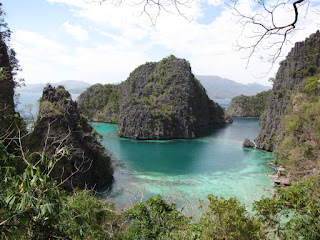
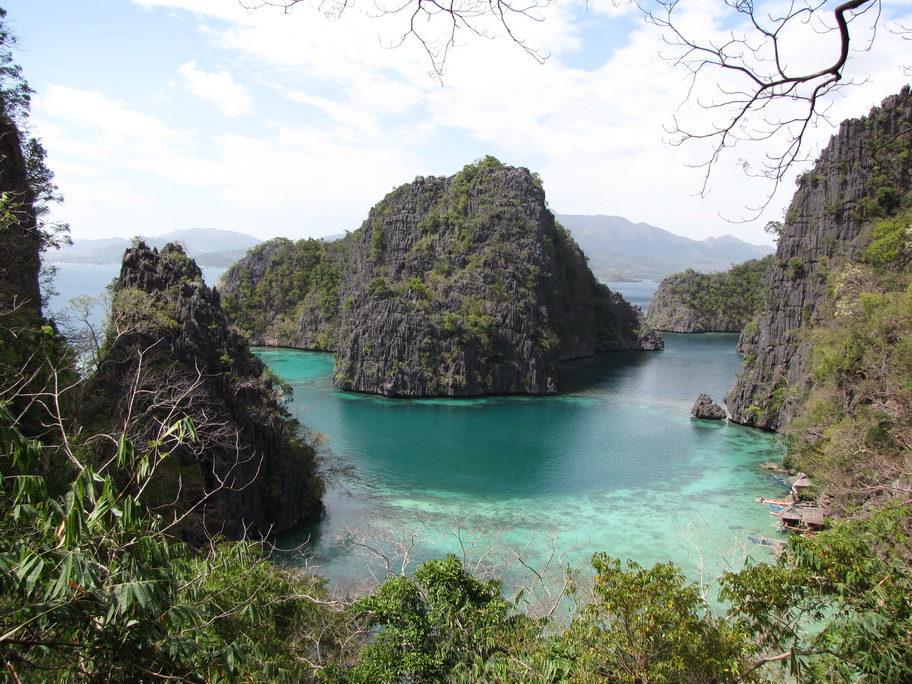
Next we went to another inland lake, Kayangan Lake.  The lake itself was much like Barracuda Lake, but it wasn't deserted.  There were lots of giggling, chattering visitors shattering the tranquillity.  We didn't stay for long.  And we climbed up to the ridge where we were afforded the sight of the day, the bay entrance to the Lake.  I would have considered the day successful if this is the only thing I had been able to see.  It is an amazing sight.  And lest you think that I simply went to some website and took this photo to put here, I am including a rare shot of me in a photo with something picturesque.  (I generally think my ugly mug ruins the ambience, but there are times when you just have to have a shot yourself at a place.  This is one of them)

Yet this still wasn't the end of the day.  We had a visit to a final snorkeling spot, which was badly damaged in some dynamiting insanity to get fish (or so I imagine), but is recovering.  And then we visited a small beach before heading back to the town of Coron.  I think the little beach is probably quite nice, but by the time we got there, the day was getting old and the wind was up.  We spent only a few moments before getting on back to town.  But it was long enough to get a snap of our boatmen, who waited patiently for us all day, and chaperoned up about.  It was a lovely day.