Showing posts with label New Zealand. Show all posts

Saturday, June 25, 2011

Heads Will Roll

Christchurch put up a sports complex at some point in the past. Then they added to it and upgraded it and made it an apparently first-class facility for sports and sports teams in the city. Then the earthquake damaged it. And then it was apparently discovered that although the upgrades to the facilities increased the value of the sports complex from 60 or so million dollars to somewhere over 200 million. Unfortunately it seems nobody changed the insurance policy covering the facilities.

Oops!

Being a Disaster Tourist

Of course, despite all my protestations to the contrary, one of the real reasons I wanted to visit Christchurch was to see what happened to the downtown area because of the earthquake. So on my second day in town, I took a bus and headed to the city center to have a look-see. The center of Christchurch is a large of historical buildings. Brick, sandstone, and other older building materials are what many buildings in the downtown are made of. And many were not apparently set on quake-resistant foundations. Many didn't have any other quake-inspired adjustments to help them weather an earthquake. And so, the two large earthquakes (and numerous smaller, yet still at times quite powerful, aftershocks) that have struck the city did a great deal of damage. Where a walk through the outer areas of Christchurch shows building here and there that are damaged, or empty lots where a building had to be taken down, the downtown core is blocked off. For a several block radius, entry to the downtown area is restricted to personnel who are evaluating buildings, engaged in their rehabilitation, or engaged in preparations to take them down. The entire area is designated a red zone, where anyone not permitted to be there will be arrested on entrance.

Of course, right outside the red zone, life and critical activities are allowed to continue. I wonder if this building was ever placed in the red zone and, if it was, how much time was wasted in getting it cleared as safe. (I know gamblers, you see, and I doubt they even wanted to leave the machine or table they were sitting at when the quakes stuck. I have doubts they even took notice of it at all.)


There is a lot of work going on in the city center. Much of it, unfortunately, is demolition.


And of that, much of the demolition is on older, often historical buildings. These are buildings that were built without thought to protecting them from earthquakes. And although an earthquake could probably get the best defended building, given just the right kind of shake, many of the buildings in the center of Christchurch were not built with earthquakes in mind.


And they have fallen.


Or almost fallen.
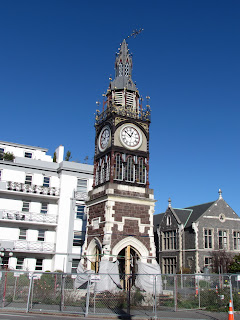

Of course, others look like they were barely affected.


On the other hand, if it was shaken around enough to do this, then they ought to make damn sure it wasn't.


Because looks...


...can certainly be deceiving. While I was having a look at this building, I heard a woman talking to some others about this being her workplace. It's a teacher's college. They were able to salvage a bunch of things from the building, but were only given a few minutes leave to do so by officials. They saved some of the children's books in their collection and other such materials, but most of the general office things were left behind. This day was the day the building was to be taken down. I suppose she was there to watch it happen.


Churches seemed to be most affected.


But they took pains to make sure they were still in business.


Even those who serve to protect us from disastrous events were affected. The brick building beside these fire trucks was damaged enough to be unsafe. The office furniture was removed from it and placed in the truck bays of the garage, and the fire trucks were moved outside. But the road is blocked and soon the fire house has to find another place to put the trucks so that they are still close enough to be able to respond to emergencies, but still not be in the way of the earthquake recovery.


This church used to be the iconic image of Christchurch. Obviously it was severely damaged in the quake.


But despite the huge cost that will undoubtedly be involved, they are taking it down brick by brick, marking where each piece belongs, and then they will put it back up, with earthquake protections no doubt.


There are signs that suggest that this event took place in the middle of daily life. And that people just ran for their lives. Things have been left exactly where they must have been on the day, and have been untouched since.


There are touches of irony around as well. I think this place now has bigger things to worry about restoring.


And I wonder if anyone will see the irony of this one.


There is also anger and the expressed desire to have things put back where they belong. That, of course, would be wonderful, but it's also unrealistic. It would be lovely if most or all of these buildings could be put back together again and everything return to the way it was. But the reality is that restoring all those buildings will be prohibitively expensive, and then no insurance company is ever going to insure them unless they have been fortified against any future earthquakes, which will be more expensive still. The reality is that most of these buildings in the center of Christchurch, the ones that have been severely damaged and have been taken down, will ever be rebuilt. They will be replaced with new, safer buildings that, unfortunately, will have less character and history.


But it isn't all going to be taken down. Many buildings will survive. But all have to be checked. I'm not sure how it must be to face the kind of daunting task it must be to have to check each and every building in order to discern if it is safe, if it can be repaired if it isn't, and if it must be taken down if it can't be repaired.


So, I spent an eye-opening day taking a walk around the downtown of Christchurch. I suppose I should be feeling a bit sheepish about being a disaster tourist, peering into a city's little drama and tragedy. But then I wasn't the only one, so I felt much better.

Christchurch

My visit to New Zealand is mostly about visiting with old friends. First Mat and Sarah, with whom I lived my first year in Korea. But I also have another friend I met in a hiking club in Korea. She returned to New Zealand a year and a half ago, and I thought to also visit with her if possible. But then, the earthquakes in Christchurch happened and I wasn't sure if she would be in a position to have visitors or not. Luckily she was and that was partially behind my wanting to go to Christchurch. At least that's going to be my story and I will stick to it to anyone who asks. Morwenna met me at the spot where I got off the bus in Christchurch. Well almost. She looked up the bus company on the internet and they informed people that the bus lets passengers off at such and such a place. In reality, the bus drops people off around the corner and down the street a ways. I got off and looked around. No Morwenna. Hmmm... Well, I'm a big boy, so I figured that I would go and find an internet cafe, see if there was a message from her, then find someplace to stay for the night and figure out how to contact her and get connected. I wasn't sure where to find those things, so I wandered down the street and around the corner to look about. And there was this familiar woman kind of hanging out. I approached, but of course I was this shadowy male figure approaching a lone woman on a dark street with low traffic. She kind of shied away and I had difficulty in actually making sure it was Morwenna before I said anything. (I didn't want to walk up and say, “Hi Morwenna!” only to have that awkward and embarrassing moment of wondering what to do next when it turns out that it isn't who you thought.) On further reflection, as I realized what her thoughts must have been having this shadowy figure approach her on the lonely-ish road, I guess I should have announced myself first and risked that bit of embarrassment. Oh well, we did recognize each other and Morwenna took me to her home, which she shares with her boyfriend and a couple other roommates.

Christchurch has been hit by 2 rather large earthquakes in the past year and has suffered a fair amount of damage. Many older heritage-type buildings suffered major structural damage, with some even collapsing outright. When we read about these sorts of events, we find out about that sort of damage and, in the case of a place like Christchurch, we are saddened by the loss of life and of the loss of historical buildings. But I think we don't really consider everything that happens in an event like an earthquake. For instance, many residential buildings also suffered damage. Homes mostly suffered reasonably minor damage, with chimneys falling, or plumbing being disrupted. But these things can really have an effect on how people conduct their lives. In Morwenna's house, the house was shaken around to the point that the insurance company isn't sure if they will have it repaired or taken down and replaced. Their plumbing was disrupted so that the toilets don't empty properly into the sewage system. So, while they can take showers, they had to have an outhouse brought in for everything else. In the city, electricity was out to most spots for at least a while. That left people with decisions about food in fridges and freezers, how to cook food using electric stoves and such, how to clean clothes. Gas ranges would have had their own trials with the dangers involved in shifting gas lines and resulting possibilities for explosions. And everything had to wait for inspections to let residents know that it was safe, sometimes even to enter their homes again.

Happily, Morwenna's home was only minimally disrupted, with the necessity of using an outhouse being the only major change, plus whatever happens with the building later, to be decided by the insurance company.

After an evening of catching on old times and then a good night's sleep, the next day Morwenna took me to a weekend market where something like a combination of flea market and farmer's market. Later that afternoon, we went for a walk on the beach. Despite health warnings about the water in the bay, and the chill of the air, there were lots of people out on the beach with their dogs and children. It was a nice day to spend just kind of hanging out.


Off to Christchurch

Another friend I made while I lived in Korea now lives in Christchurch on the South Island of New Zealand. I made arrangements to go and visit her as well. I got up bright and early and headed down to the ferry terminal for the crossing from Wellington to the South Island. Once again, I was up early enough to be seeing the sunrise.


Then it was goodbye to the North Island for a couple of days as the ferry headed out of Wellington and across the Cook Strait to the South Island.


The South Island has spectacular scenery. Along the ferry route it's all coves and points and inlets and green. And the day was a really good one for the crossing. Despite the weather of the previous days, it was sunny and the seas were fairly calm.


I wasn't able to get clear photos of them, but I saw a few penguins swimming alongside the ferry. There were also lots of jellyfish. This is the second time I have done this ferry trip, the first being about 6 and a half years ago. It was amazing then and it was amazing this time. Arriving in Picton, the ferry sidled up past an area where timber is gathered for transport to wherever it goes next. I imagine that environmentalists and forest enthusiasts would not be pleased, which may be why it seemed a bit hidden in the next inlet over.


Picton is arranged up into the beginning hills leading from the small harbour area. It's a little town, but it has a bit of character. Unfortunately there is not much to do there while waiting for a bus out after arriving on the ferry.


I waited for my bus in the spot where it was supposed to show up. In time, it did so, but the driver had no record of me. Uh oh. He said he would call the office to find out if I was expected. I had only booked the trip with the ferry and the bus the night before, so is was possible that it all hadn't caught up to his list yet. And that is indeed what had happened. The dispatcher let him know that, yes, I was okay. And so it was off on the six hour bus ride down to Christchurch. Along the way we stopped at Kaikoura. I had been to Kaikoura on my last trip to New Zealand, years ago. I remembered it being a really nice place, very picturesque. It stayed so and I wished I had remembered that and had planned a day or so in the area. It's also where my mother got to go whale watching and got an awesome photo of a whale tail shedding water. I want one of those.

Thursday, June 2, 2011

Te Papa

Te Papa is the national museum of New Zealand. Canada should take note. Te Papa is a free museum. They seem to want people to be proud of New Zealand and to easily see the history and culture of the country. Hmmm... What an interesting concept.

Anyhow, there is an interesting feature of the museum these days. It wasn't there last time I visited. The things that Google Earth has made happen. I assume the photo/map comes from a satellite of some sort. The put the whole of New Zealand, as seen by satellite, onto the floor of one hall. It is lit up rather well. Then people can walk on the image. At various spots, a person's weight seems to trigger a switch, and lights go zig-zagging out to the wall where there are television screens that show old photos of the area that has been triggered. It's pretty cool. There was none of this sort of thing when I was a kid. Ah, technology...

A Final Look at Mount Taranaki

The morning of our return to Wellington, I once again got up early and was treated to a nice dawn showing by the mountain.

Checking out Opunake

For the third day in Opunake, we took a bit of tour of the town. Early in the morning, I headed down to the beach again to soak my feet. I have been rather clumsy of late with my feet. I keep banging into things and scraping them. Then in Fiji I did the snorkelling with the fins, but no booties, and I rubbed my toes raw. Coupled with breaking my shoe the a couple of days later and wandering around in the mud, I had developed a bit of infection in a couple of my toes. So I was soaking them for a few minutes a couple of times a day at the beach in Opunake in order to try and clear the infection. It was also just nice to spend a few minutes in the surf on the beach each day.

After breakfast, we headed out to the point what felt like northwest-ish of town. The view along the shore and cliffs was amazing.


Also visible from that point was one of the off-shore drilling rigs for a local oil company. It was either 14 or 40 kilometers off the coast, depending on who is telling you. I am voting 14, since I think 40 puts it beyond the curve of the earth, but I don't remember the math. In any case, with my pretty impressive camera lens, I was able to take a photo of it.


After looking at the coastal cliffs for a while, Mat went down for a look to see if he could find some paua, or abalone. Due to attempts to help the population of abalone recover, there are restrictions of 10 per person per day for anyone catching them. Of course, that's only if you can find them, and Mat had no luck this day.


Next we headed to the cemetery, through which the Opunake portion of the New Zealand Coastal Walkway goes. We were heading out in an effort to see an old Maori fortress hill. We found this tombstone in the cemetery with an interesting name.


And then it was all for naught. The trail led past a bunch of cows, a number of electrified fences (and yes, I can absolutely say for sure that they were indeed electrified, having tested the matter for myself; not a recommended course of action), down a hill to a river with an iron bridge. That was broken. And with their baby along, we just didn't feel much like fording the river and getting wet. So, I contented myself with a photo of the hill fortress from our side of the river.


Later, Mat and I took a walk around the local lake. While we were walking, we noticed a hole that someone had dug. There were sticks and stones sticking out of the hole. We found out later (the next day) that someone had dug the hole, put sharp rocks and sticks at the bottom, covered it over and left it to be found by a passerby, the hard way. And a woman in her fifties did just that, luckily only twisting her leg as she fell in the hole (luckily because with the sharp sticks, she might have been impaled and far more seriously injured). We continued on. The farmland around Opunake is very green. Then we arrived at the cliffs on the coast again. Mat took me down to the base of the cliffs which, in times past before people really thought better, were used as the dump. People would pile their garbage into trailers, take the trailers to the cliff edge, and dump the garbage over into the sea. Now, we find that horrifying, but that is how it was done before.

But now the result is that at the base of the cliffs, there are piles of old garbage. One kind of garbage in particular is masses of iron and other metal. It has been there so long that it is now just one big mass of metal, fused or melted together. It is an interesting sight.


And Mount Taranaki put in an appearance as well, poking its head through the clouds.