After first arriving in the Mekong delta city of Chau Doc and then travelling to Ho Chi Minh City through the delta, I decided that I wanted to experience more of what life is like there. So one of the tours I booked out of Ho Chi Minh City was a two-day tour into the Mekong delta.
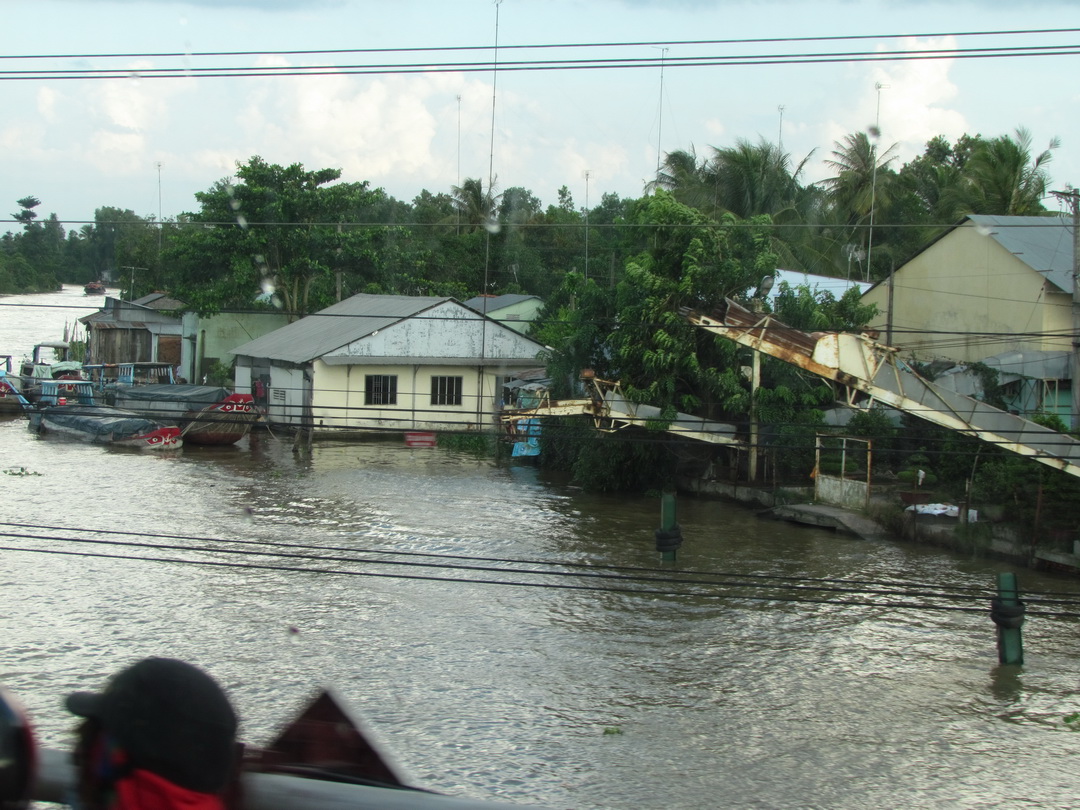
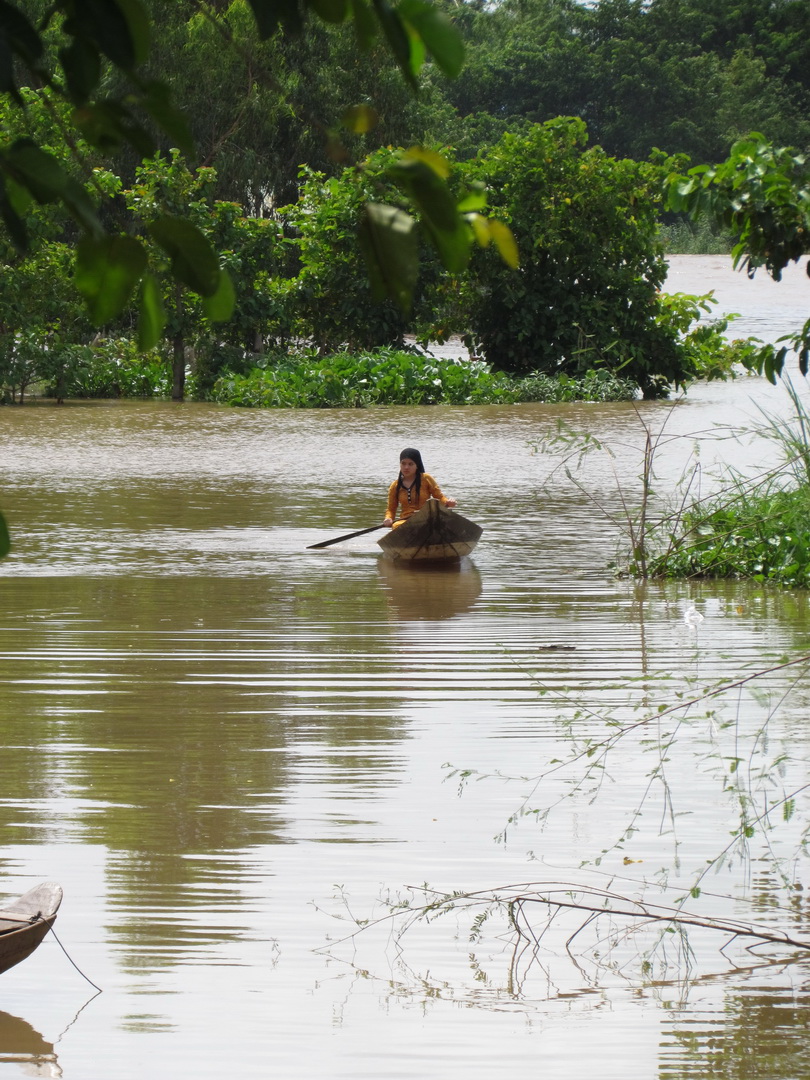
As I travelled to Ho Chi Minh City from Chau Doc, one thing I noticed was that water was everywhere. Absolutely everywhere. Every few minutes we were passing over another river or canal of varying size. The road travelled past flooded rice paddies. People were on boats. Their houses were on stilts. There were dikes everywhere to hold back the waters during times of flood. Clearly, life in the delta seemed to be dominated by the moods of the waters of the Mekong. I hoped the two days I would be spending there would give me a better understanding of how it all worked.
 But first, I noticed a building that was across from the office of the tour operator. There are loads of buildings like this one all over Vietnam. They are thin and very narrow, not really much wider than the width of a room. Yet they are deep as well. They might be only be three or four meters wide, but they might 20 or 30 deep. Before the strangeness of the buildings ever registered on my mind, someone told me the reason why buildings are like this. It seems that at one time, the Vietnamese king decided to base taxation on the frontage of a property as opposed to the area of the property. And so, people built narrow houses.
Then it was off to the delta. Our first stop was rather inconsequential. At least it was to me. There was a really interesting temple where we stopped for about 45 minutes. The outer architecture was Khmer, while the inner architecture was distinctly Buddhist. I think. After seeing temples and temples and more temples lately, I just didn't really care. But the stop was a good one as a bathroom stop.
 Then it was time to take to the water. We climbed aboard a boat and set out on the Mekong River.
 It was the rainy season and the water was quite high. And brown. Stuff floated by, some of it was trash, but a lot of it was vegetation of various sorts. Our guide told us that the Mekong is always brown. On the trip from Cambodia, Mai told me it was green in the dry season. I'm not sure who is correct. I suppose that in the delta area, it could always be brown, but farther up, in Cambodia, it could also be greed in the dry season. The time I spent around the Mekong, though, it was definitely brown.
There was a lot of activity on the river. There were many boats travelling up or down, or across the river. Along the shores there were houses, businesses, shacks, and all manner of construction that could be imagined.


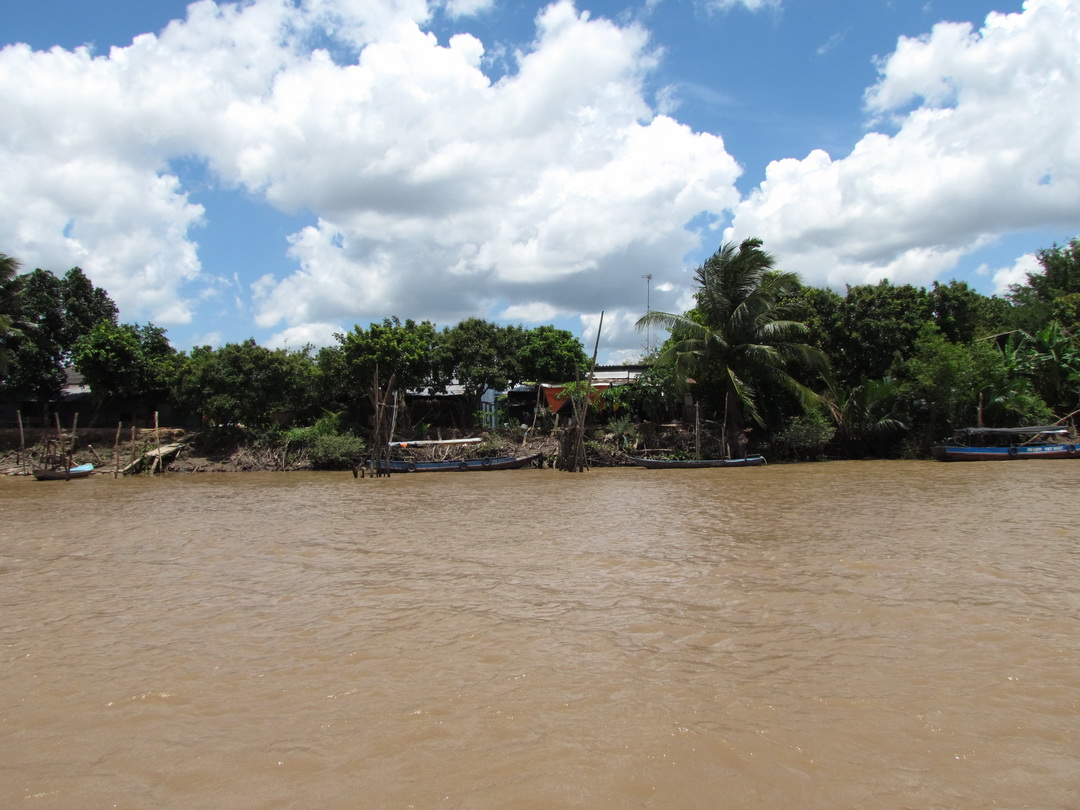

 People live because of the river. Some ply the shores with little nets, trying to catch fish.
 Others use bigger nets and their boats.
 And groups use great nets to do the catching of the fish.
 Yet others take a chance to rest, on their boats, waiting for the next time of activity.
 We had crossed the river to an island. It was big island for the middle of a river. But then it's a big river.
We went to the island to visit a coconut candy factory. It was a small, family-run deal, but a factory nonetheless. And we were naturally given the opportunity to buy some confections, after being tempted with a free taste. I did buy some chocolate coconut candy.
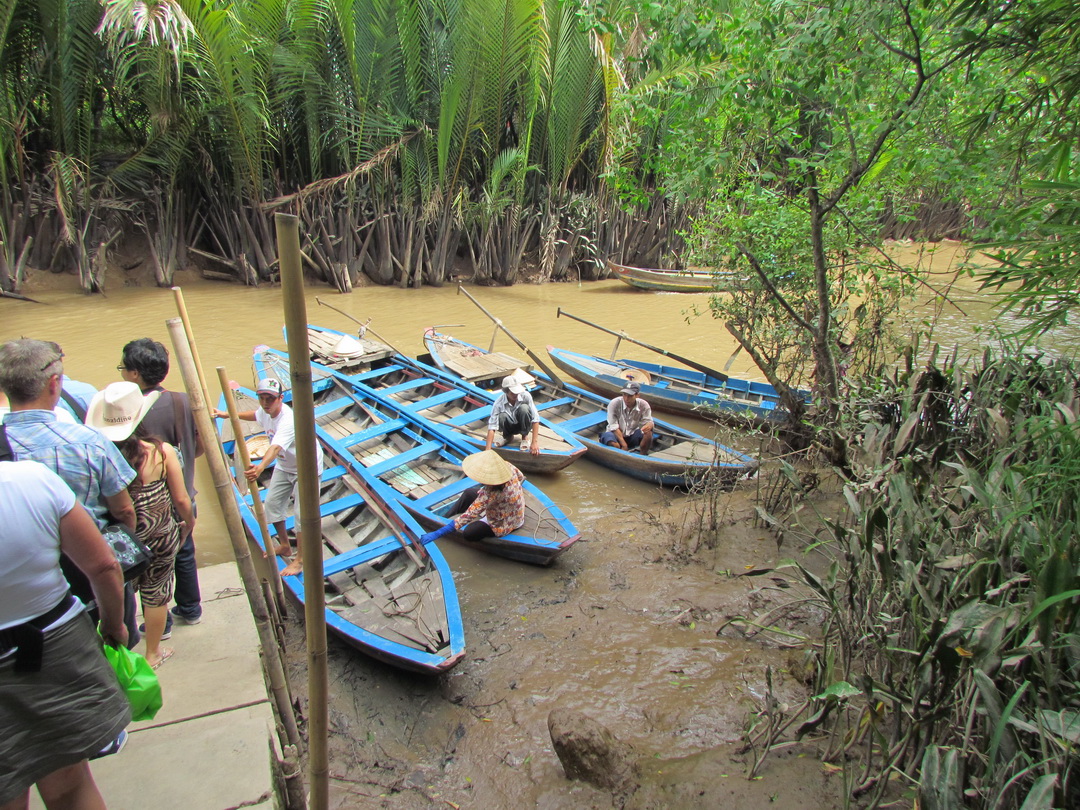 Then it was into small four person boats for a short trip through the bamboo and mangroves along a small river, for a taste of the true river experience. I'm not sure how true the experience was, artificially set up with us in a long row of boats travelling along a short stretch of uninhabited river area, rowed by some Vietnamese who were likely specially trained to be “typical” Vietnamese, you know the ones that aren't out making their living fishing and trading and such. But it was a nice little trip anyway.


Then it was a walk to a fruit farm for some fruit (part of the tour fee, but any extra fruit would be paid for), and a spot of traditional music.


Then we headed to Can Tho to get our hotel and dinner. It was a holiday weekend in Vietnam, the celebration of independence from France. There was a fairly large market on the street that night.

 The next morning, bright and early, very bright and early, we got up and headed to the wharf to go and see the floating market of Can Tho, the biggest city in the Mekong delta. The market also happens to be the biggest in the delta. This market is supported by the government and is a tourist attraction. Nevertheless, it is a true working market and business is conducted there in earnest. However, the guide told us that the market is subsidized by the government. There is a tax that is paid by everyone who brings something to the market, but it seems to be a token fee, at least to our Western sense of costs. It could well be that the 15000 Vietnamese Dong that is charged to each vendor (coming to about 75 cents) per day of participation is actually quite high to the Vietnamese. However, given the government's apparent participation in the cost of operation, it could be quite a bit higher. The reason the government helps to underwrite the market is that tourists come to see it. No market, no tourists, or so the guide spelled it out. That could be the truth. In any case, in this market people come to make big purchases and trades. It is where wholesale deals are done. People come into the market from their farms and such and sell a lot to the big wholesalers. They sell to other smaller dealers, who then take the produce out to smaller markets in the region and sell the goods there. And so it goes up and down the market food chain. There are smaller deals done in this market as well, and it all happens from boat to boat, big and small, on the river some distance from the city center of Can Tho. And it is quite a fascinating thing to watch.
 There were boats all over the center of the river. It looked a bit like chaos, but there was logic to it all. Our first encounter with anyone though was with someone who recognized an opportunity when he saw it. Tourists mean money moving along the edges of the market. And some of those tourists are hungry (particularly given the hour of the morning), or thirsty. Bring bananas or other fruit and some choices of things to drink, and a persistent entrepreneur can make a buck or two out there. So a guy with two of his sons came alongside. And the two kids were cute. The younger one at one point sold a drink and the person who bought it gave the money to the older one, but the young fellow grabbed it from him and stuffed it adroitly into his pocket. It was an amusing exchange.
Then it was time to turn our attention back to the market. The logic of it was explained to us. Almost anything was for sale in the market. We really only saw produce on sale though. In any case, whatever a boat had for sale had to be advertised somehow. A boat would accomplish that by use of a pole that rose high above the boat in the air. On the poles would be one example of each of what the boat had on hand for sale. Some boats only had one thing on their poles, for instance pineapples. Other boats were more supermarket-like. They would have numerous items on their poles. Then people in the market for something would just look about for what they needed and head to that boat.


 Having marvelled at the functioning of the floating market, we headed up a side river to a rice paper factory. We watched the full process of how rice noodles are made. In the first area we saw how they wash the rice and other ingredients. We saw how they mash the ingredients, one half rice and one half tapioca powder, together. We saw how they cook and stir the mash up and then drain it into buckets. We saw how they put the rice cakes into a cutter to make the noodles. He-e-e-y, wait a minute. Where did the noodles come from? Oh, the various areas were a bit out of order.
 We headed into the back room. There, we saw a couple of stoking ovens, fueled by rice husks that were stuffed into the fires beneath. Above, the two teams poured ladles of the rice meal/tapioca mixture onto the cooking pads to steam-cook them. Then one member of each team removed the rice papers from the cooking pads and placed them on drying racks.
 Once full, the drying racks were placed out in the sun for two hours to dry them to a consistency that would make good noodles.
 This was all a family operation and from the number of drying racks out in the sun, it seemed they make a looooooooooooooooooot of noodles.
 Back out at the river we headed to another fruit farm, where we paid for the fruit we ate this time. But before eating we wandered around the farm looking at things like the rather odd-looking dragonfruit tree.
 And how pineapples grow on the ground. Careful, don't pick one, or you'll be fined 100 000 Vietnamese Dong (about 5 dollars).
 And because we were told that if we hadn't done it yet, then we hadn't truly been to the Mekong delta, we took our turns climbing over the rather precarious monkey bridge at the farm. Then it was into the dining area for a serving of fruit, in my case a little bit too much pineapple. I had had too much pineapple in the past couple of days and this helping burnt my tongue to the point that I couldn't taste much for the rest of the day. Oops!!

And then it was time to head back to the hotel for lunch before the long drive back to Ho Chi Minh City. The insight into life in the delta was fascinating. I wonder if there is that much going on in the delta of the Mississippi.