Showing posts with label Malaysia. Show all posts

Tuesday, August 30, 2011

Langkawi and Beyond


The night before I sailed on the ferry to Langkawi, my computer developed a major problem. Windows stopped working. It wouldn't load, no matter what I did. As a result, I couldn't access my blog file in order to write any new entries, or look through photos in order to choose which ones I would include in the blog. I could look at photos through some HP software that was included on the computer. I could listen to music files. And I could access the internet. But all the other functions that I have grown used to having on the computer were inoperative. So I woke up annoyed. And I had no time to deal with problem at all. I had a ferry to catch.

I checked out and headed to the ferry terminal and caught the ferry to Langkawi. When I arrived, the Langkawi terminal was located a fair distance from the town and accommodation. It meant a taxi ride. Now, I normally don't like taxis anyway. I find taxi drivers to be generally dishonest and out to take the passenger for a very expensive ride. And if I can find a way not to have to take a taxi, I will generally do it. Added to this was the fact that I was already annoyed about my computer. This was very bad news for the prospective take-Ken-to-town taxi drivers. But there were no tuk tuks. There were no motorcycle guys. There were only cabs and my feet. It seemed there was no other option. Until I thought about it a bit more. I had come to Langkawi so that I could take another ferry over to Thailand. So I had the option of continuing on to Thailand right away instead of spending any time on Langkawi.

I probably should have given Langkawi a bit more of a chance. I gather there is a fairly nice national marine park there. But I was just not in the mood. So I bought my ticket to Thailand and headed out a couple of hours after arriving. The lone photo I took in Langkawi was of their unofficial mascot, the eagle. And tourists can apparently feed eagles on one of the tours available on the island.

Next I thought I would spend a day or two in Satun, on the Thailand side of the ferry ride. But when I arrived in Satun, one of the travel agency types in the terminal informed me that Satun really didn't have anything very interesting and that there was really no reason to stay. I should have ignored him. I suspect that it might have been a somewhat interesting place, but not for anything of touristic value. I think it might have simply been a good way to view ordinary Thais doing ordinary things without the insane focus on getting money from foreigners that exists in the places where tourists congregate. However, I took the guy at his word and let him book me on a bus up to Krabi. I visited Krabi a couple of years ago, and I quite liked it. But this time I wanted to stay on the beach instead of in Krabi town. There wasn't really any way to get to the beach that day though. I was going to be arriving in the middle of the night. I got a booking for a place in town and decided to figure it out the next morning. And off I went. So instead of being ensconced in a room on the island of Langkawi in Malaysia, as I expected and intended when I woke up that morning, I ended up a fair distance up the peninsula in Thailand, after a long day, booked into a rather shabby room in a guest house in a nice little tourist town. Oh well.

Sunday, August 28, 2011

A Walking Tour of the UNESCO World Heritage center of Georgetown


One of the big selling points for visiting Penang is the colonial architecture of Georgetown. Georgetown is where the British established one of their first settlements in the region. There are many buildings that have remained and were restored fairly recently. In fact, there are enough such buildings in the central area of Georgetown that UNESCO bestowed their increasingly meaningless favour upon the downtown area and it has become a World Heritage City. (UNESCO should just get it over with and declare the Earth as a World Heritage site of universal significance and of enormous cultural, social, historical, natural, futural, pastoral, biggial, smallial, masculine, feminine, primitive, advanced, and generally all-things-to-everyone importance to all members of the human race on the planet. Animals, too. And hey, why not plants and rocks and amoebas, and don't forget the slime molds and the seas and skies. Have I left anything out? There was a time when I thought it would be fun to visit as many World Heritage Sites as possible. Now there are too many to possibly visit.)

There are numerous brochures and pamphlets that show a bunch of the heritage buildings in the city and show them on a map, so they can be visited on a walking tour. The one I chose was fairly goofy. They were numbered in a way that like reading a page. So there were spots where the person doing the walking tour would reach the end of a “line” and then have to walk all the way back to the beginning of the next “line.” It wasn't organized very well. So I changed the order to better suit a normal sort of walking pattern.

I started at the old city hall building.


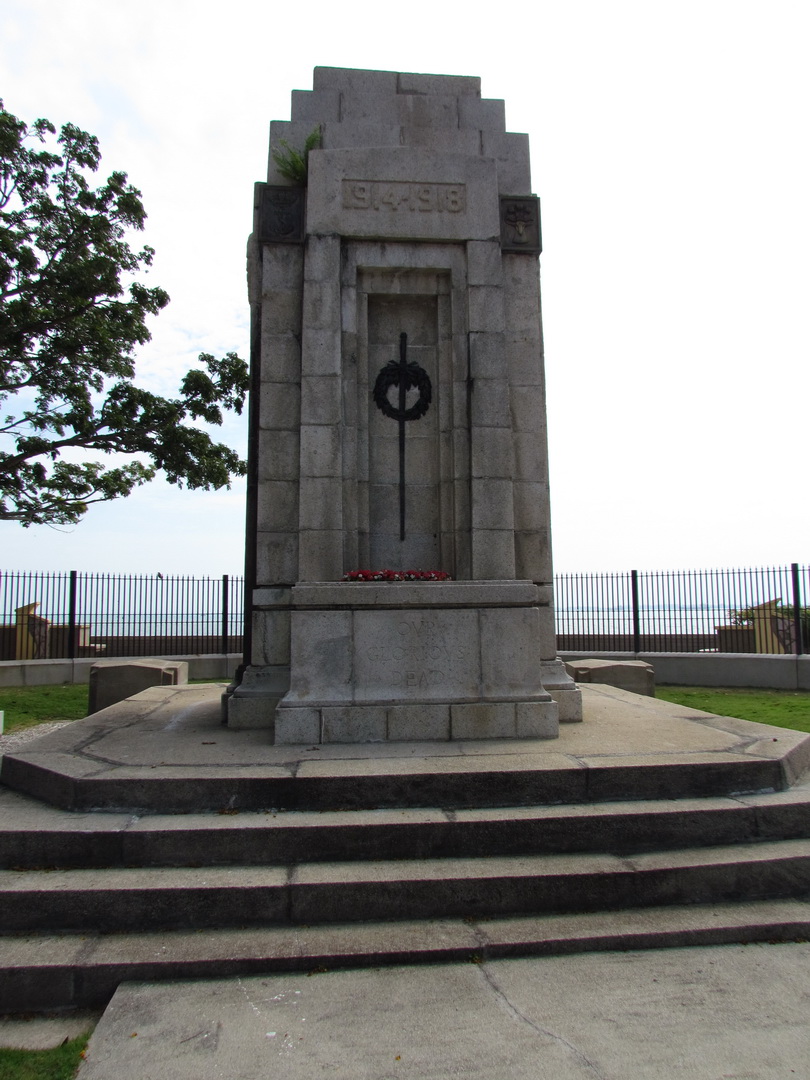
Right across the street from the city hall, was a war memorial.


The war memorial sits on a street that runs by the waterfront and is really quite attractive. And when I looked at the map later, I realized that this was actually the Esplanade, which was feature number 5 on the map. Oops!! I was out of order already.


Then I moved on to the town hall building. It was right next door to the city hall building.


Around the corner from the town hall was the Dewan Sri Pinang building.


Following this, I headed over to Fort Cornwallis. The fort was established by a sailor in the British Navy, Francis Light. And in a fit of humility, he named the fort after the British commander in India. The initial structure was made of wood. Later, Francis Light wanted to make it a more formidable fort and sought to procure funds to renovate it into a stone structure. The powers that be, however found the strategic value of the fort to be lacking and denied the funds that Light required. So Light used his own money to renovate the fort. It is a quite a nice structure to wander around in for a while and it has a nice set of reading panels showing the history, not only of the fort, but of the English presence in Malaysia.


Adjacent to the fort is the Queen Victoria Memorial Clock Tower. It looks nice lit up at night, but I had forgotten to bring my camera when I was out at night looking at it, so this more drab daytime view is what we have.


Across the street from Fort Cornwallis, are the state assembly buildings.


It was at this point that I realized how the walking tour was laid out and that I was now going to have to walk all way back to the “left-hand side of the page” and start reading again. I did this and got a good look at one of the nice colonial churches, the Cathedral of the Assumption.


Next to the cathedral stands the Penang State Museum. The walking tour map says that this museum “houses a plethora of Penang historic artefacts.” With a description like that I couldn't resist going in for a look. From the outside, it doesn't look like much, but inside... Wow!! There was indeed a huge collection of interesting things. The most interesting exhibit rooms dealt with the various ethnic communities and their rituals of marriage and death. It was really a very impressive museum.


And next to the museum was St. George's Church. I had actually looked at this church on my first night in Penang after the long day of travelling from Taman Negara National Park. It looked better at night.


The Goddess of Mercy Temple was around the corner and across from the Little India area. I have seen shrines to this goddess before. The best one I saw was on a hill in Macau. This goddess is the protector of mariners and so is an important figure in sea and ocean areas.


Across the street from the temple was the Mahamariamman Temple. This is a Hindu temple and is on the outskirts of Little India in Georgetown.


Around the corner from the Hindu temple was the Japanese Teochew temple. This temple didn't look like much from the street, but inside it had been renovated and was quite large. And it seemed a bit incongruous sandwiched in between a couple of other shabby buildings.


Around another corner from the Japanese temple and down the street a little bit was the Kapitan Keling Mosque. It's large and imposing and the architecture is pretty cool. And it was interesting to me that these four quite different religious beliefs were to be found only a few minutes walk from each other.


Next on the tour was the Cheah Kongsi. But the next three buildings after it led away from the waterfront and the final parts of the tour. So I went the other way and began with the Islamic Museum. The museum was said to house the heritage of the Muslim community in Penang. I would have liked to go in and see the museum, but it was Tuesday and, in a switch for usual museum days off, this museum was closed on Tuesdays. Oh well. It took a bit of searching to find it because the map made it seem as if it were in one spot, but it was actually on the other side of the block. Now given my natural genius for the misreading of maps, it would be natural for anyone to say at this point, well, it wasn't the map but the map reader. Oho!! I say. There were some other people that I saw, who had the same map as I had. They seemed to be searching for the same place and had ended up stuck at the same place as I was stuck. So, nyah!!! It wasn't me.


Next up was Khoo Kongsi. This was the clan residence and temple for a group of Chinese immigrants. It was tucked away inside a block that was presumably owned and maintained by the Chinese family/families that built it. I think it was being renovated. I didn't actually go in and see that one because they wanted around 10 dollars for an entry fee. The fort had been 2 dollars, and the museum had been 1 dollar. It seemed a bit out of proportion to me and, without knowing if it would be interesting or impressive, I wasn't willing to give in to that kind of extortion. So I left.

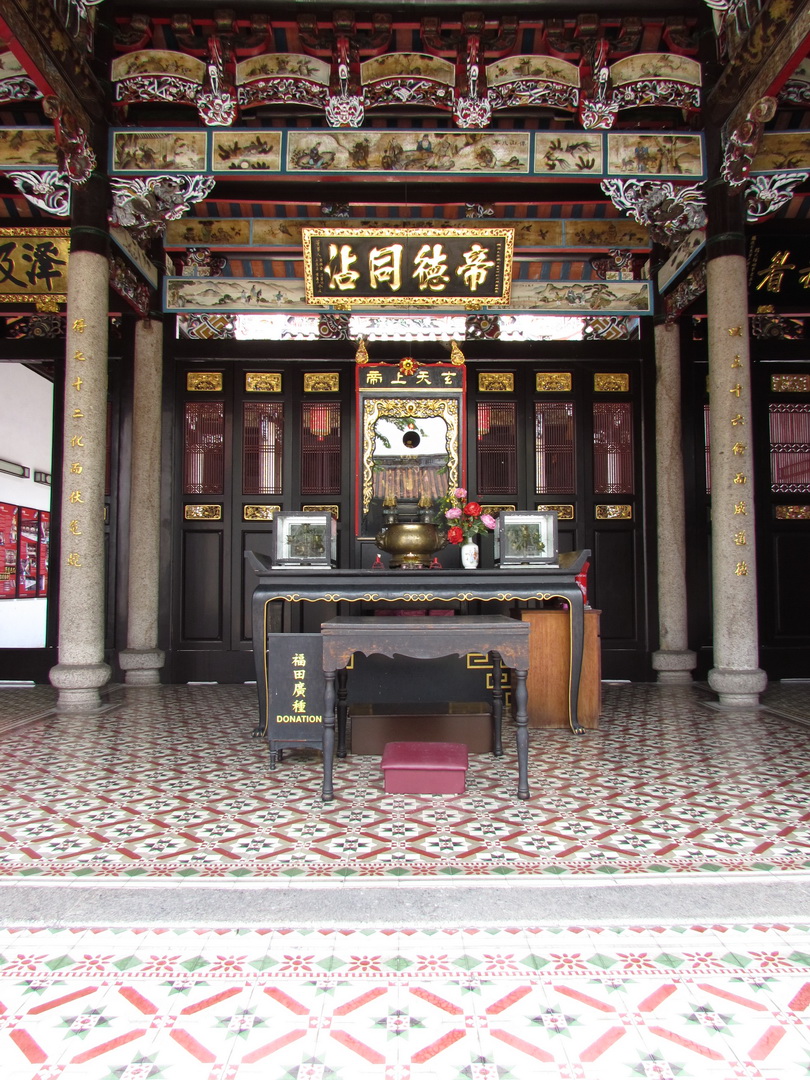
The next place was the Cheah Kongsi, another Chinese clan residence and temple. This one was free. So I felt vindicated in my choice not to pay to go see the previous one. Perhaps the Cheah Kongsi was less impressive, but I will never know. And I found it quite impressive enough.


By this time, the clouds had been building up and it looked like rain was on the way. The next building in the tour was way off in the middle of the area, quite a distance from anything. I decided to forgo it in favour of staying dry, and moved on to the waterfront. Once again, I did them out of order since I was arriving at the area of the final stop on the tour. This was the clan jetties area. A whole community built their residences out over the water on stilts. I wanted a good look so I started out onto this pier. As I passed the guard house, the guard came out and told me I couldn't go there. I asked him where I could get a good look and he directed me out onto the jetties themselves. And it was a good view. I'm not sure I would want to live like that, but it seems to be a nice little community.

Finally it was on to the ferry jetties and wharves. The ferry that goes between the island and the mainland seemed suitably old and historic,...


...but the jetties were all shiny and new seeming. There were posh restaurants and it seemed an upscale area that would be quite pricey.

In the end the tour was a way to pass time. I didn't know what else to do on Penang, having visited the national park on the previous day, and not having booked a ferry ticket to Langkawi until the next morning. It was an interesting walking tour, though.

Friday, August 26, 2011

Penang's National Park


Penang is an island off the western coast of Malaysia. Penang has a national park. It is out in the northwest corner of the island. In the morning, I asked at the desk of the hostel where I was staying and was told that I could take a bus from right out front and go all the way to the park. Simple enough, so off I went.

It took about an hour to get to the park. When I arrived, it seemed a bit of a sleepy place. There were no great crowds. There were only a few people about. Even the stalls that provide food and souvenirs and, possibly more telling, tours for visitors were mostly closed. A sign announced that visitors should go the office to get a park pass and register. I duly went and signed in and got my park pass. My free park pass. They wanted to know where I planned to go. I eventually decided that they wanted to know in case I didn't show up by the end of the day to sign back out. Then they could send out searchers to look for the body. I had read about a turtle sanctuary and information center in the park. I thought it would be interesting to learn about the conservation of turtles, so I thought I would head there. But when I got there, there was also a hike to a lighthouse, and that sounded interesting as well. I registered my intention to go to the lighthouse. And off I went. I first had to deal with a ferocious feline blocking my way. I thought I wouldn't have to deal with big vicious cats until I got into Africa, but I figured this would be good practice and I snuck by without mishap.

It was a very warm day and I had about a liter and a half of water with me. The hike to the lighthouse was about four and a half kilometers. It was through the jungle and there were lots of interesting things to see along the way. Just at the entrance to the park, I came across a couple who had hired a guide. They were busy staring into the nearby jungle in a way that suggested they were seeing wildlife. When I got up to them, they were watching a monkey in the mangroves. But the spot to view the monkey was on a swaying bridge and it was hard to get a clear photo as a result. I was bummed.


I needn't have worried though. A short while later, I crossed paths with this guy.


And then a little after that, I looked up in the trees and saw this one.


I reached Monkey Beach, a nice long white sandy beach. At the end of the beach the trail led up onto a hill that went up about 250 meters. By that time I had drunk about half of my water. I wasn't sure I wanted to hike up to see a lighthouse, with dwindling water on a hot, sunny day, and then trek across the park to the turtle sanctuary. In the end it seemed best to not go to the lighthouse and head to the turtle sanctuary. So I turned around and headed back towards the turn-off for the other side of the park.


And I think the reason for the name of the beach, Monkey Beach, is all the monkeys that are around. This one was just hanging out.


Then I passed a whole troop of them on the path. They gave me a wide berth as they went past.


I made it back to one of the turn-offs to go across the park. This path was supposed to go past a canopy walkway. But the canopy walkway was closed and apparently the path was as well. But the tape didn't seem to be across the pathway. So I followed it. This turned out to be a rather bad idea. I ended up bashing through the bushes on a rather hidden trail as I made my way up to where it finally met up with the first trail (from the park entrance). I was worried at one point that I might be on this path and get hurt. However, I had registered for the lighthouse trail and so they would never find my body. But I did make it through in the end and got to the other side of the park. But I took another wrong turn and took the long trail around a special lake. The lake is a meromictic lake, one where sea water and fresh water meet. The sea water stays at the bottom and the fresh water sits on top and the two don't mix. I had swum in a lagoon of this type in the Philippines, but apparently this phenomenon only occurs in a few places on the planet.

Then I headed onto the beach. The very hot beach. The burning hot beach. But there were pine cone-like things from the trees at the edge of the beach. The got between my feet and my sandals and were very painful to walk on. So I took off my sandals. But the sand felt like it was burning the flesh from my feet. I was caught either way. It was a rough walk across to the ranger station at the beach. I was hoping very hard that they had water as I had all but run out of water getting there and it would be a long, thirsty hike back to the park entrance if they didn't. Luckily, they gave me some water, from a tap, and told me that I could drink water from the streams in the park as they were safe. I wasn't completely sure that would be true, but I didn't have much choice. I was really thirsty.


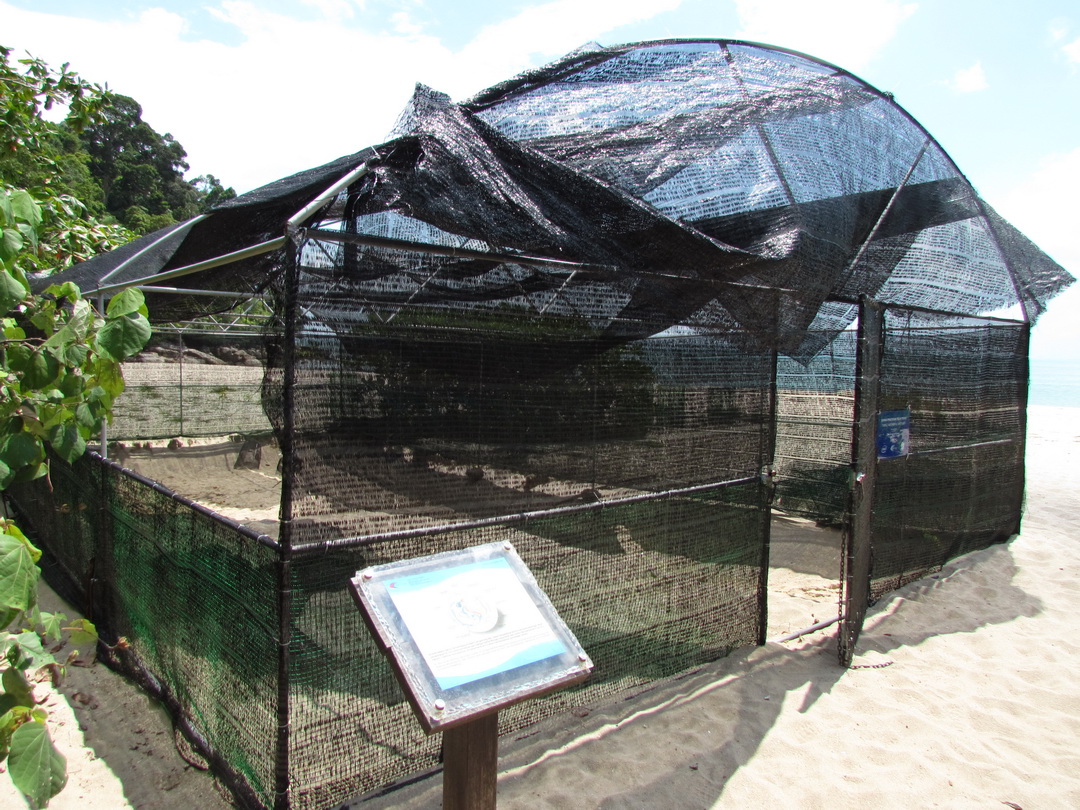
They also pointed the way to the turtle conservation sanctuary. Eagerly, I headed over to learn about how they save turtles at the beach... And found a building with a couple of bored looking caretakerish looking people who did nothing to try explain anything about the operation. They barely even acknowledged the arrival of visitors. Inside the building there were a number of reading panels showing how the turtles come to the beach, lay their eggs in holes, which are immediately dug up by the conservation staff, put into protected holes safe from predators and other threats and left to hatch. The baby turtles are allowed to grow a bit, and are then released into the beach to make their way into the sea and hopefully live a good life as they replenish the population of turtles in the area. It was a long way to come to read panels and I was somewhat disappointed that I had not gone to see the lighthouse. I did see where they kept the turtle eggs in their protected holes, though.

But still, if you go there, go for the lighthouse.

How Prejudices Begin


I was told to be at the bus stop to catch my minibus to Penang at 8:30 in the morning. I hate to be late, so I was there at about 8:10. I saw some other people about getting people sorted out for other buses. They asked me about my plans and they told me that my bus was just over yonder and I should just wait there. So I did. And I waited. I saw my bus go off around the corner. I figured it was off to pick someone up and would be back shortly. I waited. And I waited. 8:30. No minibus. 8:40. No minibus. 9:00. No minibus. I finally started to think that maybe it didn't have any other passengers and I was going to be stuck somehow. 9:15. No minibus. I was just about to head to the tourist information office to find out what was going on, when at 9:20, the minibus turned up. Ah! I had also just realized that I had left my cap at the hotel, so I figured that since everyone had kept me waiting and worrying, I would go and try to retrieve my hat. It took me about three minutes, but it felt good to delay everyone for even that couple of minutes. Revenge is fun.

I asked the driver what had happened, why he was so late. He said there had been a problem at the hotel. He didn't elaborate, so I was left to try to figure out what sort of problem it could have been. That sort of thing usually means that someone has slept late and has held the whole process up. There were six people in the minibus, so I looked them over suspiciously, wondering which one had been the sleepyhead. They all seemed to be together. And then when I went to get into the van, they were all sitting in the three rows of three seats with one seat between them and some of their stuff on the empty seats. They said they thought I would have to get in the front seat next to the driver. I readily agreed, since that is about the best seat in a minibus, but I could this situation ending up being a rude awakening for them as to how things work in the transportation business in Asia. We headed off for the last pickup at a really nice looking place just out of town. However, because the minibus was so late, the people there got tired of waiting (I think) and they made other arrangements with another company. I think the people in the back kind of thought they were in the clear at that moment, but I knew better. The driver made a call and sure enough there was someone who could replace the lost fares in the minibus. We headed back into town to pick them up. There were three. And with all of us (the six original people turned out to be all from the same family and they were travelling together with a fair amount of stuff between them. The three new additions also had fair-sized backpacks and there was just lots of stuff that had to be fit into the minibus. Too much, really. So we spent about 15 minutes trying to get everything, and everyone into the bus. In the end there were bags under feet, and on seats and on people, as well. It was quite cramped. To their credit, the family didn't make too many complaints about the situation, but they did seem to be awfully surprised about how uncomfortable this was going to turn out to be. And once the roster had been passed around to list names and nationalities and such (I presume so the bus company would know where to try to send any bodies should anything untoward happen), I discovered that the family was Dutch. Now anyone can be new at the Asian transportation game. There is no particular reason why they ought to know how it works, particularly since it seemed they had been staying at some higher-class hotel.

And at a rest stop part way along, I found out that it hadn't been anyone sleeping in. There had been a storm the night before, and it's possible that it disrupted telephone lines to and from the town. When they had been trying to pay for their room, the credit card machine wasn't able to get through to process the payment. The hotel staff also couldn't call the credit card company directly to try to process the payment that way because the phones were down. They had had to haggle out a solution to the situation and it had all taken close to an hour to sort out.

I don't know if I was supposed to change to another minivan after about an hour or what the deal was supposed to be. A comment from the driver suggested that I was only supposed to be in the van for an hour or so before changing to another vehicle. But whatever the case, it ended up that I travelled all the way back to the Cameron Highlands before changing to another minibus to go the rest of the way to Penang. I had suspected that I would end up back there, but it hadn't been my preferred route. I didn't end up staying in the town in the highlands, though, so it was no big deal. But it ended up with another Dutch family joining the minibuses passengers. This time it was a family of four. The two children (well, young men really) were deaf. And for some reason it seemed that neither one wanted to sit on the seat beside me. They seemed to have a little fight about it. And after being told to be in the back by the driver, one of the boys just went and got in up in the front. Then the driver came back and looked in and seemed a bit puzzled by where everyone was. He discovered the boy in the front seat and told the parents that he had wanted to put some of the luggage in the front seat and the boy would have to come back to the back. And the sour look on his face as they realized that one of them was going to have to sit beside me was enough to give a guy a complex. I have been discriminated against before, but it seemed an odd reversal that deaf people should be showing some kind of a prejudice against me. They even moved my stuff before asking, when we stopped at a rest stop part of the way to Penang. I was a good deal miffed at that, but I let it pass because I did end up with a more comfortable seat in the swap. But they could have asked first.

And again, here was a Dutch family showing a rather pronounced lack knowledge of how things work in the transportation industry in Asia. I know that it doesn't mean that all the Dutch are like that. But it did leave me wondering what goes on in the Netherlands that the Dutch would go out travelling in Southeast Asia assuming they were going to be getting their way because that's how it would work at home. The mother even had at the driver for seeming tired and that she was worried. She was telling him how to drive. It was strange.

In the end, all was well, and I got to Penang, only a little late because of the late start. But the second trip was altogether less comfortable because of the people in the minibus being quite excitable and, well, annoying.

Among the Creepy Crawlies of the Night in Taman Negara National Park


I really should have thought this one through a little more. I might have realized how it would go. The chance to see spiders and other creepy things in the nighttime rainforest would be too much for most people to resist. And so they wouldn't. And they didn't. I figure there were at least 8 groups of 15 to 20 people tromping through the jungle just opposite the town. There is a posh resort, the Mutiara Taman Negara, on the national park side of the river and we were stomping through the jungle just behind the resort.

We did get to see a number of bugs and such. There was a stick insect. You can see it in the center of the photo towards the bottom.


There was a termite mound on this tree. (It's towards the top of the photo.)


And there was a pretty big looking black widow spider as well. I haven't ever seen one that looks like that. Maybe they have a different one here in Malaysia.


There is also an animal blind in the area. Our guides took us to the blind and shone their big-ass flashlights into the distance and the light was reflected back from the eyes of some deer out in the forest foraging. We were lucky. Not as lucky as the guide of my group though. He had previously seen some elephants out there. And one time he even saw one of the park's rare tigers.

Unfortunately, our guide explained that it wasn't a very good night for seeing bugs. There seemed to be a storm coming. Before a storm, bugs and such are scarce and are difficult to find. It's after a storm that there is lots to be seen in the area. We still saw a bunch of interesting things. And I enjoyed the sounds of the night in the rainforest, with the comfort of having a guide to make sure I didn't end up meeting some ugly end in the night. But with all the other people stomping around in the dark, it did sort of feel very staged and as though we were farm animals being led around through the night. At least we weren't being led to slaughter.

Taman Negara National Park


It's interesting that 'taman' means 'park' and 'negara' means 'national.' So in essence, this is a redundant name. This is in exactly the same way that 'timor' means 'east' in the Indonesian language, so that East Timor is a somewhat unnecessary name. (Except for that pesky West Timor.)

In any case, I was up and raring to go for my time in the world's oldest rainforest. I had signed on for a full-day package that would see me heading up into the rainforest canopy, trekking through the jungle up to a nice view of the surrounding jungle, shooting the rapids on the river, and visiting a native village. I was excited.

After breakfast, I gathered with the group that would be heading out for the jungle trek and canopy walk. Our guide called us all together and put us into a boat for the short trip up the river to the entrance where we would be beginning our trek. We had been previously admonished to make sure that we had our park passes and camera permits. (And once again, I just don't get the whole camera permit business; what person is going to go and frolic in the world's oldest rainforest and not want to bring a camera along? So just make it a park pass that includes a camera permit.) If we didn't have our park pass on us (or if we hadn't purchased a park pass) and there were some spot check by park rangers, we would be faced with one of three options. If the park ranger were in a good mood, we might be told to go and get our pass, or to go and buy one. This would require leaving the group, the rest of whom would continue with the program, not wanting or feeling particularly like waiting for the idiot who had forgotten his/her park pass to correct the situation, and correcting the missing park pass problem. That would mean a one hour walk to the main park entrance, a ferry across the river, the retrieval of the pass, another ferry across the river, and another one hour walk to catch up to the group, who would likely just be completing the morning activities. This would be slightly less if the idiot without the pass just went to the park office at the entrance to the park and bought a new one. Now if, on the other hand, there were a money crunch on, or if the park ranger were in a bad mood, the third option would be a fine of 10000 Malaysian Ringgit fine and up to two years in jail. That would come to about a 3400 dollar fine. And this would all be for the sake of a 1 Ringgit park pass, and a 5 Ringgit camera permit. Or about 2 dollars. Yet, there were still people who didn't yet have a park pass. (I will give them the benefit of the doubt as they might have come in on a public bus and not had the chance to buy the passes yet.) But anyone who would think of skirting the entrance fee to the park for the sake of 30 cents would be insane. In Canada, access to the national parks is around 10 dollars for a one-day pass, more for a week and year. Here it was 2 dollars (including a camera permit) for the entire duration of a visit.

Off we went. We reached our entrance point and began a short hike up to the world's longest forest canopy walk. It's a bit over 500 meters long and gets up to 45 meters above the ground. It was only about 200 or 300 meters to get to the canopy walk entrance from where the boat let us off, but I was already sweating, profusely, by the time I got there. It was very humid in the rainforest. And it was only about 10 o'clock yet. Yikes!


We had to wait for a little while before we could go up. This was a high tourist time for the park and so there were lots of people doing this forest trek and canopy walk. We waited patiently and then our guide told us to come on up. She pointed the way to the entrance and then said she would meet us on the other side. Wasn't she going? No. She was afraid of heights, so she wasn't going.


Canopy walkways are cool. You can look down from great heights and you can look down on trees that you would normally only get a look at from below. These canopy walkways were originally conceived by scientists who wanted to be able to go up and look for animals and other things in the canopies of jungles. Then regular people started finding out about them and they wanted to go, too. The tourism potential was apparently too great to pass up and there are lots of them in the world now. Of course, if people want to go up to the canopy to see animals, they need to find private ones accessible only to scientists. The tourist ones are very unlikely to provide viewing opportunities of jungle animals. The reason is very simple. Generally animals don't like other noisy beasts about. When they hear them coming, they skedaddle. And if they know of a place where there are generally a bunch of noisy beasts about, they won't go there. Now as it happens, tourists are generally lumbering bunches of noisy beasts. And every day in Taman Negara, these hordes of noisy beasts climb up the canopy walkway and make their way across to the other end. The two conditions for pretty much ensuring that interesting animals won't be anywhere near the area are met, and so it is unlikely, in the extreme, that any animals will be viewed by anyone on the walkway. There are lots and lots of times when I really wish people weren't so stupid. One of those times is when I do something like a canopy walk and think it would be kind of cool to see a monkey swinging from tree to tree. Alas, I am usually surrounded by people who think that it's cool to chatter incessantly while they are walking on a plank, held by netting 40 or so meters above the ground. But maybe I am strange for thinking it's cool to listen to the sounds of the jungle when I am immersed in it. I wish I could have listened to more of the jungle, rather than listening to the three Germans behind me talking about whatever it is they were talking about.

Yet, still the sights from the canopy walk were quite awesome.


One of the really great things about this canopy walk was how they attached it to the trees. Putting nails into trees is generally bad for the health of the tree. So they found another way to anchor the walkway to the trees. The put wood blocks around the trunks of the trees that were used as anchors and then wrapped the ropes used to make the walkway around those blocks of wood. This made it so the blocks of wood would absorb the rubbing and stresses of people being on the walkways.


I will take their word for it, of course, that the walkway is completely stable and anchored to the trees in a way that won't send visitors crashing to the jungle floor far, far, FAR below.

When we got down from the canopy walk, our guide met us and led us up the hill to a good viewing area. The operative word here was up. Another operative word here was hot. Yet another operative was humid. It was a wet climb up the hill, which wasn't even all that strenuous or difficult. Along the way, our guide showed us some features of the rainforest. She showed us one of the plants in the forest that has lots of water inside for people to drink if they are thirsty (or living there).


She showed us a really big soldier ant. This ant bites and will draw blood from the gouged out area of flesh it leaves behind.


She showed us a hive for bees called sweat bees. They don't bite, but they will seek out people who have been sweating a lot, to collect their sweat (for the salt that it contains). I guess the large numbers of sweaty tourists passing by everyday makes it a very good place to have a beehive, if you are a sweat bee.


And she showed us a tree that the natives use to collect poison for their blowdarts, used to catch monkeys and birds when they are hunting. The poison from this tree is only a paralytic poison. The animals hit by darts with this poison just fall paralyzed from the trees. The hunters then cut out the flesh with the dart in it, not wanting to ingest the poison, and kill the animal. Then they take it away and eat it. Probably a bit gruesome to think about, but there was a time when we all were members of groups and tribes of people who got food this way. We don't think about it anymore because now we can just go to the grocery store and pick up a slab of meat, without ever having to think of how it got there.


Finally, we reached the first viewpoint. It gave a nice view out over the neighbouring forests.

Then our guide sent us up the last 400 meters or so to the top lookout. Again she stayed behind. This time it wasn't because of height. I suspect it may have been just to rest. We the foolish tourists could go up and get a nice view, slogging up the hill in the killer heat and humidity, while she stayed smart and rested by not going all the way up. But again, it was a nice view.

Then we headed back down, picked up our guide and returned to the boat for the return to town.