Showing posts with label Luxor. Show all posts

Friday, January 13, 2012

Boarding the Train Bound for Nowhere


After successfully returning Kei to the hotel for his bus, Isis and I had several hours before it was time to go and board our train. We stayed in the hotel for a while, surfing the internet. It was sure nice to be in a country again where they just have wifi available in the bulk of hotels and other places as well. India was sure stingy on that score.

Since we were going to end up in Cairo and Isis' flight was later the day of our arrival, I thought it might be a good opportunity to go shopping for some items of silver. My friend Channa asked me to get a couple of silver pendants with the names of her daughters put on them in hieroglyphics. I wasn't sure how to recognize real silver, nor was I sure I could get a very good deal, being the crack negotiator and haggler that I am. Ahem! With Isis' strong personality and willingness to go to the mat on some things, I thought she could help me with that. So I started looking up silver places in Cairo. Isis began looking up silver places in Luxor. She found a shop that was highly recommended on the internet that was near Luxor Temple. It was frequented by many Taiwanese and they all spoke highly of it. We decided to go down there and have a look, since we had some time.

We arrived in the area and first found the papyrus shop that was also recommended by the Taiwanese netizens. We went in and found a really nice man (whose name was too difficult for me to have a hope of remembering) who was an artist and had a team that painted lots of different papyruses of different sizes and scenes. And they were very reasonably priced. Isis didn't correct the man's thought that she was from Taiwan, and that meant that anything we bought would get 20 percent off, making them even cheaper. I couldn't help but buy some more. These I was sure were going to send the profits to the right people. And the man was so nice. So I now have some nice gifts for some people.

Isis acted as if she was Taiwanese, according to the store owner. She hemmed and hawed and thought things over very carefully and took a lot of time. A LOT. I should have gone out to find the silver shop while she was deciding, because it was supposed to be nearby. But I didn't. I watched her shopping instead.

As our time was closing before we would need to go to the train, the shop owner's friend came in to say hi. His name was Moses. Hmmm... Was he the same Moses as the owner of the silver, which was Moses Jewellery? Yes. Oh!!! I wish I had gone to see him sooner. I had this errand for my friend, but now we were out of time. He said that was nonsense. We still had twenty minutes before we absolutely had to go. He could get the engravings done in ten or fifteen.

I went into his shop and quickly picked out a couple of cartouches and gave him the names of Channa's daughters and he sent them off to be engraved. And Isis came in as well. She saw the silver and her eyes lit up. She wanted to buy some as well. But her style of hemming and hawing and studying gummed things up a bit. She took lots of time and wanted an engraving for herself as well. She had to be rushed to make a choice, as our time was really getting short. We had gone from having about 4 hours of spare time to having about 5 minutes. And that was going to be cutting it very close.

She eventually chose about ten pieces of jewellery for herself and friends and family and we got it all back, polished and finished. We paid and set off for the train station. We had to really get a move on. We were quite possibly going to be late for the departure and have to rely on the train being late. We got to the station right on 10:15, the departure time. We rushed onto the platform and into the train. We got in our cabin and congratulated ourselves on making it. Dinner was served and eaten. Then we got ready for bed and got settled. But the train had not yet departed. Well, I had seen how often that sort of thing happened in India and other places, so I wasn't very concerned.

We went to bed and settled down to sleep. Still the train had not departed. I was starting to think there might be some kind of problem. But nobody was saying anything, so I wasn't sure. It would have been nice to have some kind of information. I have noticed that Egyptians are not long on providing information. I think this as a failing. I like to know what's going on.

After falling asleep, I was awakened to voices in the corridor. I heard someone discussing about why the train was still stopped and that there was only one way for the person he was talking with to really deal with things. She apparently had a flight to catch early the next day, around noon. He was suggesting that she get off the train, go the airport and catch an early flight to Cairo, so that she could make her flight at noon.

At hearing this discussion, I popped out into the corridor to get more information. This man seemed to have some. It seemed that there was trouble down the way to Cairo at a place called Dandara. Apparently there was some kind of protest that involved some kind of fire being set near the railway tracks. There was no danger to the rail line as of yet, but with tensions in the country and the way little protests can quickly turn into something major, the railway had decided to suspend service and delay all trains. Our train had become grounded at Luxor. The man told me (and others who were looking for information) that even if the problem were cleared up right then, at about 2 am, and the trains were to start going immediately, it would still be around 4 the next afternoon before we reached Cairo after all the trains ahead of ours were cleared out of the queue. And there was no indication that the problem was going to be resolved anytime soon. There was no indication that it wouldn't, of course, but in such situations it's best to assume that it won't be the most favourable result.

With that information, I headed back into the cabin to wake Isis and let her know. Her flight wasn't until after midnight the next day, so at the present time there was no problem, but if it lasted much longer she would need to start contemplating other options to be there for her flight. She said that she thought would soon start to go and that she would deal with it in the morning.

Morning came and the train bound for Cairo, but really bound for nowhere, was still in Luxor station. When we woke up and got up, I advised Isis that she should make other arrangements. And she should get on it soon because the flights were going to be booking up fairly quickly with all the people wanting to be back in Cairo. She agreed and went off to deal with it. I stayed on the train because I figured that with most of a week before my flight, my best bet in terms of getting a replacement way to Cairo that I wouldn't have to worry about the cost of was to stick it out with the train and wait for them to tell me it was done.

I lounged around in the cabin, had breakfast and wrote my blog stories for later posting. Then another guy woke up. It was about 8:00 or so. He was from Germany. I don't know how he could have slept through all the discussions through the night, or all the people getting off the train that morning to deal with not being in Cairo, but he and his cabin mate managed to do it. And his flight was at noon. The next possible that he could get was around 9:00 and he was still on the train. He would have had to get to airport and on a plane, starting from bed on a train with no plane ticket, in twenty minutes in order to be able to make that flight. And the one after that wasn't until after 11:00. Just hearing that part of things, I knew he was screwed. He held it together for a good while, but wasn't pushing anything with anyone. And he wasn't getting any answers. He also wasn't getting any closer to being on his flight home. Finally he had enough.

In all fairness, he did have a couple of valid points. There was a car attendant for every car. And they knew for a good long time that the train wasn't going anywhere. They also could have been reasonably expected to think that there were some people on the train that would be headed to Cairo to catch a flight. When the guy on the train who was helping the lady get a flight to Cairo was doing that, the officials on the train should have been going around making sure everyone knew there was a delay and that they might want to consider making alternate arrangements. And given that he had made his arrangements to be in Cairo in plenty of time for his flight, and now it wasn't going to turn out that way, it really was up to the railway to make it right, at least according to western ways of thinking.

On the other hand, this was Egypt. It's not a western country where a particular kind of response to this sort of thing can be taken for granted. And he really ought to have been thinking of it those sorts of terms.

Instead he went off on the people representing the train, not the railway company, about German efficiency and how things would be done in Germany. He railed at them about professionalism and the way to effect proper customer service. He wanted answers and he wanted them now. And if he didn't get them, dad gum it, he was going to go back to Germany and tell his national newspaper about how the Egyptian train system works. Then they would see. There would be nobody coming to the country at all, because it was such an influential newspaper. Then to add to it, he demanded from the head guy on the train to have the numbers of his boss. He was going to call him and give him a tongue lashing as well. The guy gave him a phone number, but couldn't give him a name of a boss. This enraged the guy all the more. Why in the world was he not able to give him a name? What kind of operation was this? (Um, not the one you are used to, dummy.) The train head guy couldn't give him a name because there was a team of people at the level above him. He could talk to any of them if he called the number. So the guy demanded all the phone numbers of all the people above the train head honcho. He was going to call them all and yell. It was getting more and more ridiculous. I haven't often heard someone be so ineffective.

I just about peed myself laughing. It was a good thing I wasn't the train head honcho. I would have barked back, letting him that no matter what he told his newspaper, people would still come and he the German twit wasn't about to change anything on that score. He should have been paying more attention in order to be in a better position to be aware of the problems that can arise and to be ready to find solutions. I don't know how much more happened because the German moved off with his indignation to make his phone calls and vent his frustrations.

I decided to start trying to find out more, but there was really no more information. I did see a bunch of Egyptians leaving the trains and going to make alternate arrangements. I decided at that point that it was time to abandon ship as well. If the locals are giving it up, then it's time to face facts oneself.

Just as I was leaving the train to go and try to find a refund, Isis came back. I hadn't expected to see her again. She had gone off and it had been an hour and a half or more since then. I thought she had got a good flight and had left town. But she had booked a flight for the late afternoon, and had come back to find out what I was going to do. I figured my best bet was to try to find a bus. The train staff had given me a bunch of information about where I could go and how long it would take. They were really nice and very apologetic, like it was somehow their fault that their countrymen were upset and had stopped the trains. I told them not to worry, that I was going to tell people that the country was good and there were good people in Egypt. They were grateful for my understanding.

Isis and I went to the ticket office in the station and got an immediate refund with no questions asked. I figured it was going to be easy, but I had been told I would have to go to the station in Cairo to deal with. It was very nice that it was done right there in Luxor. Then we walked out of the station and saw dozens of minibuses ready and loading people to take them where they were headed. And with the people who were approaching us, they weren't even taking advantage of the situation by charging an arm and a leg. I really saw the kind and helpful side of Egyptians through that morning. It seemed everyone in the area, including those drivers who would normally have been trying to take a bit of advantage of tourists, were genuinely trying to help. It was really nice to see.

Isis thought maybe she would try to cancel her ticket, which was quite expensive (it was a last minute ticket, after all), and catch a bus, which was my intention. But she couldn't find anyone who knew the phone number of EgyptAir. We went to try to find it on the internet. Then we tried to make the cancellation at the tourist information office there in at the train station. But they were unable to do it. We were going to have to get to the main office in town to do that. Time was slipping away and with a nine hour bus ride to Cairo in a kind of anything can happen feel to the situation, in the end, I advised her to keep her flight ticket because it was better to pay a bunch for the flight and be on time than to waste too much time cancelling it and not making it back on the bus in time.

She was looking a bit freaked out by all of this. I had been very impressed by what she had accomplished. She had visited Syria a couple weeks earlier, and then Jordan, both (particularly Syria) being a bit hot at the moment. And she had done all that on her own. But she seemed a bit shell-shocked at that moment. She wanted me to come with her. I wasn't really sure about why, if I was some kind of stablizing influence or something. But I figured if I could get a cheap enough ticket, there was no harm in being in Cairo. I didn't really relish the thought of a nine hour bus ride back to Cairo, even though I had by this time spent way more money than I really wanted to spend in Egypt. So I agreed. We got a good ticket in the end and were on the same flight to Cairo.

Then we had a few hours to kill before our flight. So we decided to pick up where she had left off the night before. With Moses. She wanted more silver. So we headed back to that spot. Moses actually had another store, and after a while (and another silver store in between, where Isis bought a couple of other things), we found Moses, who was very glad to see us.

She browsed and bought a few more pieces of silver and Moses gave us a pizza, Egyptian style, that was delicious. And we whiled away the time until we had to go catch our flight. And again, Isis took a lot of time browsing, to the point that we almost ran out of time again. She was very good at that.


At length it was time to leave and we went out to find a taxi to take us to the airport. This was accomplished and we made good time, arriving this time in plenty of time for the flight.

When we got to Cairo, we went into town to pick up her stuff from the hotel where she had left it while she was in the south. And she gave them a piece of her mind. They had sold her her package to visit the sights in the south, but they had told her she would be having particular conditions, like private cars and guides, and various other things. Obviously, since I met her on the tours, she was lied to on that stuff. So she was mad, and her strong approach to such things came out again. She was really hard on the guy at the hotel. And he had a point. She hadn't gotten in touch with them to straighten things out. He couldn't do anything about things going wrong if he didn't know smething had gone wrong. I don't know the whole story, but she apparently did try to contact them, but had the wrong number. They fought it out for a while, with the guy capitulating in the end and offering her a room until she had to leave and a free ride to the airport. Not much consolation, but she was partially mollified. She was able to let go once she bullied the guy into a room for the whole night and when she left, I could stay there gratis. I resolved to pay them something the next morning, as I didn't like the guy being bullied into it.

But Isis also had a point. She had tried to contact them. And she had written proof that things had not come out the way they were supposed to come out. And the guy was so intent on justifying himself and his position that he wasn't really listening to her and working on a customer service solution to the issue. That would have meant first hearing her out properly. Not many Egyptians that I have encountered have this art mastered. It's sad. They are going to hurt their tourist trade at this critical time if they don't learn how to listen to their clients.

However, in the end, we ended up in Cairo in time. I had a place to stay that was going to cost more than I wanted, but less than it could have cost. And Isis got to the airport on time. All was well that ended well.

And if you ever come to Egypt and go to Luxor, if you want papyrus scrolls, visit Lotus Papyrus. If you want silver at good prices and great quality, visit Moses Jewellery.

A Second Day in Luxor and a Do It Yourself Tour of More Temples and Tombs


Isis had been unsure whether she was going to stay in Luxor for an extra day or try to head down to another place with a temple between Luxor and Cairo. She eventually heard that the other temple was not well preserved and wasn't really worth it, so she stayed in Luxor. After the long day, Kei and I dropped in on her and she said she wanted to visit more temples the next day. It was going to be a do-it-yourself day or temple visiting.

Isis had told us that a place called Habu Temple was absolutely amazing. It had lots of colour and paint left and it was in really good condition. Kei and I had decided that we were going to go there. Isis said she wanted to go back and there were a couple of other places she thought would be good. Kei and I were not long on where we actually planned to go, so we accepted Isis' plans and went along with her itinerary.

First though, we had to take care of some business. Kei was going to go on the bus to the Red Sea town of Dahab. I was supposed to go as well, but it required an overnight bus for 14 hours in a bus that wasn't a sleeper bus. I really didn't look forward to that and I eventually decided that I wasn't going to do that. That meant that I had to go somewhere else. I decided that maybe I would try to find the temple that Isis had talked about between Luxor and Cairo. Then when she said it sounded like it wasn't in good shape, I scratched. I decided that I would return to Cairo and then head to either Suez or Alexandria. I figured I would take a bus. But Isis had booked a train ticket and asked if I would go with on the same train. It was a bit expensive, but the train was going to be more comfortable than the bus, so I agreed. So our first stop of the morning was to the travel agent so that I could try and get a ticket on the train that evening, the same one as Isis.

We got to the travel agent and then Isis' strong personality started to show itself as being sometimes disruptive. We explained that we wanted to try and get me on the same train. The agent tried to sell me a flight, that would have been slightly cheaper, but would also require getting into Cairo from the airport and finding a place to stay, and all at the convenient hour of after midnight. Having experienced that once already, I decided it was just as well to take the train. It would end up being about the same or cheaper. The agent seemed less than thrilled about that. I suppose his commission would have been higher on a flight. Tough nuggies for him. He started working out the train ticket and trying to get Isis and I even in the same cabin. He also asked us what our plans were for the day. We told him we were going to go across the river and tour some temples. He offered us a car and driver. I was leery of this choice. After my experience with the driver at the pyramids, I didn't think it was maybe the best or cheapest option. The other two liked it though and it ended up that we would each only pay 50 pounds each. So we went for that option. But through the whole time, Isis kept at the man, asking him questions and trying to get him to work it all out faster. This, of course, only kept interrupting him and kept him from getting things done very quickly, which only made Isis harp more. Eventually we got her reading a book on her phone and the man got things done, including getting Isis and I in the same cabin on the train. I had begun to wonder though, if I really wanted to be in the same cabin with her.

The bills of sale were drawn up and we were off. But I failed to notice that the itinerary listed for our driver stated three places he would take us. We had talked with the agent about four places.

But we headed off and reached the west bank by about 11 o'clock. Initially the driver thought we were wanting to visit a tomb in the Valley of the Kings, the tomb of Siti I. We actually wanted to visit his temple. So when we arrived at the Valley of the Kings (and I had recognized the road we were travelling, as I had been on it only the day before), we had to tell him to turn around and go back down to the town area nearby. He seemed a bit annoyed by that, but then he had not listened to the instructions the travel agent had given. He took us to the composite ticket office where we could get tickets for twelve different sites on the West Bank of the Luxor area (not being, of course, the actual West Bank). We purchased tickets for three places: Habu Temple, Deir al-Madina, and the Temple of Siti I. The driver came up and seemed a bit surprised by our choices. He tried to tell us that we weren't going to Deir al-Madina, but the Tombs of the Nobles. But we told him we were going to Deir al-Madina and he gave in. But then I checked the agreement slip and found that we were likely to be faced with trouble later as it listed the Tombs of the Nobled, but not the Deir al-Madina. I let that go for the time being, as we did have a bunch of places to visit and we might not end up with enough time to visit anywhere else, as Kei did have a deadline to be back and meet his bus.

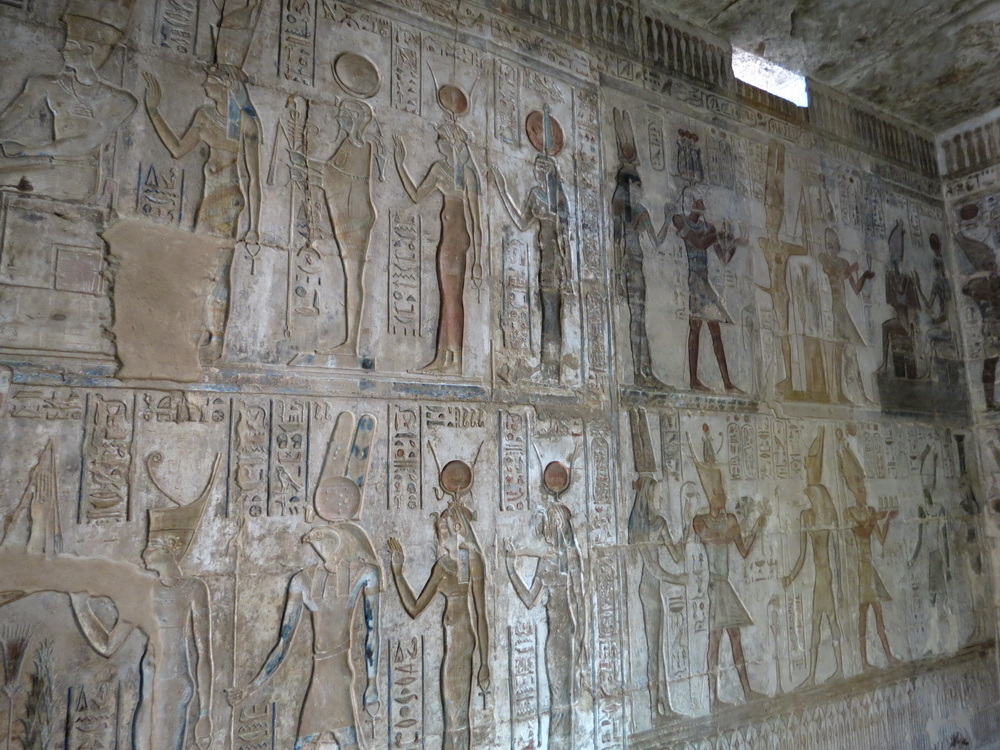
With the plan in hand, the driver decided to go to Deir al-Madina first. This was a tomb area. There were a couple of tombs there open to the public, as well as what looked to be a cemetery, and a temple at the end of the site. We went down into the first tomb, where we had to leave our cameras outside again. Not wanting to trust the attendant, or to be giving baksheesh (tips) after trusting him, I stayed outside with the bags and cameras while the other two went in first. Then they waited while I had a look. It was an amazing tomb. It was very small and cramped to crawl through the little doorways, but the colours were fantastic. There were clear hieroglyphics and all sorts of stuff down in the little space. I was happy we had chosen this place.


The other tomb was similarly small, although not as cramped. Again we were not allowed to take photos, but we didn't get stopped with our bags at the door. But there was attendant there watching the whole time, so surreptitious photos were out of the question. We were offered the chance, several times, by the attendant, but with the requisite payoff for him for the privilege of doing so. We declined. But the colours were again magnificent and it was a really interesting tomb to visit. It was all the better because there were few visitors.

After the two tombs we wandered down to the corner and the temple. And we were amazed again. There were all kinds of scenes carved on the walls. There were lots of hieroglyphics and plenty of paint. And there was no prohibition on photos here. So I took plenty. The attendant tried to make a show of showing us around, even though we virtually ignored his efforts. It didn't keep him from sticking his hand out afterwards, but that is part of this particular beast called being a tourist in Egypt. The temple was worth the hassle and having to ignore his requests though.


There was even a very clear depiction of the weighing of the heart. When a king died, his soul would proceed to the underworld and he would encounter Anubis and a scale with a feather on one side. The king's heart would be placed on the other side of the scale. If the heart rose, meaning the feather was lighter, the king would be judged as having been a good king and he would proceed to heaven. If, on the other hand, the heart sank on the scale because it was heavier, it would mean the king was bad and had committed many bad deeds and the king would go to hell. It is a famous scene from the Book of the Dead, but I have never been able to take a photo of it anywhere because it has always been in places where photos are not allowed. Here I could though. It's cooooool!!

This first stop had taken about an hour and a half, so I was hopeful that we were going to take so much time that we wouldn't have time to get into trouble with our guide about wanting to visit an extra place that wasn't part of the deal we made originally. Our next stop was Habu Temple. Isis had told us it was a very interesting and that she had spent two hours there on her first visit. That would be perfect.

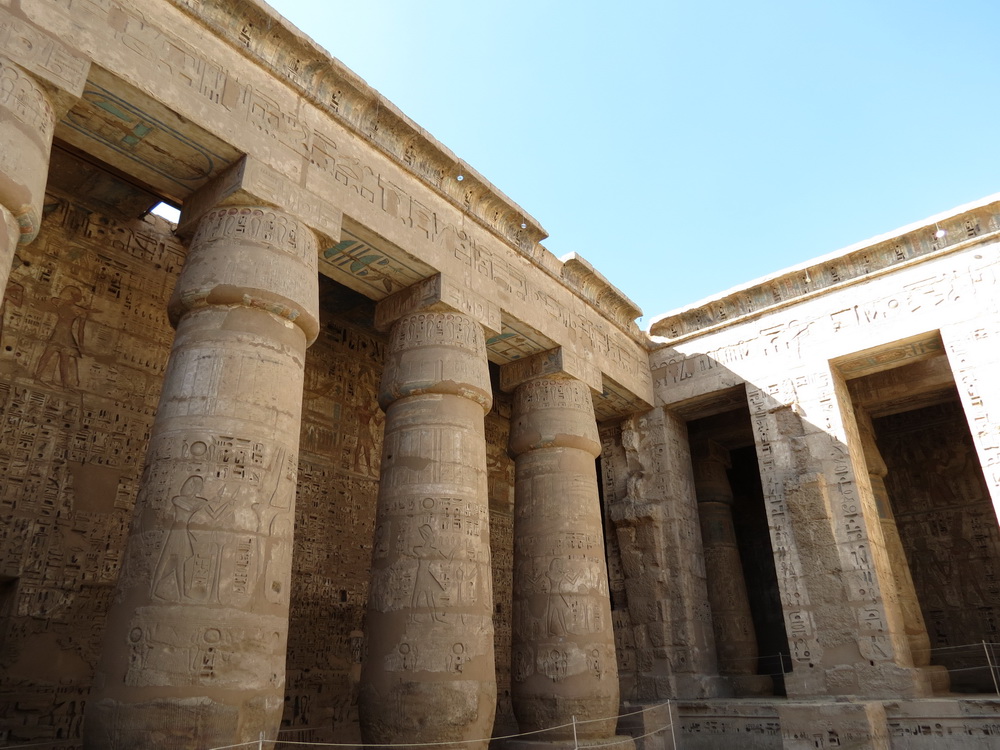
It was an interesting temple. It was set up much the same as Karnak Temple on the East Bank. There were large gates and then the traditional areas for each kind of folk, common, priests, and the top dogs of king, queen and high priest.


 Once again well-preserved carvings and paintings adorned the walls.


There was a difference though in these carvings on the walls. Many of the hieroglyphics were very deeply carved, as though Ramses II (who had the temple built) was worried the hieroglyphics might somehow be erased.


It turned out that the Habu Temple wasn't as large as I had hoped and we didn't take nearly as much time inside it as would have helped for later. But it was nevertheless interesting and I enjoyed looking around it. Again, there were not that many visitors, which made it that much better.

I also got to listen in on a couple of guides for a few minutes here and there, often in French. (It's amazing how even western, but non-English speaking, people seem to assume that any other westerner doesn't speak their language, be it French, Spanish, or whatever, and when someone might seem to be eavesdropping, since it's in another language, they don't make any attempt to prevent themselves being eavesdropped upon when they would do so if the lecture was in English.) I learned that the temple, when found, was in pieces. It had since been put back together for the most part, but it must have been one heck of a jigsaw puzzle.

Finished with Habu Temple, we headed for the temple of Siti I. I forget where he fit into the whole order of kings, but he was somewhere around Hatshepsut and the others. It doesn't really matter too much I suppose. We went and immediately I knew we were going to be facing difficulties. Over the course of the few days I had known her, I had come to have an idea of how Isis would react to things. Her immediate reaction to the temple was kind of a what-that's-it? Actually it was a general thought amongst the three of us. The ticket for the site was the same price as the other two, so we were kind of expecting a bit grander sight. Instead it was just a small temple in the middle of a much bigger ground, where something much larger had probably been at some point in the past. It seemed to be a bit of a rip-off to me. But more to the point, it was only about 1 in the afternoon, it was not going to take that long to explore and we would have plenty of time afterwards to be getting Kei back to the hotel for his bus at 4:00. And that was going to mean that, as this place would likely prove to be a bit disappointing for us, Isis would be wanting to get the ticket to go the Tombs of the Nobles, one of the places she had been talking up for a couple of days. I groaned a bit inwardly as I knew what was going to happen. We were going to tell the driver we wanted to visit one more place, he was going to point out that our agreement paper only listed three, and the only way out of it all was going to be to pay more money, after a probable argument by Isis to get her way, and without paying any more to boot. But that was going to be a while later. Maybe the temple would surprise me and keep us occupied for longer than I thought it might.

Alas, that was not going to be the case. Isis looked around for a few minutes and then sat down to read a book. When we asked her about why she was reading instead of exploring, she said it was because she liked to read in these sorts of contemplative places. I don't know if Kei was fooled, but I wasn't. She just wasn't that into the place. Oh brother!


Kei and I did look around though. It actually was quite interesting, but there definitely wasn't that much to the place. We were trying to find the carved scene that was shown on the ticket. It looked quite interesting and showed some kind of offering by someone to a god or maybe a king. But despite going in every room and looking at every scene depicted on the walls, it remained hidden from us and we were unsuccessful. It must be in the one place we didn't look. Or it could have been a lot of places. There were a bunch of other nice scenes though and it was overall a nice temple.


By the by, we finished that visit, too. It was only about 1:45 and it was time for the fireworks. Before we reached the gate, I stopped the other and asked what they wanted to do. I knew that Isis wanted to visit the Tombs of the Nobles and so I just asked her if she still wanted to do that. She said yes, so I told them that our written agreement with the travel agent stated that we were visiting only three places and this was going to make four. I felt it was likely the driver was going to kick up a fuss and that we would maybe have to pay for the visit to the extra site. I thought we could probably manage with an extra 50 pounds total, but I wasn't sure. Predictably, Isis stated that we had contracted a service to go to everything we wanted to see and we were not going to be paying any more money. Not her and not either of us. And out we marched to the driver. We told him what we wanted and, like I expected, he pointed to the paper and said that wasn't what was agreed and that we had to go back. So Isis told him he would wait there at the temple, as though we were still inside. We would walk to the Tombs of the Nobles (which was actually too far away for that to be practical) and return and he could then return us to town. She was all set to do so when the driver just decided to take us to the ticket office again. We got in, Isis convinced she had won her way, and proceeded to the ticket office. But the driver had not backed down, he had simply decided to call the travel agent and get help from someone who could actually talk to us, as he spoke very little English. We got to the ticket office and he had gotten in touch with the travel agent. The other two had gone off to get tickets to the tombs, and I was left to talk to the agent. He informed me that if we were going to be continuing our time on the west bank, he would have to charge us a full day's rate and that would come to 150 pounds more. I immediately stopped the other two and had them come back. This was more than I was prepared for. And I am not very good at dealing with that kind of thing anyway. Isis is far more combative than I am and I decided to let her handle it. She argued the agent into what she thought was submission, and we went to get tickets, only to have the travel agent call again and argue with her some more. Her arguments were a bit weak as far as I was concerned, but she was certainly sticking to her guns. We got yet another bystander in on it all and he was trying to translate and explain, but Isis was really having none of it and was on the attack with both the helpful bystander and the driver. I eventually got her calmed down enough to explain that it was neither the bystander's nor the driver's problem. The bystander was trying to help and the driver was just doing what he was told to do. He had explained that he had to go back and get another group and that it was a time issue to him. If we were going to keep him, then the extra charge had to be levied in order to make his lost income from the later charter. Our beef was with the travel agent, who had actually changed the rules when he had talked with me. When we first made the arrangement with him he had written down the agreement, erroneously (and that was on us, me actually), but had mentioned nothing about when the time was up. He mentioned nothing about a half day (which had begun at around 10:30 after the whole deal with the train tickets had been sorted out, so what exactly constituted a half day for the guy was unclear). He mentioned nothing about the driver having other things to do. He mentioned nothing about there being a full day rate if we didn't conclude our activities in time. I don't know what would have happened had we stayed in the three places for long enough to run afoul of the time limit, but I shudder to think of the consequences. That actually probably would have annoyed me enough to become combative myself. As it was, I was torn because we had definitely not examined the written agreement carefully enough to be completely in the right. But I managed to convince Isis to back off a bit and give the people in front of us a break. We would deal with the travel agent later. But we needed to get this settled quickly because the driver was definite that he had to be back by about three to get his next bit of business. And Kei did definitely need to be back to catch a bus at 4:00. If we were not going to compound our problem and have everyone angry we had to deal with this now and get on with our plan. It was eventually worked out that the driver would accept 50 more pounds, but it was on the understanding that we would visit the tombs quickly enough to be back in Luxor by 3.

The tombs actually had four separate tickets, each one allowing a visit to 3 or 4 tombs. We decided that we could visit using only one ticket in the time allowed. Our helpful bystander gave us his opinion on which one would be the best. We purchased that ticket and headed off. Isis was a bit disgruntled, but settled that we would be dealing with the travel agent later.

At the tombs we went in and were immediately set upon by one of the people who lived in the area. He wanted to show us the way to the tombs, despite there being signs pointing the way. I took this as a sign that we would be asked for money. So I stopped with the guy and told him my opinion of that, and that I wouldn't be wanting his help because I didn't want to give him any money. He wheedled and told me he was just trying to look out for his family and that I could spare something for him showing us the way. I told him it would be tough luck and he should just give up the idea and go away because we really were in no mood to be paying anyone anything. He frowned and said something to the effect of, “Fine!” Then he stomped off. And I caught up to the other two. And then a different guy came up and gave the same spiel as the first guy. They started to follow him. I told them to be careful because he would be asking for money in a moment or two. And I said it loud enough for him to hear. He indignantly said he was not going to be asking for money.

He showed us the way to the tombs and told us how to get down to them. Then he stuck out his hand and said, “Candy? Do you have any candy for me?” I almost smiled at that because it was kind of clever, but it still annoyed me more because, despite his gentle seeming approach when he came up to us, his help still wasn't really help at all. It was just a ploy to get something. Nevertheless, called on it before he could get to it, he switched his tack to something else that wasn't money. It deserved a bit of admiration for the ploy. He still got nothing.

Inside the three tombs, those of Ramose, Ouserhat, and Khaemhat, there was more art on the walls. Some of it was quite good and again well-preserved. But it looked much like that I had been seeing now for two days. It was a bit different in that these were nobles, and not kings. The scenes depicted on the walls were of everyday life, not of kings being judged or shown the way to the fabulous afterlife. But they were still tombs and that was starting to get a bit old. I found it was actually a good thing that our time limit only allowed us to visit three of them. I would be getting bored of tombs soon. But again, we were not allowed to take photos. And with the deadline looming over us, I didn't even take any photos of the outside area.

We headed back to the van and, while Isis hit the bathroom, I paid the driver 50 for the extra site and I gave him a tip for all the trouble. He wasn't happy with my tip, but I told him I was tipping him for me, not for the others. I only have so much money. He still wasn't really impressed.

We got in the van and headed back to town. I explained to Isis and Kei (who understood much of the stress of the situation) that we had no particular beef with the driver. He had taken us where we wanted to go and done it without much fuss. And for that, they might consider giving him something for his trouble. They agreed.

So when we reached the hotel, they did pass him a bit of money and he was mollified. He was also just in time for the afternoon tours and would be able to make his next fee. All was well.

We bid Kei farewell. He had to head off to get his Lonely Planet from the restaurant we had eaten at the night before. And Isis and I headed off to deal with the travel agent. But when she found out that I had paid the driver the money already, she was thrown off a bit. She had been planning her arguments to avoid paying anymore to the travel agent, not to try and get anything back. She had to rethink her approach. I told her that I was okay with how things had shaken out. I didn't expect any money back out of it. I was satisfied and I had had a good. She explained that she often thinks that if she isn't happy with a situation, that must mean that nobody is either. She had to rethink that as well, I suppose. In the end it was just too much to worry about, and would take time we didn't want to give to the travel agent. We didn't even go in to see him. But, for the record, he did change the deal, so I would advise against going to get the Thomas Cook travel office on the main tourist drag in Luxor to do anything for you. He played a bit of dirty pool. Of course this had come to seem par for the course in Egypt.

The Valley of the Kings, Queens, Various Temples, and History in Luxor


A wake-up call (more of a knock really) at about 7:30 heralded the beginning of a long day of seeing some of the best known spots of Luxor. Breakfast was included in the tour, so we trooped down to the restaurant to partake. It was the best breakfast I had so far encountered during this tour. Where most places managed a couple of buns and some jam, maybe a boiled egg, and a small piece of cheese, this hotel had a good buffet, with cereal, meat, vegetables and even a cook on hand to do eggs up properly, or at least to some sort of specifications. I was impressed.

We ate our fill and headed down to meet our guide for the day, hoping that he wasn't going to be as much of a dud as others had been so far. He wasn't. I don't remember his name, but he was immediately engaging. He had a nice air about him and seemed to be relaxed and easy to get along with. He talked with everyone and made sure all could hear him and understand. All together there were seven of us, three from the original trip that started in Aswan, and two Egyptian couples, one of whom were on their honeymoon. Congratulations went all around upon learning that.

Our first stop was the Valley of the Kings. Unfortunately, I have absolutely no photos from inside the entire complex. I have only a few shots from outside looking in. There was a time when people could take their cameras into the area. They could take photos outside the tombs. But inside the tombs photos have not been allowed, since the paint and colour inside the tombs is highly sensitive to light and would be degraded over time. In order to prevent such degradation, first tourists were asked not to use flash photography. When tourists proved not to understand basic instructions like that, photography was banned. And a couple of years ago, when it was discovered how prevalent the practice of offering something to the guards in exchange for being able to take photos inside the tombs had become, cameras were forbidden to be brought inside the compound. It is such a shame that people can't understand the damage they do in the quest for their selfish aims. It's also a shame that so many of the people who might claim to be helping preserve Egypt's cultural and historical heritage would look the other way and allow the degradation of the same for a few cents.

In any case, I have nothing to show for my entry into the Valley of the Kings, except memories. Which are enough I suppose. In order to aid my memory, this is one of those spots where I felt that it was worth investing in a postcard set and CD with photos on it showing what was in the tombs. So I did. I bought it from the guide, who told me the money went to the officials at the site and the proceeds went towards preservation of the tombs. I have no real idea of whether or not it really did, nor of how much commission he got on the deal, but I can't really concern myself with that. I would go crazy trying to make sure all the money I pay to various people for supposedly legitimate things is actually legitimate.

The Valley of the Kings was chosen by the kings of the 18th through the 20th dynasties to be buried. The very first kings had been buried in graves with a simple mound over them. Over time, these mounds were improved and added to in step fashion until the results were the first pyramids. These were called step pyramids.

Later dynasties added onto the practice and soon pyramids were the plan rather than the result of additions over time. The culmination of this practice of building pyramids were the great pyramids at Giza.

There was one problem with such grand displays of the power and wealth of a dead king. Everyone knew where they were buried. The pyramids served as beacons pointing to the final resting places of the kings and pharaohs. In ancient Egyptian cosmology, when the frail and short-term life ended on Earth, everyone would proceed to the underworld. Some would go to “heaven;” others would go to “hell.” But if the dead person had the means to make it so, they would be buried with all the stuff their souls liked and would need in the afterlife. In the case of the pharaohs, this meant the gold and other signs of wealth that accompanied them in life. There were massive amounts of treasure in the pyramids and burial chambers within. And with the beacons of the pyramids pointing the way, grave robbers proved quite capable of finding the treasure and removing it.

By the time of the 18th dynasty, the kings had decided on a new way of being buried that would hopefully prevent the dastardly thieves from taking all the riches from their tombs and making it impossible for their souls to have a comfortable afterlife. A place was found where a tomb could be dug in tunnels in a mountain. The king would be placed inside after death and mummification and then the entrance would be sealed up and hopefully concealed well enough to prevent grave robbers from finding the tombs.

The Valley of the Kings was the result of this change. It was chosen for its remoteness (it's 30 or so kilometers from Luxor, a day's journey in a world with no cars), as well as its composition (the mountain is made of limestone and so is easy to dig through).

The tombs vary in size and length and opulence. Some are very short. Some are quite long. Some have side tunnels that seem to go nowhere and have no obvious purpose. It took a while for the guide to get around to explaining why. As soon as a king ascended the throne, he would have his tomb begun. He would participate in the planning and the choice of location for the tomb. He would design it as well. Now, while the king was living, it could never be stopped. To stop the construction of the king's tomb was to say that it was finished. If the tomb was finished, then that would imply that so was the king, and that was a bad omen. Then once the king actually died, there were seventy days to get the tomb ready, as well as the king's body, for burial. This was just not enough time to do much completion of a tomb project. So it can be said that no tomb in the Valley of the Kings is complete. The lengths of the tombs, being dependent on the length of the reign of the king, meant that if the king was long-lived there was a long and elaborate tomb. But some kings only lasted for a couple of years, which meant their tombs were only small holes in the mountain.

To date, there have been 62 tombs found, including the most famous, King Tutankhamun's tomb. Most of the tombs have been open since ancient times as, while kings were trying to be really smart in their deception of the thieves, grave robbers (as most all thieves, crooks, and brigands) proved themselves almost as resourceful and able to think like and out-think the kings and their advisers. The single exception to that was King Tut's tomb. Discovered accidentally by Howard Carter, it had lain undiscovered for thousands of years. It had riches beyond description inside, most of which can be seen in the Egyptian Museum, or in exhibitions around the world. But there is still hope for more. Sixty-two tombs have been discovered. However, a paper discovered in one of the tombs told of 102 tombs out there in the hills. If grave robbers happened to be illiterate, there are possibly up to 40 more tombs waiting to be discovered. That may be a big if however, and there is the possibility that it was a misleading trick by someone to try to keep the grave robbers occupied. There may be more tombs out there waiting to be discovered. Only time will tell and there are teams out there looking. Or they were until the revolution.

The ticket that was purchased allowed us access to three tombs. There are some 15 or 20 tombs that are currently open to the public, with the rest being closed for various reasons ranging from conservation to unsafe conditions. Two of the tombs require an extra fee, Tutankhamun's and Ramses II's tombs. As the stuff inside was all removed, the only reason to enter one of those tombs was to say I had been there. It was already rather expensive, so I declined to even entertain the idea. Our guide told us he would choose what he felt were the three best tombs to visit. We trusted him to do so. They were all Ramses kings, the fourth, the ninth and maybe the first (I don't remember well which numbers they were; there were too many of them).

Inside there were chambers and corridors. There were hieroglyphics on the walls. Most had their sarcophagi in the burial chambers. And it was all rather well-preserved, despite all the traffic and the grave robbing. It's quite a sight.

Next it was on the next spot on our itinerary, the fairly obligatory (unfortunately) shopping stop. We were taken to an alabaster shop. We were shown how rough stones are cut and shaped and used to make wonderful pieces for the home. And since they were stone, they were large and heavy and unlikely to find their way into my pack for the trip home. They didn't, so it was a reasonably useless stop for me.


After the useless shopping stop, we headed to the temple of Hatshepsut. This was a temple set at the base of and cut into the mountain, on the opposite side from the Valley of the Kings.


Hatshepsut was one of the few female rulers of the Egyptian people. But this was not easy for her to accomplish. During the old Egyptian kingdoms, rulers routinely married their sisters. I can see why each dynasty seemed not last too many generations. The next ruler often came from amongst the offspring with other wives, but the king and queen were siblings if at all possible. This kept the power where they wanted it and made it easier to control.

Hatshepsut was the queen and her brother was the king. Then the king died, but there was an heir. However, the heir Tutmosis was only four years old. He couldn't rule as he was too young. Hatshepsut was considered as the ruler, but the people didn't support her. They wanted Tutmosis to be the king. The solution was that Tutmosis would be the titular ruler, but Hatshepsut would be helping him and making the decisions until such time as Tutmosis was old enough to assume the throne. This arrangement worked for about four years, but Hatshepsut grew to like ruling Egypt. So she decided to more or less take over. She shipped Tutmosis off to military school. The people rebelled and would not accept her as sole ruler, so she worked out a solution. The way to the people's acceptance was through the priests. The way to the priests was to shower them with money, which she did. The priests, who liked getting money for their projects worked out that if she could be linked to the sun god, Amun, she could be legitimized in the eyes of the people. So they convinced her to wear men's clothing to be seen as a king, and the earthly aspect of Amun. Thus she came to be viewed as a man, and all of the statues of Hatshepsut ever made show her as a man.

As king, Hatshepsut wanted to make some kind of further gesture to show her legitimacy as “king.” she also wanted to be connected to, even buried in, the Valley of the Kings. She chose a spot for a temple, which was right beside another temple that she admired. 

She directed her architects and builders to make a temple that was the same, but built into the mountain. This became the temple we were visiting. To help her position, the temple was position so as to have the entrance pointing to the entrance to Karnak Temple across the river in Luxor. Karnak Temple was dedicated to Amun, which helped further establish the connection to Hatshepsut. At the back of the temple she had her builders start a tunnel that was to go through the mountain to the Valley of the Kings. It's thought that the tunnel would lead to where she wanted her tomb.


Alas, this was never completed. Hatshepsut forgot one thing in all of her work to gain legitimacy. She forgot the one person she had wronged the most, her co-ruler Tutmosis, whom she had sent away to the military. He grew up while she was being king. And he was bitter. He became a general in the military and had a large command of soldiers who were loyal to him. He marched on Hatshepsut and ousted her. Then he set about wrecking everything she had done, removing her image from anything he could find. He was trying to show that everything during her reign had no legitimacy, that it didn't exist because he had been the rightful ruler all along. He put his name over hers many times, hacked her face off statues and tried to erase her image and name from anything he found. Legend had it that he killed her, but studies on her mummy showed she died of natural causes. It would seem that Tutmosis' murder of Hatshepsut was figurative rather than literal.

The damage to the temple was quite extensive and shows that, while hell might have no fury like a woman scorned, military school had the same embittering effect then that it has now.


But despite all the damage he caused, Tutmosis only damaged images of Hatshepsut.  He didn't do any damage to the rest of the temple or its art, so there is considerable beauty that remains in the temple as well.


From the temple we headed into the Valley of the Queens. Our guide suggested that we needn't go there as there wasn't really anything of interest there. We wouldn't even be able to go into the tombs of any queens because they were all closed. We would only be able to enter the tombs of some of the princes. But we all wanted to go in, so in we went. I suspect the guide just wanted to save some time, but that was up to him. It was our tour.


In the Valley of the Queens, we were allowed to take our cameras in with us, although the prohibition of using them inside the tombs was still in effect. Apparently the whole illicit photo deal inside the Valley of the Queens wasn't as much of a problem as it was in the Valley of the Kings. Women always seem to get treated that way. Oh well. We visited three tombs of princes, all of them sons of Ramses II. They were interesting and actually we saw more colour and paintings on the walls than it seemed were in the tombs of the Valley of the Kings.

Despite the prohibition of taking photos, I still managed to surreptitiously snap a couple, although I was good enough not to use the flash. And I didn't get caught. Others were caught and did pay some considerations to the caretakers for the “transgression.” But I don't know how much it can be considered a transgression if it's so easy to get the officials to look the other way. It's more of a transgression in conscience than fact, I suppose.


Our final stop of the morning tour was at the Colossai of Memnos. This is a Greek name for them, but they were actually statues for an old king of Egypt. And they were just sitting out in a field. There was no particular temple of anything else that could be associated with them at this point in time. And our guide, although he told us their provenance, really felt they weren't particularly important. Others in the tour were tired and the statues were not overly interesting otherwise, so we spent about 5 or 10 minutes looking at them, then we headed back to the hotel for lunch and a short break before we began the afternoon program.

The afternoon was for two temples, Karnak Temple and Luxor Temple. Our first stop was at Karnak Temple. This was a temple built in honour of Amun Ra, the sun god. It was aligned to point to Valley of the Kings, but I wasn't clear which came first. It was a very large temple with gates and special areas. But like all other temples in Egypt, and probably elsewhere, there three main areas: the public area, the area for the king, queen and priests, and the inner sanctum where only the king and the high priest could enter. There was also an important side entrance. Out the front of the temple there was a canal that led to the Nile. Once a year, in the past, the idol of Amun Ra would be loaded onto the boat of the god. It would be carried to the canal, and then would be sailed out to the Nile. It would sail up the Nile for a few kilometers to Luxor Temple. This was where Amun Ra's consort was. Amun Ra would stay in Luxor Temple for ten days each year and then return via a processional along the street of the sphinxes, a road leading from Luxor Temple to the side entrance of Karnak Temple, and which was lined with sphinx statues along its length. Karnak Temple was originally fairly small, but was added onto by successive pharaohs until it became the massive site that can be seen today.

All the contributions were too much for me to remember, but I do remember a couple of them in particular. One was by Ramses II, who really was probably the most influential of all the pharaohs. He completed a set of pillars in the Hypostyle Hall. They were massive. They were begun by one pharaoh and completed by Ramses II. The biggest reason I remember them is because this was, I think, one of the places that was featured in the second Mummy movie with Brendan Fraser.


He also contributed a couple of giant statues of himself. I wasn't overly surprised by this, with the number of statues of the man all over Egypt.


The other addition that I remember was that of Hatshepsut, because she was the one who had caused so much trouble by trying to take over the pharaoh's throne as a woman. She contributed an obelisk. There used to be eight obelisks in the temple, but five were taken from Egypt and are now located in five world capitals. Three remain in the temple, but one of them has fallen down.


After explaining things to us for about 45 minutes, we were left to wander and take photos for about 40 minutes more. It was getting late in the day and the light was quite interesting, but it was a large temple and it really would have made a good place to look around in for at least two hours more rather than the 40 minutes we were given. Oh well.


From Karnak Temple, we headed to our final destination for the day, Luxor Temple. However, our guide was once again campaigning for the fact that it wasn't necessary to go in. Everything that was about the temple that needed to be seen could be seen from outside and there was no need to enter. As it was after 5 in the afternoon and most sites close around that time, I decided that it wasn't worth the entrance price to go in, if I wasn't going to have a lot of time to look around. The entrance fees in the country get to be quite pricey over the long haul, and this day had been an expensive one for that. But if the itinerary for the day was too much for the time allotted, maybe the touring companies in town need to rethink how they go about it.

Again, it had been a long day, and I wasn't all that interested in Luxor Temple by this point, so I don't remember too much more about it than what had been related about its relationship to Karnak Temple earlier. One thing that did stick out from the explanation though was that the temple had been completely buried by sands when the Muslims came to town. The found the tops of the columns protruding from the sand and thought they would make a great base on which to construct a mosque, so they did. Then, later when the archaeologists started looking at the site and then digging, they found this massive temple under the sand. The mosque was not removed, so it remains as an interesting and unique feature of Luxor Temple.

This concluded the day's programs and we returned to the hotel exhausted and satisfied. It had been a big day, but it had indeed continued the change that I had felt during the felucca ride. It was a much better organized and easy feeling day than I had had before the felucca in Aswan and I felt very satisfied with Luxor in general.