Showing posts with label Kiribati. Show all posts

Wednesday, May 18, 2011

Wandering Around South Tarawa

I really wanted to like Kiribati. I had seen that documentary about the Phoenix Islands, and the photos of Kiribati that had been part of that program. I had read about how friendly the people were. And I really wanted to like the country. But, to be honest, I was finding the country to be kind of a chore. It's hard to find cheap accommodation. Restaurants are few and far between. Bus drivers will just drive on by. I'm not sure if it's just me, or whether they do that to everyone, but they seem very impatient and I would be passed by a number of minibuses before one would stop for me. And there is just not much that is of interest to do. Not much anyway that is easily identifiable. Perhaps if I had visited the tourist information office instead of the tour office, I might have learned of more to do, but everyone I talked to suggested the same thing. There are only a few things of interest on Tarawa and then it's kind of boring. And I was getting kind of bored.

In an effort to find some redeeming thing about Tarawa, and of Kiribati in general, I set out early on my last day in the country. I wasn't sure of the name of where I was wanting to go, so when I flagged the first minibus down, I was a bit slow on being able to tell the driver where to take me. And he just drove off and left me. That was annoying. Then I decided that the airport was close to the eco-aquaculture farm I thought might be interesting. So the next minibus that stopped for me, I said the airport and they let me on. While I was at the airport, I took a photo of the facility. Apparently there is going to be a survey team coming in the next few weeks to start the upgrading process of the airport and road. It should be interesting because there is only one road on the island.

From the airport, I headed towards the eco-farm. Along the edge of the road, on the lagoon side, it looks like they are trying to reclaim some land. Those mangroves are planted in awfully neat rows for it to be Mother Nature's idea.


Then I reached the eco-farm. I thought it might be interesting, but it's just a working farm for the cultivation of milkfish. And because it's just a working farm, there really isn't any tourist facilities associated with it. No information placards, no people about to explain anything, nothing. What there is is a whole bunch of pits with water in them, many interconnected by pipes and such, and fish. Lots of fish.


So next it was out to the end of the island in the middle part. There is more or less a boomerang shape to Tarawa. But at the end of the south part of the island, as it turns towards the airport and the north part of the island, there is a road that leads to the turn part of the boomerang shape. (I am just going to assume that makes any sense at all, and leave it for you to figure out.) The village there is called Temwaiku. I thought it would be just a short way. I mean, how far can the island go in that direction, when most of the island is a couple of hundred meters wide, at most? The answer is that it can go really far. Almost an hour later, I had rounded a curve and was heading in the general direction of around the eco-farm and back to the airport. But I hadn't found the end of the road yet. I did find many of the same sorts of houses I had seen on Abaiang, but not much of in the villages of Tarawa.


By that time it was getting time for lunch. After a few aborted attempts at finding a place to eat (some places seemed to be restaurants, but were not; others were restaurants, but were closed), I was told where to find one, by catching a bus. While I was looking around though, I found what I think is the only place on Tarawa with a curb on the road. It was right near the hospital.


I finally got to a Chinese restaurant, where I met a couple from Australia. We were chatting for a while and they told me about something that sounded interesting near the Kiribati Parliament building. It's another eco-farm project funded by the Taiwanese government. It is to grow milkfish as well, but associated with the farm, they also have a little aquarium with a bunch of tropical fish. I enjoyed talking to them, but he was far more optimistic than she was. She just had something negative to say about almost everything he would point out.

I headed off to the Parliament and took a better bunch of photos of it. 
 
There was also a pretty cool mosaic map of Kiribati.  Apparently Kiribati, in area is the size of Australia.  It's just that it is more than 99 percent water.


Then I went next door to the eco-farm. There were little plaques showing how big the pools were and how many fish they had. I found the aquarium part as well. There were some interesting looking fish.


The caretaker of the farm appeared and watched while I looked at the fish. Then he explained a little bit about the operation of the farm. This was already much better than the first farm. He told me that they have a number of pools and they are working hard at building a stock of mature fish that can be bred. They are trying to develop a bait stock. Milkfish, because of their colour and shape, are attractive to tuna and make good bait. So young milkfish, if a viable stock of breeding fish can be establish, could become a good export or business opportunity for Kiribati. This farm was an attempt to do that. However, it takes seven years for milkfish to become mature to where they will breed. This farm had been in operation for 6 years already. The man tending the farm had been there for about 2 and a half years. Because milkfish take so long to mature, the farm is actually very expensive. The fish need to be fed, as they are captive and in pools that don't have food coming into them. They need to be tended and their numbers need to be monitored. He told me that they can only change the water when the tides are high enough and that is when the moon is either new or full. The rest of the month, they are unable to change the water, as they don't have pumps to do so. If the numbers get to high in the pools, then the oxygen gets depleted and the fish die. There are some sort of phytoplankton in the pools that put oxygen into the water through photosynthesis, but that is only during times of sunlight. At night, there is danger to the fish, as there is during times when there is lots of cloud and rain. And Kiribati has just begun the rainy season. The fish in the large pools are for food (there is a separate pool for the breeding fish), but it is a losing proposition for the farm. It takes 2 kilograms of food, over the course of however long, to grow a fish to 1 kilogram of weight. That is in addition to the time and manpower involved. Fish food is 4 dollars per kilogram, so 8 dollars for a 1 kilogram fish, plus the time and manpower cost. But the fish can only be sold for 4 dollars, as that is the going rate for any fish caught in the sea. The man at the farm seemed a bit perturbed by it all. But, he's still there, raising fish.

Following the little tour and explanation, I headed back to the guesthouse and got ready to leave the next day. While I was sitting there, I met a man who was staying there. He was from Fiji. He has been there on and off for almost five months, working. He is working to transfer some property and equipment from BP Oil to the Kiribati government. He doesn't have much to do, except pay a security guard and paint a fence or two, but he has to spend three weeks at a time in Kiribati on Tarawa, with only a week or so back home in Fiji. I told him he must get very bored. He just hung his head a bit and agreed.

As I said at the start, I really wanted to like Kiribati. In the end though, I enjoyed the visit and I am glad I went, but it's not a place I would recommend as a place to travel. It would be interesting to stay for a while working and getting to know the people, but it's most definitely not, at this point, a tourism destination.

Sunday, May 8, 2011

Returning to Tarawa

On the Friday, it was time to leave Abaiang behind and return to Tarawa. I thought about staying for a couple of extra days, but it is just fairly restful out on the island, without much to be able to do. I might get out and meet some people on my own, but there wouldn't be much more to see or do. On the other hand, I haven't actually seen much of Tarawa on my own. I want to walk around a bit and see some things in a more relaxed and individual way. So I came back. (Besides, the principal of the college offered me a job teaching English, so if I were to return here and do that, I would have plenty of time to get to know people on the island.)

I got up without much idea of when I was supposed to be at the airstrip. The flight was supposed to leave at 9:30. But they were told that I needed to be at the airstrip at 8 because the plane was going to leave at 9:10. So I quickly had breakfast and headed over to the airstrip and checked in. It was about 8:30. I got weighed again along with my bags (I gained a kilogram while I was on the island; I guess it was really good food.) I paid my airport fee. I had been told it would be 20 dollars, fairly steep for even a large international airport. It turned out to be only 2.50. And then I waited. And waited. And waited. Island time. :)

The plane actually left Tarawa at 9:10. Then it went to Marakei again. Then it arrived at Abaiang. At shortly after 10. Oh well. There was a little boy, then his much older sister and then another sister who came to talk to me/check me out. They were nice and interesting and it helped pass the time while I was waiting. (But I didn't take any photos of them. I forget sometimes.)

I came back to Tarawa and went for my very expensive night on North Tarawa. Somehow, I let Joe at the tour office convince me that it would be a great idea to spend a night at this spot at the first break in the island on the north side. There is no bridge across here, and no road. When you cross you have to either walk and wade across while the tide is out, or take a boat across when the tide is up. And then I stayed in a little hut that stands out over the water (when it's high tide). It is quiet, picturesque and very peaceful and relaxed. And way, way too expensive for just me. If there were two or three of us staying in there it wouldn't be so expensive, but just for me, I don't know what I was thinking when I agreed to stay here. I must have wanted to get a taste of what it's like to have lots of money and nothing else to do with it.

I wandered around this little island. 


I found the broken bridge. I met some people, and had a nice time. 


The night was quite impressive with the moon over lagoon as the sunlight faded from the sky.


Eric

At St. Joseph's College, I was looked after by a man who works as a teacher there. He is from the Solomon Islands, and he is a very interesting man. He is full of stories. He has four children from various mothers and fled the Solomon Islands at the height of the ethnic tensions there. At the time he had a large tract of land with a big house and a lot of vegetables and fruits. He knows a great deal about agriculture. At the time of the ethnic tensions in the Solomon Islands he had been supplying vegetables and fruits to the airlines of the South Pacific, and had gotten the label of organic stamped on his produce. He also has worked in numerous other countries, usually in the agricultural sector, teaching and growing. He ran for parliament in the Solomon Islands twice, but came in second twice, before giving up the idea. Then the tensions came and he left the Solomon's and has been at the college ever since, biding his time. He is also apparently some kind of cousin to the current prime minister of the Solomon Islands. He comes from Gizo, in the western province and is the son of a preacher in a church, but the grandson of a crocodile god worshipper. His grandfather passed all of the tribal knowledge on to him, including how to worship crocodiles. He has a wide and varied past and experience. Maybe. There are so many stories and so many things that he has allegedly done, it seems a bit incredible that one person could have done it all. And in some of his stories, little details changed a little bit from telling to telling. (For instance, the first time he told me about his first defeat in the elections for parliament, he lost by four votes. Later it was by 6. Little details. They will get you every time.) I think some of it all is true, but I am just not sure how much of it all is what really happened, or really happened to him. But he certainly is a heck of a character and I was very glad to make his acquaintance.

To the Ends of the Earth and Back

When I read about visiting the outer islands, I read that visitors are supposed to bring some kind of tobacco cake with them for a ritual that is performed in some places on the islands. I wasn't too sure what that meant, or where these places were, but I remembered just in time before I left that I needed to take some with me. I went to a store and the proprietor had a couple left, which he sold to me. The second morning I was in Abaiang, one of the new teachers, Ioane, was asked to take me around the island to do my arrival ritual. This was even though I had arrived some time earlier. But it still needed to be done. (The teacher later told me that it was a new custom and he didn't think it was real.) So we hopped on a motorbike and headed out to both ends of the island. We first went to the far end from where the school was located. (And from the setting sun, I guess that was the north end.)

We travelled through a number of little villages on the way and it was more scenes of typical island living, grass huts and open living areas. There weren't many people about, and Ioane told me it was because it was warm and people were resting. He also said though that many people had gone to Tarawa because that's where jobs and money are.


When we arrived at the end of the island, there were a couple more little islands off to the west that were only accessible during low tide.


We then searched around for the man who would perform the little ceremony that visitors participate in to get the protection of some sort of island spirit. I had been told about this ritual and that I would have to bring little tobacco cakes of some sort with me to the island to offer as a token for the protection. I had gotten hold of two of the cakes, but Eric (the man at the school who was looking out for me, more on him later) said that the people who performed the ceremonies often took the cakes for their own personal use. So he cut one in half and told me to only use that much for the offering.

Ioane found the man eventually and he came to end of the island. He dipped the tobacco cake into the water and got some sand. He put the tobacco cake on the altar and had me dab some of the sand on my cheeks. He said a few words to the altar and then gave me this wreath thing to wear on my head. Then, when he thought we weren't looking, he took the tobacco cake. (I actually hadn't been looking and so didn't notice, but Ioane did see him take and he was somewhat offended.)


Then we headed back to the school for lunch. On the way, we passed this somewhat devastated area. At some point in the recent past, the water's edge was breached on the lagoon side of the island. The salt water of the lagoon swept inland to make a new swampy, salty lake-like spot that grows and shrinks with the tides. As a result, all the palm trees in the area have died, not being able to deal with salt water. There was a little village there, but not it is kind of cut off from the main road, and the resources they had there are not available any longer. I gather that climate change/global warming scientists and writers are making grand claims about how this is evidence of how we are changing the climate, the seas are rising, and the catastrophe is upon us, and that Kiribati is about to bear the brunt of what is coming. Eric says it's all bunk. He says that what really happened is that nearby someone built a new sea wall out into the currents of the lagoon. The currents all changed, water backed up against the sea wall, which raised its level enough that it breached the shore and caused the change in the area. (Another man I met later, upon hearing about the sea wall, understood exactly the same thing.) It would seem that climate change advocates have got the cause wrong, debunking their claims (at least in this instance) wrong, if they do have the ultimate culprit, human action, right.


Further along the way back, we passed the largest maneaba on the island. It is where large-scale meetings are held, mostly for the big religious festivals, like Easter and Christmas. It was built on the lands of one of the churches. Its size is quite impressive. There are a number of the structures around it, one for each village on the island.


We also passed the main island council buildings in the central town of the island.


And then it was a spot of lunch before heading to the other end of the island.

The other end of the island was much closer. Where it had taken well over an hour to get to the north end of Abaiang, it only took about a half hour to reach the south end. It actually took a bit longer because it began to rain quite heavily. But when we got there, the man who was performing the ceremony (visitors need to go to both ends of the island to be fully protected) took the tobacco cake and threw it into the ocean. So I guess nobody uses those ones for their personal use down at that end.

Then he took us to the very end of the island. From that point it is possible to see North Tarawa. It was here that the man told a story about the beings who protect the islanders of Abaiang. There was a man on North Tarawa, Naoboika. He was either looking out at Abaiang, or maybe he was travelling there, when he saw a woman bathing in a natural bathtub there. Her name was Nikuau. They fell in love and got married and had three children, two girls and one boy. (I don't remember their names.) Somehow, they became stones that are inside this ring on the end of the island, and they protect visitors to the island. They also help with people trying to catch fish, if the people ask for help.

After this ceremony, we returned to the school (St. Joseph's College) for dinner. It was a long day, taking the whole day pretty much to get end to end, but it was interesting to see how people live their lives on the island of Abaiang.

Abaiang

After the night at the Lagoon Breeze Lodge, a place on a little lagoon with a rather nice setting, I set off early the next morning for the airport. My flight to the outer island of Abaiang was at 9:00. That meant being at the airport by 8, and I would have to leave the guest house at 7:30 or so. The guest house had said that they would take me to the airport, but at 7:30, there was nobody about looking like they were ready to go, so I just headed out to the road to catch a minibus. As I was waiting and watching the fourth or fifth minibus pass me by (did I look scary?), the woman who had been working the night before arrived for work in the morning. She did a double take, wondering why I wasn't waiting for the truck to take me. I told her, then she looked and said that the truck was gone anyway. She helped me get a minibus, but it still took three or four more buses passing me by (I really must look scary) before she finally flagged one down for the airport.

At the airport, I found that there is actually a check-in counter. It's made of a wood plank desk or two. They take your baggage and weigh it. Then they weigh your carry-on bags. Then they weigh you. It was an odd experience getting weighed like baggage. Then we went through into a small room for the security check. I'm not even sure the metal detector really worked. Then it was on into the waiting room to wait for boarding.

The planes they have for going to and from the outer islands are just little puddle jumpers, no mean feat given the size of the puddle in question (the Pacific Ocean). Only 15-20 people can take a flight at a time. It was kind of exciting to fly in one. And since they aren't really pressure controlled aircraft, they couldn't fly that high, so there was a great view of the ocean below.


A couple of the islands were also visible as we passed.


We first landed at Marakei Island, dropped off a few passengers and took on some more and then flew on to Abaiang. The “airport” is just a couple of shacks where they collect people and luggage. The runway is just a flat space cleared of coconut trees. It's very bush, but it seems to work.

At the airport on Tarawa, I met a man who works at the place where I was going to be staying. It's a school that goes from primary school right up through college prep. And then it turned out that the principal of the school was also on the plane, so he made sure that I got to the place all right and settled. The school is rather large. It's residential, as students come from all over Kiribati, even the first graders, and so they have to have a place to stay and live. They are on some sort of term break, so there was almost nobody at the school while I was there except for a few staff members. That meant that it was quiet. It also meant that I missed out on one of the customs here. Visitors are usually greeted by some kind of song/dance of welcome, performed by the students. But there were no students, so I didn't get to see the Kiribati song/dance. I would have liked to see that, but it wasn't to be. So I was just shown to where I would be staying while I was there. I had a room at the back, by the beach. Opening the back door gave a nice view.

I had some breakfast, a walk down the beach for a while, then I was taken around the village nearby to have a look at the lifestyle of the people living away from Tarawa. The houses were the most interesting to me. The are mostly open, with no particular level of privacy.


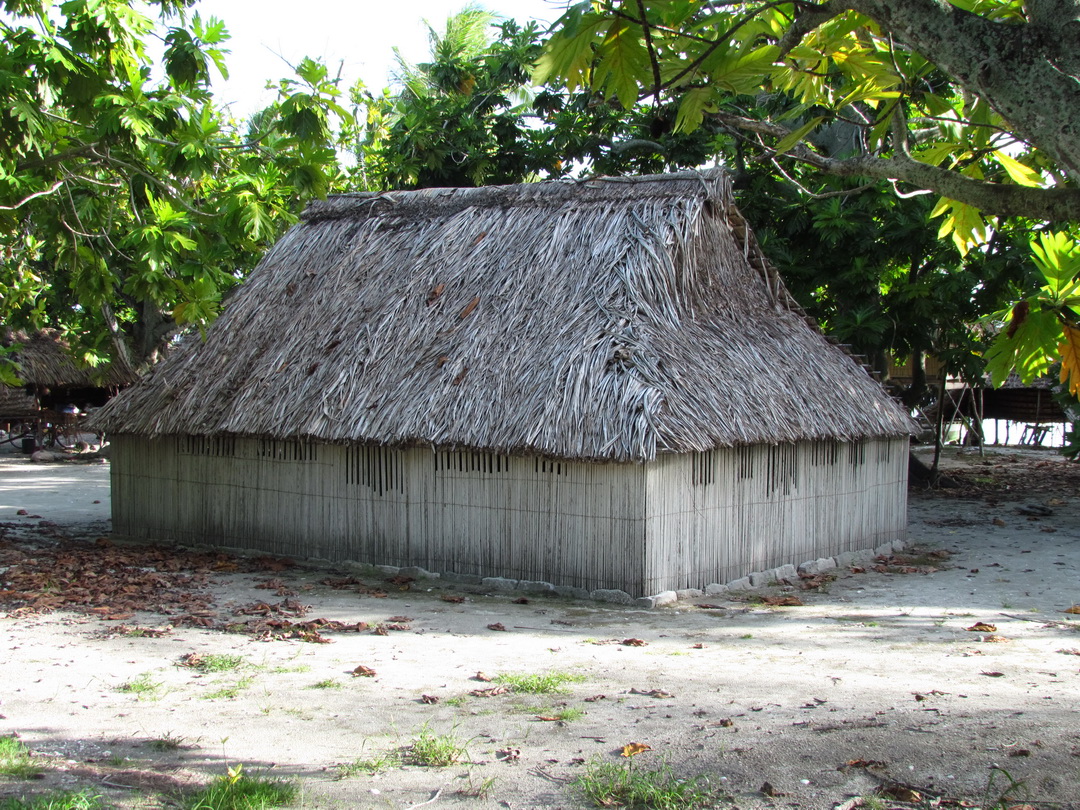
 Almost every family also has what is called a “maneaba,” or meeting place. This is where ceremonies are held and family gatherings. Each village also has one, and then each island has a larger set of these places for large-scale gatherings for religious events and other similar times.

There are also some different customs regarding the dead. The Church, in numerous forms and denominations, has been in Kiribati for a long time and has had its influence. As such, many of the dead are buried in cemeteries. Some, however, are treated differently. Some families bury their dead on their land and then tend the grave with special decorations.


Other indications of the dailiness of life were also in evidence.


I'm not sure if this sign was a joke or was supposed to be serious. But it's good to know the building isn't that strong.


On the way back, we met some young people who wanted us to take their photos. So we did.

And then we turned back and had dinner at the dining hall. Then it was turning in time and a fairly early night.