Showing posts with label Indonesia. Show all posts

Wednesday, August 3, 2011

Candi Sambisari

Prambanan and Borobudur are the two well-known temples around Yogyakarta, but when I went to the city's tourism website, there is a whole list of other temples in the area. One of them is called Sambisari Temple (Candi, pronounced 'chandee', is the Indonesian word for temple). It seems that one day a farmer was out working the fields and his hoe hit something hard. Curious, he dug it out and found a rock that belonged to something. A bit more digging and he probably realized that he shouldn't have gone and done that because he was now going to have to forfeit his land to archaeological research of some sort. He had found the remnants of a temple. The antiquities department got wind of the find and came and began a dig. Eventually they had to dig down 6 or 7 meters to uncover a fine example of a Hindu temple. And they restored it and now there is a temple that is open to the public that is in a big pit. Naturally, I had to go and have a look, being such an odd quirky story. And it is quite a nice temple.


Why was it under all that dirt? Well, nearby is a volcano called Mount Merapi. You might recall the name as being the volcano that erupted in the fall of 2010. It is a very active volcano and always has been. After the Sambisari temple was built some thousand or so years ago, the volcano erupted and the resulting ash and mud and other debris covered it up.

I suspect this means that the whole area around Yogyakarta must be littered with temples waiting to be found and dug up.

Now there are no buses that go to this temple. There are no touts waiting at the nearest bus stop to try and convince tourists to take their pedi-cab to the site. There is only one sign that I saw that even points the way. I had to ask directions more than once. But it was a nice walk through the countryside and when I arrived, it was virtually empty. I had it pretty much to myself. In some ways that made it a much more satisfying experience that either of the big temples. And the countryside was quite charming to experience along the way as well.


Trials, Tribulations, and Sultan's Palaces

There is some kind of chain reaction going on. Or maybe it's just the long-awaited third of the law of threes. But I tried to book a ticket to Malaysia in the morning and was not able to get either of my credit cards to go through to buy the ticket. Others might have taken this as some kind of cosmic warning not to get on a plane, or to stick around. I took it as a challenge. I found a travel agent and had them help me book my ticket. Then I paid for it with cash. With the commission fee for the travel agency, it didn't really come out any differently since I was not paying the online credit card usage fee. I am starting to wonder what the heck is going on though.

After getting the ticket booked, I was in a bit of an off mood, shall we say. I stalked down the street to go and see one of the sights of the city of Yogyakarta itself, the Sultan's Palace. All sorts of Bechak (bicycle cab) drivers shouted out asking if I wanted a ride somewhere. I have gotten to the point where I am okay with them just doing their best to earn a living, even if it is hassling people who don't even look in their direction, trying to get a fare. I normally now just politely say, “No, thank you,” as I walk on my way. But today, in my somewhat dark mood, I was just saying a curt no as I continued on.

At the end of the street, I reached the Sultan's Palace. I bought myself a ticket and went inside. But it was kind of odd. There was no house. It looked a bit shabby and unkempt. And it didn't seem much like it would the residence of the Sultan. I took some photos though and then I met a woman that I had met at the top of Borobudur the day before. She had taken the time to explain something about the structures at the top of the temple. And here she was again. And she as confused about the Sultan's Palace as I was. I was glad I wasn't the only one. She had thought there was more to it as well. She seemed to remember that there were some museums of some of the Sultan's stuff and that sort of thing. But we chalked it up to changing times or some such. I decided to head off to the Water Castle, and we took our leave.


I got directions to the Water Castle and followed them. I ended up at another ticket window, but it didn't really look much like something to do with water, so I asked where I was. The Sultan's Palace. Hey, wait just a minute here. I was just at the Sultan's Palace. Over there? Yes. Well, that's the ceremony place. This is the residence. Oh. And then she told me there were four separate parts to the Sultan's Palace, including the ceremonial area, the residence, the museum, and the Water Castle. And, of course, each had its own entrance fee. Naturally. I think Yogyakarta is one of 'those' tourist areas. It's going to get a bad reputation if the city isn't careful. I hemmed and hawed a moment and then decided that I was there and I would go in. So I paid my entrance fee, and my second camera fee (the first being at the first Sultan's Palace area), and went in. I don't understand this whole camera fee business. If you are going to invite someone in to see what's there, then do it. Let them look around, take some photos, whatever. But include it all in one price. This whole nickel and diming crap is a bit annoying after a while.

Anyway, I looked around at the Sultan's residential area and looked at some of his stuff. It looked a lot more like a residence and a palace than the other place did. There were a number of portraits of sultans past and a whole bunch of treasures of various sorts. And it's still all the stuff of a life or lives. It doesn't matter if they are the lives that most of us can only ever dream of living with gifts of opulent antiques or goldware. It only has true meaning to the person who lived the life. And perhaps to the adoring subjects in the case of a sultan, but even then he's only the sultan of Yogyakarta. So, I wasn't all that impressed with the Sultan's Palace(s), I guess. But it is one of the things about Yogyakarta, so I'm glad I went and had a look.


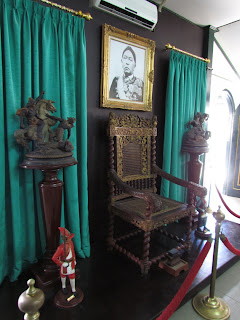

After that, I finally got better directions to the Water Castle and wandered off in search of it. I headed out, turned left and then left again. Oh, but not that left. Or the next one. Oh, THAT left. And then down that street, I turned left again, but I wasn't supposed to. The guy on the street that I was passing on my way, following the sign that pointed to the Water Castle, told me that was for cars. I could just go in the gate that I had passed. Oh, well thank you very much. I am continually impressed with how truly helpful the Indonesians are to visitors. The Indonesians who don't drive pedi-cabs, or are selling batik, or trying to get me to go and watch some performance, at any rate.

Turned in the proper direction, I entered the gate and started looking around for the Water Castle. It didn't look much like I was going to find it easily.


Then this man approached and asked me what I was looking for. I told him I was looking for the Water Castle. He pointed where I should go and then started off in that direction himself. I could smell a bill in that move. I tried to not follow him, without it looking like I was trying not to follow him. But when I would dawdle to take a photo, he would stop and wait for me. So I had to take the tack that I was going to have to tell him to get lost, without putting that rudely of course. So I told him that he didn't need to show me the way, that I didn't need a guide. He said he wasn't a guide. He worked for the sultan and lived in the area, the sultan's lands, for free and tax-free. Nevertheless, I said, I wasn't going to pay him any money. He said he didn't want any money, he just wanted to show me around. I wasn't entirely convinced, but I gave up and resolved that if it came to it, I would not pay much. I have such a strong will, don't you think? He led me around through this little community and to the entrance of an underground mosque. He said I should see that first, as the sultan's family used to use it before the roof collapsed in the earthquake a couple of years ago. It was an interesting place. I didn't know mosques could be underground. As we were leaving, there was a small donation box. My guide made no mention of it all, just started showing me the way out. And because of that small act of being a free guide, I left a small donation.

Then we moved into the Water Castle area itself. The man told me that the whole area used to be under water. It was some kind of a lake, for the enjoyment of the sultan. In the center of the lake, there was a swimming area. The sultan would be taken across the lake in a canoe and would enter the swimming/bathing area. Before he arrived, 40 (or was it 140, I didn't quite hear the number my guide mentioned) women would go through an underground tunnel to the big swimming pool and frolic. The sultan would arrive and would go up into a tower and watch them. Then he would make a choice of which of the women would be favoured that day. The chosen woman would join the sultan in the tower and they would go through to the small, private swimming pool for a while. After that they would retire to the bedchamber to, as my guide termed it with a knowing smile, play. Then they would bathe, change clothes and carry on with the day.

This was the entrance tunnel for the women.


This is the entrance to the main swimming area. Above the entrance is a protector god in the Hindu religion. I asked my guide about that later. It was curious to me because Indonesia is currently a majority muslim nation. But this seemed to suggest that at one point the rulers were Hindu. He said that, yes, the first sultan was Hindu, but the rest have been muslims.

Here is where the women would frolic in one pool, and the children of the household would play in the other.


This is the tower, from where the sultan would observe and then make his choice.


The sultan's-eye view.


The private swimming area must have been a bit more impressive than it is these days. Of course that kind of cavorting and carousing probably isn't favoured any longer so it likely doesn't get the care it used to get.


The bedchamber where the sultan and his choice of playmates would play. One of the things my guide had pointed out to me was the height of many of the doorways and corridors in the Water Castle. They were only about 5 feet high, requiring us to stoop over to walk through. My guide told me that the people at the time were not that small. The doorways and corridors were made that high so to force people to bend over, and pay respect to the sultan.

At the end of the tour through the Water Castle, my guide took me to the shop, where I did buy a batik painting (probably for a lot more than I might have been able to bargain it down, given how easily the proprietor accepted what I had to give, which was less than half the price he originally quoted; I must get more hard-nosed in bargaining for purchases in the future). And then he took me to see his brother's paintings which were even nicer, but I couldn't buy anything more and told him so. He took it well. Then he took me to the entrance area and bid me farewell. And never asked for a dime for his services. I really hate it when I have allowed my jadedness at thinking everybody is out for a buck, which then stomps on (in my head) those who just genuinely want to help out a visitor. I wonder if there is any middle ground at all in how one can approach all people, and not get ripped off out of it.

Borobudur


For the first time in this country, I feel ripped off. I can find it somewhat justifiable that I go to places like Borobudur or Prambanan and pay a lot more than Indonesians. I find it reasonable to go to Bali and pay twice what I pay in Jakarta for a room for a night. I find it forgivable that I follow a man to a mosque and get done for a fair amount of money for the “tour” he gave me of the mosque. But I just can't reconcile taking a bus out to a monument site, where I am paying far more than locals are anyway, and paying twice the fare that locals pay to ride that bus. And though I couldn't be bothered to fight it out on the bus, I really think this is possibly that bad part of Indonesia that had to be here.

But anyway...

I made my way out to the Borobudur site and then had to deal with touts who wanted a ridiculous amount of money to take people to the entrance gate of the temple. I guess there must be those who fall for it, but come on. They should be ashamed of themselves. After paying the higher price to enter the site, I went in and had a chat with a bunch of students who were demonstrating at Borobudur. It's not what you are probably thinking. They had made a bunch of posters to show people. The posters had etiquette rules to follow as visitors to an ancient site. Things like, don't climb on where you shouldn't. Don't take any pieces of it away. Don't draw graffiti on it. Don't scratch your name on it. In other words, treat the site properly so that it's still here in the future for others to enjoy. It's really, really, REALLY sad that it takes reminders like that. And yet, I know how often I see people doing bad things to monuments and other spots just because what they want is more important than being good visitors. Respect for old things just doesn't seem to exist. It's sad. While I was chatting with them about all of that, there were photos taken. The girl was in high school and the boy was in university.

The first time I heard about Borobudur (that I can recall), was in Indonesia the first time I was here. I don't ever recall knowing anything about it before then. And by the time I heard about it, I was in Bali and had no time to go and see it. Since first hearing about it, I have seen a couple of television programs that have talked about the temple, read a magazine article about it, and a newspaper article. Then, while I was in Melbourne, there was a news story about a visit by Richard Gere to the site as well. It was like Borobudur was calling me to come for a visit. Which is the main reason I decided to return to Indonesia. I figured I had to go and see it.

Borobudur was built in the 9th century or so on a hilltop that was modified to hold it. (I presume this means that the hill was overly hill-like and round for the purposes of the Buddhists who erected the temple, so they flattened it to their liking.) Then stone was quarried from nearby rivers and brought to the spot and used to build the temple. It is about 35 or 40 meters across the base, and 18 to 20 meters high. There are 9 or ten levels that are climbed up to reach the top. The first 5 all have corridor-like walkways around the edges of the temple. Once one reaches the top 4 or 5 levels, however, there are just many stupas amongst which the paths wander. There were roughly 2 million stones used in its construction. Somewhere along the way, it was abandoned to the jungle. And as jungles will, the trees took it over and kind of took it apart. Along comes that old rascal Sir Stamford Raffles (of Singapore fame), who re-discovered it and had it partially restored.

There are some nice reliefs carved into the walls along the galleries of the lower levels. Once again, I am not sure which ones were original and which were restorations or replacements.


Lots of carved Buddhas abound all over the temple.


At the top of the temple were a large number of stupas.


Inside the stupas were usually statues of Buddha. Two of the stupas are open and the Buddha is open to view. One of these two guys is involved in what I think is the iconic photo of Borobudur. The photo is of a shadowy view of the Buddha, framed against nearby stupas at either sunrise or sunset. I never had plans to make it for those times, but I hoped to get a photo in the daylight of that angle. Unfortunately, the volcano Mount Merapi exploded in November of 2010 and sent ash all over the area. The top part of the temple is still under-going restoration to clear the ash away. It is closed and nobody could go up and see the Buddhas any closer. So I had to make do with these photos. Maybe I will be able to return one day and get a better shot at my photo. These still turned out all right.


Notice how easy it seems to be to make it seem as though I was the only one there. There were actually people teeming all over the temple for much of the time that I was there. Patience and just going along the paths where the tour guides don't take people (because so many are on a day tour from Jakarta or Bali and so only have a short time to spend at the temple), make it reasonably easy to get photos without the annoying people in them.

I passed a group of young people several times on each level of the temple. They were taking photos here and there, and at times it seemed either they or I was stalking each other. I even at one point jumped into one of their photos, just to try to be cute. When I was sitting at the bottom again waiting for a clear shot of the temple with few to no people in the frame, one of the group approached and asked to take her photo with me. I agreed, subject to my usual fee, a photo on my camera in return. I don't know what this look on her face was, but she was actually very nice.


On the way back out of the site, there is a maritime museum that shows some of the carved reliefs of Borobudur. These reliefs have some kind of sailing vessel in them. Some anthropologists and historians decided to test a theory that some of the stories told on the temple actually related some of the maritime trade history of Indonesia. They looked at the ship(s), analyzed it, figured out its dimensions, built and then sailed it over the route of a supposed ancient voyage, around the bottom of Africa. (I have been reading of lots of these sorts of recreations of ancient voyages from various nations down in the South Pacific. They seem to be quite impressive.) This is the ship they built.


On the way to the temple, just before reaching the little town of Borobudur, we passed through another little town with another temple. It didn't seem to be very far away, so I asked if the bus would pass back that way if I managed to get myself there. I was told it would, then I was offered a ride back to that temple. For a price, of course. I had decided that I wanted to walk, both for the exercise and because I was tired of being ripped off and the attempts to be ripped off by transportation types. I said no. Most just turned to the next mark, but one guy pursued me for a long way and kept lowering his price to pedi-cab me back to that temple. He just didn't seem to get it that I had made up my mind and that my no was not going to magically change to anything else. Eventually, he did give up though, and I made may way through the couple of villages on foot. They were typical seeming villages.

And I did get back to the spot with the other temple. It was much smaller, but had an interesting tree nearby that gave it atmosphere.


And then it was back on a bus, that did come by and pick me up, to Yogyakarta. I met some other returning foreigners on the way back and they were quite interesting. I even got a good recommendation from an English girl whose roots are Ghanaian to definitely go to Ghana in Africa. I was planning on it, but it's good to have another recommendation that affirms my choice. And despite the annoyance about being ripped off by transportation, I did have a good time at Borobudur. It is a spectacular site.

Prambanan

Yogyakarta has two fine examples of religious temples that are nearby. One is the Buddhist temple of Borobudur. The other is the Hindu complex of Prambanan. And Prambanan is apparently the largest Hindu complex in southeast Asia. I'll take their word for it, but I recall there being some Hindu aspect to the temples of Angkor and they are much larger. Perhaps I am mistaken though. In any case, the Prambanan complex is located at the end of one of the city bus lines of Yogyakarta. (Although it is not called a busway, it operates in exactly the same way as the busway system of Jakarta.) Early on my first morning in Yogyakarta, I debated whether I would go to Prembanan or to Borobudur first. I opted for Prembanan because it was just a bit easier to manage. I headed to the bus stop and caught the appropriate bus and off I went. About an hour later, I arrived at the bus terminal and was accosted by touts wanting to drive me to the gate. When I said I would walk, they seemed aghast. “But it's a kilometer!” And? Are there crocodiles blocking the way? Will I have to duel with a sword to gain passage without someone to take me there safely? What? I guess all the tourists who fly in for a day tour from parts unknown, who have all kinds of money, and who can't seem to do anything for themselves (because they never seem to) give some kind of we-foreigners-are-helpless-and-pampered kind of impression because it's like a foreign concept that a foreign visitor, who has already managed to get himself almost to the site on the public transport system, still is going to want to take a ride a few hundred meters to the entrance of the site he/she has come to see. I don't exactly begrudge people their money and how they use it, but I wish they wouldn't add to the pampered and money-is-no-object idea that the people of poorer nations often have of us. Or that I wouldn't rather have the experience of getting someplace on my own, on the bus, walking, however it may be. Anyhow...

As I was walking to the entrance area, I passed outside the gated area and had a nice view from outside.


I hoofed it to the ticket office, the please-go-here-foreign-visitors ticket office. Now I know that in a country like this, it's impossible to charge everyone the money it takes to protect a site like this. The price is too high and if they were to charge the same price to the local people, the local people wouldn't be able to afford to come and visit it. And the site is their cultural heritage. They ought to be able to come and visit it. I don't know exactly what the locals pay to come and see the Prambanan complex, but I do know it must be significantly less than the 117 000 Rupiah that foreigners pay. (That comes to about 13 dollars, so it is not outrageous and I don't begrudge paying that price so that a site can be protected and rehabilitated.) But... I felt a bit patronised by going into a nice, air conditioned ticket office where there was “free” tea and coffee, and probably a nice bathroom. I know I'm paying more. And they know I'm paying more. Perhaps they don't understand that I know I am paying more. But we all know why I am paying more. And if they are really putting any of the extra money that I am paying into electricity for air conditioning, coffee and tea, and a nice bathroom, instead of into the preservation of the religious site, then I don't want to pay more.

Okay enough sour grapes. I went into the site. It's quite amazing. There are actually four temples on the grounds of the complex. Prambanan is the largest. The Hindu religion has numerous gods. The three chief gods are Brahma, Shiva, and Vishnu. Brahma is the father of the world, Shiva is the destroyer, and Vishnu is the protector. (I think. My knowledge of Hinduism is getting a bit old and I didn't spring for the tour guide to show me around.) The Prambanan compound has three main temples, one for each of the three main gods. There are also three lesser temples for three of the lesser gods. (Ganesha was one of those.) Now unfortunately in 2006, there was an earthquake that was centered pretty much under Yogyakarta and the Prembanan complex. Much of the site was damaged and restoration efforts are on-going. Nevertheless it is an impressive view.

Because of the earthquake damage, many of the surrounding structures have had to have been taken apart. The whole process is detailed on signs nearby. They went and took photos of the structures. They measured it. They marked each stone for its place in the structure and then took the structures to pieces to be reassembled at a later time during the restoration process. These are all disassembled stupas that had sat around the Prambanan compound.


This is in addition to all the damage that the years and years of use and erosion have wrought. Some blocks have been replaced, but the designs that were carved on them have been lost. It's a shame because the carving must have been exquisite. And even though I can't really tell for sure which is original work and which is restored or replaced work, it seems it must have quite impressive when it was originally done.


Shiva's temple. I think. Truthfully, they all looked the same to me.


Restoration work is on-going.


She and her family had hired a guide. I heard her say a couple of times, “Wow!” But I'm not really sure she meant it.


Inside each of the temples there were statues. There was one of Brahma, and Shiva, and Vishnu.


I think this one was Vishnu.


I liked how the profile was lit from the light coming in the door.


Nearby, there were three other smaller temples. The first was quite small, Lumbung Temple. It was Buddhist. The other temples were not Hindu, and must have been examples of the two religions co-existing peacefully. This temple had been damaged quite heavily.


Then it was on to Bubrah Temple. This was damaged even worse.


The last temple was Sewu Temple. It was a much larger Buddhist temple. It is actually second in size only to Borobudur of the Buddhist temples of Java.


It also seemed to have suffered a fair amount of damage during the earthquake, but is undergoing restoration.


However, its marvelous Buddhist architecture still shows through well.


After visiting the four temples, it was a quick visit to the on-site museum and then a return to Yogyakarta after a successful jaunt to the edge of town.