One essential part of any visit to Cambodia is a visit to some of the places that have been implicated in the tragic recent history of the country. In 1970, the head of the military, Lon Nol staged a coup d'etat against the king, Norodom Sihanouk. Sihanouk was a very popular king with the people, but after being deposed he fled to China. In the meantime, a man who became Pol Pot, had been educated in France and China and had developed a great new idea for how society should be organized. He had developed a hatred for the west, and the US in particular. He also felt that the communist system of China had failed. So he had returned to Cambodia armed with his new idea and he started fighting in the jungles and spreading his message. I don't know how successful he was initially, but when Lon Nol deposed King Sihanouk (with help and munitions supplied by the United States), Pol Pot saw an opportunity and seized it. He made contact with King Sihanouk and gained the king's support. He began drawing people to his banner, saying he would fight to restore the king to his throne. Pol Pot's army, the Khmer Rouge, started to gain soldiers. For 5 years, they waged civil war against the government's army, slowly gaining ground. In April of 1975, the Khmer Rouge took the capital of Phnom Penh, and routed Lon Nol's forces. The Khmer Rouge had control of Cambodia. Pol Pot now had the power and position to initiate his plans for the perfect society. His idea of a perfection was an agrarian society, where there was no education, no money, no religion. So he began. His first move was to tell the people of Phnom Penh that the US was coming and they would kill them all. The only way they would be safe would be to go into the countryside and take up roles as farmers. This was his story and many people listened. The rest began forced marches into the countryside. The cities emptied and Phnom Penh has been described during the reign of the Khmer Rouge as a city of ghosts. Having achieved a measure of control over the populace, the next phase of the operation was to begin to root out anyone with education or religious views. They were captured and tortured, and killed. Anyone who resisted the new regime was turned in and killed. Along with anyone who was convicted of these “crimes” often their families were killed as well. This took place all over the country. The spots where people were killed took on the name, in history, as killing fields. One of the most famous of these was the Choeung Ek Extermination Center. One of the most important torture centers was called S21. It is now known as the Tuol Sleng Detention Museum. It was a detention and torture facility. People were brought to the detention center where they were tortured for any information. They were also tortured to the point where they would make a confession of crimes against the regime. They would write a confession of their “crimes” and then sign it. This was in effect signing their death warrants. In a twisted sense of justice and punishment, the Khmer Rouge wouldn't kill anyone who had no confessed crimes. After signing their confessions, they would be killed and buried near Tuol Sleng. After a while, there were too many bodies for the area to handle and a new area was selected. This became the Choeung Ek Genocidal Center. People were finished with at Tuol Sleng and then transported to the Choeung Ek Center. There, they would be taken out one by one and be executed by an open pit. Their clothing would be stripped from their bodies, if not bloodstained, for reuse and then the bodies would be dumped into the pit. Once all the batch of the convicted had been executed and dumped in the pit, it would be covered up immediately, with appropriate measures taken to hasten decomposition and to minimize the odour emanating from the area.
Over the course of almost 4 years from April 1975 through January of 1979, some 20000 people passed through Tuol Sleng. The Choeung Ek site is estimated to have had about 16000 people buried there. When it was found, they dug up almost 9000 bodies. The rest of the bodies have been left undisturbed. The two sites in Phnom Penh, along with many other sites of torture and execution throughout the country have been preserved in order that people will never forget what happened when one man developed a warped idea of the perfect society and how it could be brought about.
And because Cambodia has worked so hard at preserving that grim history, it is important as a visitor to the country to go and pay homage to that history and to reflect. Then maybe it can be kept from happening again. (Only it hasn't, as has been demonstrated often enough in the time since the Khmer Rouge in Cambodia.)
I met a man at the guesthouse where I stayed in Siem Reap. He came to Phnom Penh on the same day as I did, and we ended up at the same guesthouse there as well. These days it is easiest to hire tuk tuks to get about to the tourist sites in Phnom Penh, the same as elsewhere. He had arranged to go around to the Choeung Ek site and Tuol Sleng with a tuk tuk driver. I asked if he would like to split the fee for the day and he agreed. So we visited these places together.

We began at Choeung Ek, located about 17 kilometers from downtown Phnom Penh. The tuk tuk was kind of slow, but it gave time to take in the sights and sounds of the now bustling city. On my first visit in 2001, the city still bore scars of its tortured history. There were large craters in some of the main roads. Buildings had gaping holes, presumably from some kind of explosive contacts. On this visit the main roads are in good condition. There are parks and trees and the city is fairly clean. Many of the side roads are still in bad shape, but they don't look like it was recently a war zone anymore. It is just that this is still a developing country and they haven't cleaned everything up yet.


When we reached the Choeung Ek Genocidal Center, it was also quite cleaned up. The pits that had been opened were still there. Some of the explanations of what took place at this blood-soaked site were still there. However, on my first visit, walking along the paths among the burial pits, there were bones littering the ground underfoot. I remember walking along and listening to the crunch of things underfoot. I didn't really think about it until I looked down and realized that the crunch was coming from bones that were all over in the dirt beneath my shoes. And the dawning realization that I was walking on the remains of people who had been exterminated in a brutal fashion was quite sobering. There were graphic painted depictions of what had gone on here, Khmer Rouge soldiers killing babies by throwing them in the air and impaling them on their guns, or swinging them around and smashing their heads against a tree. It was a very impactful place, albeit in a way that was a bit heavy-handed. Now much of that isn't in evidence any longer. It is a much cleaned up site. I'm not sure if it's better off that way or not. It is certainly a more civilized presentation. But possibly the more “family-friendly” feel to it is not to the benefit of the reason for the preservation of the site.

One thing that hadn't changed was this tower...

...and what was kept inside. (However, there used to be the skulls of 7 journalists who were killed by the Khmer Rouge and dumped in the pits. I suppose those bones had been repatriated to their families.)
As time went on, the Khmer Rouge ran short on many supplies. They were forced to do things to conserve certain resources, such as bullets. Thus executions were conducted using blunt objects to bash heads in, or using leaves like these banana leaves, with serrated edges, to slit the throats of the victims.

Some of the pits where the victims were thrown after execution have been preserved. Others are open to the elements.

This is the tree where children were murdered by swinging them around by their feet and bashing their heads. They know that because it was covered in blood and bones and brain matter when they came here after the country was liberated by the Vietnamese.
Now there is also a fairly good museum on site that explains the hierarchy of the Khmer Rouge and what happened after they were overthrown, including the recent tribunals that have finally been convened to try the leaders of the Khmer Rouge. (At least try the leaders that are still alive. Pol Pot and a number of others escaped final justice by dying before the tribunals could ever be convened. It is small consolation that they died in custody.)
While Andy and I were looking at the site, we stopped for a bit of a breather in a small rest hut. A young man and his father came along and stopped to talk to us. The older man had never been to the site before, so his son had brought him that day. The older man had lived through the days of the Khmer Rouge. He graciously consented to talk about that time with us, even though he spoke no English and we spoke no Khmer. His son translated back and forth for us. It was a moving few moments.

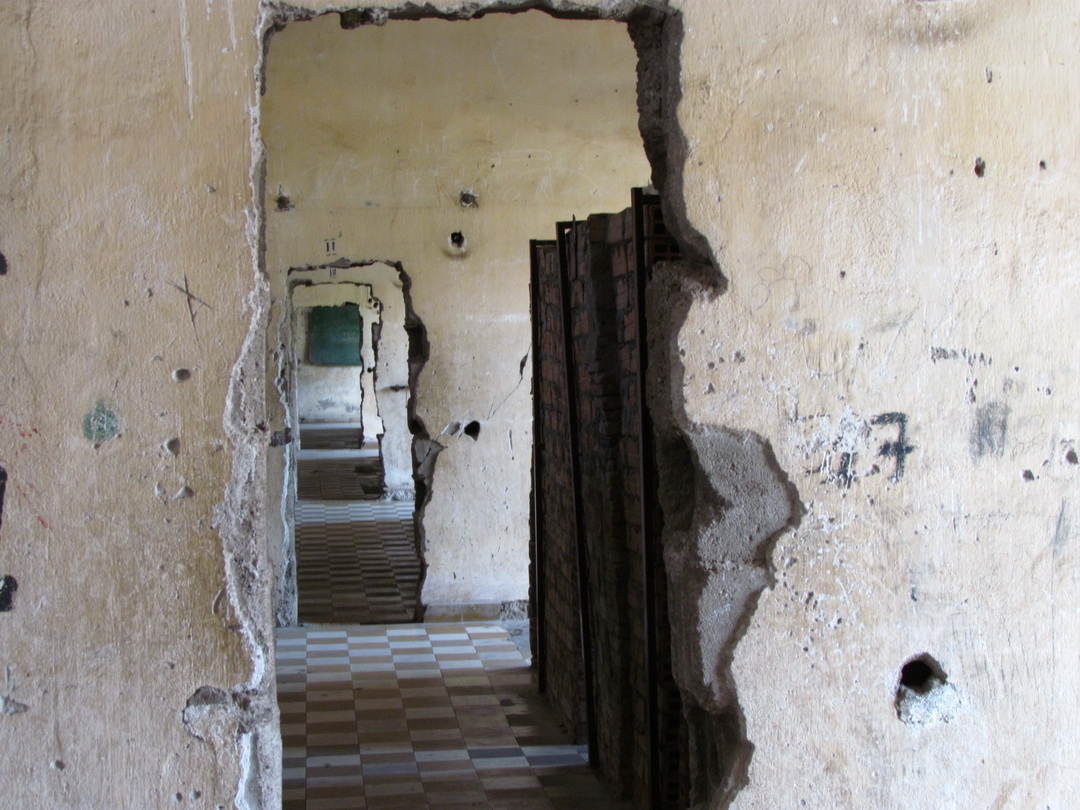
From Choeung Ek, we hopped back into our tuk tuk and headed into town and the Tuol Sleng Museum. This place was much as I remembered it. The school is arranged in four buildings. The first building was used for housing prisoners as well as the torture of higher ranking people. Nobody was safe from the regime, not even the Khmer Rouge. If someone became suspected of traitorous thoughts or actions, they were apprehended, brought to Tuol Sleng and interrogated.

When the country and city were liberated by the Vietnamese in 1979, Tuol Sleng was abandoned. 14 final prisoners were slaughtered there and left as they lay as the Khmer Rouge fled to the jungles. The bodies of those people were found and buried just outside Building A. The torture beds were left in the cells in the building and photos showing how they were found now adorn the walls.
Just outside Building B there is a hanging post. Prisoners would be hung by their feet and interrogated until they passed out. Then they would be dunked in filthy water to wake them up and the interrogation would proceed.
Building B has more cells and interrogation areas. These were filled with photographs. The photographs showed the people who had passed through the center. Every person who came to Tuol Sleng was measured and photographed, to have records of the enemies of the state perhaps. Once they had confessed and written their confessions these would be kept in files with their photographs. When the prison was liberated, thousands and thousands of files were found. Once again, in a bid to make sure that nobody ever forgets what happened in that time, the photos were put up for visitors to see. Room after room of photos are arranged along the main floor of Building B and then D as well.


On my first visit to the museum, they had a pedestal with a bust of Pol Pot on it, to show the face of the man who had perpetrated this horror against his own people. There was a damaged bust on the pedestal and a defaced one lying on the ground beside it. There were people who didn't care to have his face displayed there. By my second visit, it seemed they had given up on trying to have the bust displayed. The pedestal is off by itself...
...and four defaced busts are off in a corner, in a cage.
Building C had a couple of floors of individual cells in either brick or wood.
The top floor had a small exhibition about the leaders of the regime who are now on trial, including photos and biographies as well as bits of their writing.
Building D had more photos of the victims of the center. There were also paintings that depicted the different methods of torture. All were disturbing.
At the end of the series of buildings, there used to be a map of Cambodia. They had it on the wall, and it was done all in skulls and bones. This has been taken down at some point, probably for being too graphic. However they still have a photo of it in its place.
After delving into the gruesome for a few hours, Andy and I were a bit tired and had had enough of that part of the history. Andy wanted to find a new hat, so we headed to the central market. I just wanted something to do, so I went along with him in his search. He never found a hat that met with his satisfaction, but I did find a hat that was interesting. It was odd to find a hat with the city slogan of a minor South Korean city in the middle of the market in Phnom Penh in Cambodia.


 Outside the silver pagoda is a small representation of Angkor Wat. There is some French company that operates a hot-air balloon ride that rises nearby Angkor Wat. I think the view must be something like this one. Now I know what it looked like.
 Aha!!! I knew they came from somewhere.
 And there it is.

 And then I passed a dessert shop. They boasted handmade ice cream. There were many options for dessert, but in the end I opted for the chocolate cake with ice cream combination. It was delicious!!