I really enjoy getting out into an area to explore it and see it for what it really is. When I get somewhere I like to take walks to look around. This gets me familiar with where I am, so I am less likely to get lost, but I also get to look at where I am in a better way than if I am in a taxi or tour vehicle of some sort. One of the best ways to do this is to take a bicycle ride.
Ubud has many tour agencies that offer bike trips through the countryside. And they make it easy. They take you up to a high point of the terrain and all that is needed is to coast down most of the way back to Ubud. Sign me up!!!
The day got off to a rocky start. I had been told I would be picked up at 8:30. I was ready and waiting by 8:15. I waited. And I waited. And I waited some more. 8:30 came and went. As did 8:45, and 9:00. By 9:15, I was wondering what was what. I headed down the street to the office of the agency where I had booked the trip, but it wasn't open. Well, I had no other choice, but to head back to my guesthouse and give it a little longer before finding something else to do and dealing with it later. As I approached the guesthouse, there was a man looking about, and I knew that had I waited a few minutes more, I wouldn't now look as though I was the one holding the process up. It figures...
There were two other people on the trip. They were a married couple from Brazil. It was a bit odd to learn that, because the guy was an avid surfer, and the idea of a family man being a surfer seemed a bit weird. But I guess there is no reason why it shouldn't be.

We headed up toward the volcano where I had viewed sunrise the previous morning, but by a different route. We stopped part way up at a tourist farm for a while. We got to see guavas, and pineapples, the trees where cinnamon comes from, lemongrass, and various kinds of coffee. We even got to see a couple of caged civet cats, held in cages for the benefit of visiting tourists in order to show where a prized form of coffee comes from. One coffee tree makes some nice bean fruits. These cats come along and find the best fruits and eat them. They continue on their day (night, actually, as they are nocturnal). Eventually, nature takes its course and the civet cats leave the beans behind on the ground. In the morning, the farmer comes along and collects the “processed” beans. They are taken to the “factory” to be washed, dried, roasted and turned into coffee. This particular coffee is called Luwak Coffee and it is highly prized, and expensive. Personally, I think all coffee tastes like crap, but this coffee would make that a literal description. In any case, you would have to pay me to drink any coffee, so there is no way I will be trying Luwak coffee.
After our little tour of the farm area, we were shown the coffee making process in their “factory.” It's not really a factory in any way connected to what you normally think of as a factory. There was a little fireplace where one man was roasting possibly a pound of beans in a little steel kettle-like container. Nearby there was a wooden mortar and pestle where someone else was pounding the beans into powder. The same would happen to the cinnamon, or the lemongrass, or any of the other products of the farm. After the factory, we sat and got to sample some of the products. Some were quite good. They even made cocoa, but it needed sugar to make it appetizing. I didn't know raw cocoa was so not nice tasting. I liked the lemongrass tea, with its cinnamon and nutmeg and cane sugar. And then we had the opportunity to buy some of the products. I haven't been buying much so far, mainly because if I buy anything, I then have to do something about it, but also I have done my fair share of getting woven things, silk things, and other such handicrafts. They all start to seem the same after a while, and it's hard to buy them. I also sometimes wonder who makes those sorts of things and how. Are they hand-made? Are they made locally or far away? Who gets the benefit of the sale of scarves and things like that? But these products I was sure of. They were made on that farm, by the people I met there and they were doing it to make a living. And the make nice little gifts, so I bought some lemongrass tea. And then spent a few minutes fending off the man who was helping as he was suggesting all the other stuff that I might want to buy. Sigh!! People are just never satisfied with any sale. Oh well.

As a side note, I am noticing a whole new kind of terminology that has come into being with the growth of “Eco-tourism.” As the troubles of the environment gain more press and people are urged to travel responsibly and do eco-tours, other tourism streams seem to want to jump on that bandwagon. So we are hearing lots about medical tourism (people who go to other countries to get surgery, often because it is cheaper in the other country. Or green tourism, or gallery tourism, or wine tourism. And here, at this farm, it was called agro-tourism. I wonder how many more x-tourism terms are going to be made before we get bored of it all.

After the farm we headed up to the top of the edge of the volcano where we stopped for breakfast (even though it was about 11:00 by this time) and got ready for our bike trip back to town. But the view of Mount Batur was quite nice. At least it was until the low clouds started drifting into the caldera. And the fog started to obscure the view. And just as we were finishing our breakfast, it started to rain. It went from just being cloudy to a full on torrential downpour in about three minutes, and we were left sitting there wondering if it would break or if we should just go. In my experience such sudden downpours often end just as quickly and in a short amount of time, so I figured waiting a few minutes would find the end of the rain. But no, it just kept pouring. We eventually decided that we would put on the rain gear and just start out. So we did.

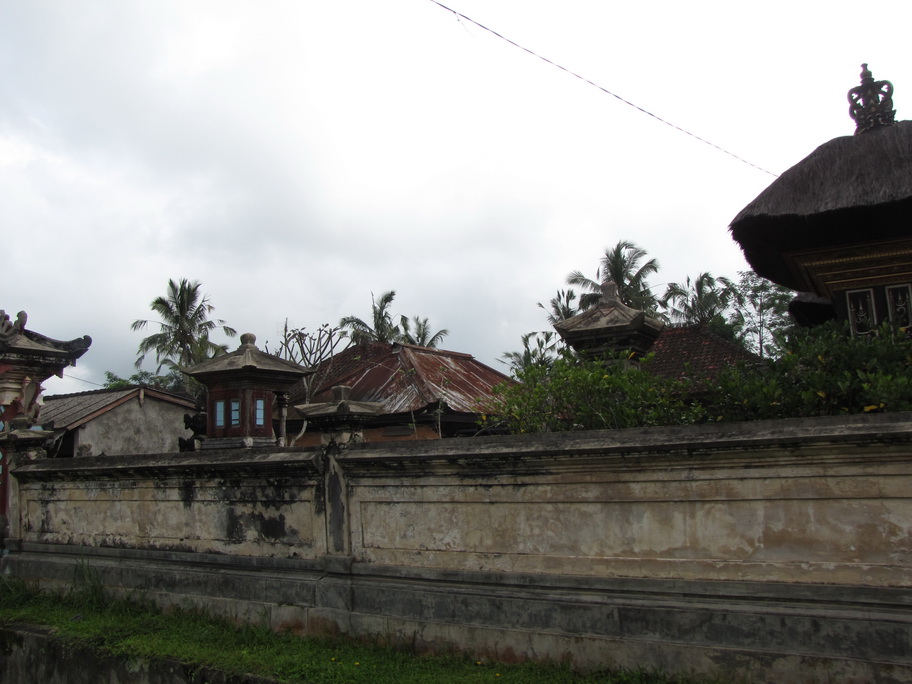
Shortly after we got below the edge of the caldera on our way down to Ubud, the rain slowed and then quickly stopped. This was one of those rains that happens against a mountain. The moisture laden clouds hit the mountain and stop. The moisture laden air behind it piles into the stuff stuck against the mountain and it builds quickly until the air can't hold the moisture any longer. And it starts to rain. (However, I am more familiar with it in Canada in winter where moisture laden air ends up dropping lots of snow on one side of a mountain pass, while the other side can be pretty much bone dry.) We were soon taking off our rain coats and enjoying nice weather back to Ubud. We passed through towns on back roads. We saw community elementary schools and hospitals and local government offices. When we arrived at each town, we would see temples. Each town has at least three community temples, one each for three of the main aspects of Hindu deities. During special seasons, the whole town prepares offerings for use at the main temples, in addition to the offerings they prepare for their own homes. Each home also has a temple, but these can vary widely in size and elaborateness. Not surprisingly, this relates to the relative wealth of the owner of the property. Wealthier home-owners have bigger, more elaborate temples in their homes. But they are everywhere you look in each town.


The journey was really nice. We travelled through little communities and people waved and said hi all over. I imagine that they must see all kinds of people on pretty much a daily basis, but there was none of the hands out with things to buy, although we did pass many souvenir shops of various sorts on the way. Mainly we passed people engaged in the dailiness of life.


Then we passed down into the areas where rice-growing was viable. I guess there is a fairly narrow set of climatic conditions for growing rice. Higher up towards the ridge of the volcano's caldera, conditions weren't favourable, although there was still one rice field per community, for use by the community so they could prepare the offerings for their temples. But down towards Ubud, rice-growing was viable and the terraces began. We saw many of them all over and they were quite beautiful. We passed through countryside with rice terraces on either side of us. It was serene. And then we got closer to Ubud and reached a place called Tagallalang. This is tourist trap central. We arrived there and there were hordes of tourists, and the hawkers as well selling their tourist wares. It was busy, noisy, smelly, and generally horrid after such an idyllic passage through the countryside. The lone selling feature of the spot was the absolutely spectacular rice terraces right across from the road. The only minor obstacle to getting a good photo of them was the ridiculous man who picked up a bunch of bamboo and stood in the way of the photo-taker, presumably to give the photo more character and authenticity. No, get out of the way, you fool. And no, I am not going to give you a posing fee.


Finally we ended at a guest house set among some rice terraces just outside of the Ubud center. It was a great to finish the day's spectacle.